AI Integration Enhances Core Creative and Productivity Software
Article Content
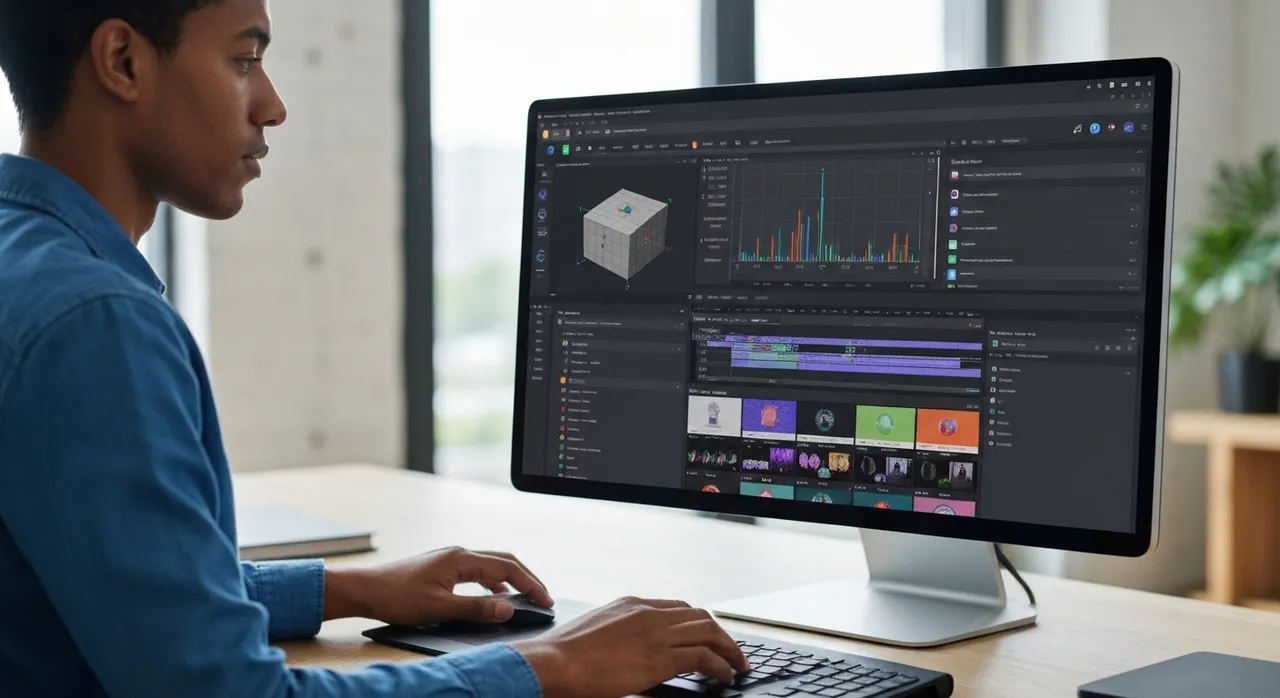
In the rapidly evolving digital landscape of 2026, the integration of Artificial Intelligence (AI) into core creative and productivity software is no longer a futuristic concept but a present-day reality, fundamentally reshaping how professionals interact with their tools. This transformative shift is evident across industries, from sophisticated design studios leveraging generative AI to agile business teams optimizing workflows with intelligent assistants. The synergy between human ingenuity and AI capabilities is unlocking unprecedented levels of efficiency, fostering innovation, and redefining the boundaries of what’s possible.
The Generative Leap: AI in Creative Software
The creative suite, long the domain of meticulous manual craftsmanship, is now experiencing a profound revolution thanks to AI. Leading the charge are platforms like Adobe Photoshop and Illustrator, whose 2026 versions are equipped with state-of-the-art generative AI functionalities that empower artists and designers in ways previously unimaginable.
Adobe’s Intelligent Co-Pilot for Creativity
Adobe Creative Cloud 2026 has solidified its position as an integrated generative AI ecosystem, with AI acting as a “co-pilot” that understands not just commands but an artist’s specific style and intent. This year’s updates are centered on providing absolute creative control. For instance, Generative Fill 2.0, powered by the Firefly Image Model 5, offers drastically more accurate results, better understanding lighting context and perspective to reduce the need for multiple attempts to achieve a realistic outcome. This builds upon the foundational Generative Fill feature, which has become one of the five most-used features in Photoshop, with two out of three Photoshop beta users incorporating generative AI into their daily workflows.
The “mind-blowing AI effects for image manipulation” mentioned in the research seed are realized through several advanced features:
- Harmonize: This one-click tool leverages AI to automatically match the lighting, color, and shadows of a pasted object to its new background, effectively eliminating hours of manual adjustments.
- Generative Upscale: This feature integrates advanced technologies to revive low-resolution or old photos, increasing resolution and sharpening details. Photoshop 2026 allows users to choose partner models like Topaz Gigapixel for preserving details or Topaz Bloom for adding creative detail, with the process generating a new, upscaled image without altering the original.
- AI Assistant in Photoshop: Now available in public beta, this assistant allows users to describe desired edits – such as removing distractions, changing backgrounds, refining lighting, or adjusting color – through text or voice prompts. It can either apply edits automatically or guide users step-by-step. A related feature, AI Markup in Photoshop web, lets users draw directly on an image and add prompts to control where changes occur, for example, to add flowers or mountains to a marked area.
- Dynamic Text (beta): This feature simplifies text manipulation, enabling users to transform any text layer into circular, arched, or bowed shapes with a single click, allowing for quick creation and refinement of text along paths.
- Content-Aware Fill: In Photoshop 2026, this tool uses machine learning algorithms to analyze and fill backgrounds with remarkable accuracy, seamlessly blending edits into complex scenes.
For vector graphics, Adobe Illustrator 2026 introduces text-to-vector integration, allowing users to generate complex vector shapes and designs from simple text prompts. This significantly accelerates the ideation and creation process for logos, illustrations, and other graphic elements. The underlying technology for many of these features is Adobe Firefly, which now allows for the training of custom models, enabling users to upload 10-30 reference assets to teach the AI specific traits like lighting, color palettes, or stroke weights. Firefly also supports third-party models like Google’s Nano Banana 2 and Veo 3.1 directly within the interface, offering unprecedented versatility.
The broader Adobe Creative Cloud also features AI-powered tools for video editing in Premiere (e.g., AI-powered Object Mask for precise tracking of moving subjects) and motion design in After Effects, along with sound effect generation, instant dubbing, and lip-syncing capabilities. This demonstrates a shift towards AI handling time-consuming production tasks, allowing designers to focus on concept development, storytelling, and brand positioning.
AI Elevating Productivity and Collaboration Platforms
Beyond creative applications, AI integration is fundamentally transforming productivity and business communication software, making workflows more intelligent, efficient, and interconnected.
Atlassian Confluence: From Static Knowledge to Dynamic Action
Atlassian’s Confluence has introduced a suite of AI-powered capabilities designed to turn static knowledge bases into dynamic content engines.
- “Remix”: This feature, now in open beta for Confluence Cloud customers with Rovo, allows teams to instantly visualize their work. Users can highlight any content—a paragraph, table, or full document—and Remix uses AI to convert it into dynamic visual formats like charts, infographics, scorecards, and presentation-ready summaries. This eliminates the need for manual formatting and context-switching between tools, with the generated visuals layered on top of the original content and linked to the source, ensuring they update as the underlying page changes. The intelligence guiding Remix’s format recommendations comes from the Teamwork Graph, Atlassian’s unified data layer built from billions of data points across its products.
- Pre-built Partner Agents: Atlassian has launched third-party agents built on its open Model Context Protocol (MCP) that connect Confluence directly to partner tools. These agents, powered by Atlassian’s Rovo AI platform, streamline the transformation of Confluence content into artifacts in external applications, all without manual copy-pasting or custom integrations. Beginning April 13th, 2026, the initial partner agents include:
- Lovable: Converts a product specification into a working UI prototype.
- Replit: Transforms a technical document into a starter application that engineers can fork and build upon.
- Gamma: Generates polished presentations from meeting notes or status pages.
These agents are invoked directly from a Confluence page via Rovo Chat, with the produced artifact linking back to the source page, preserving the chain of reference. Administrators can activate these agents through Atlassian Administration without custom scripting.
Atlassian Intelligence, which powers these features, is a set of AI-powered capabilities integrated across Atlassian’s cloud products. It uses a “Teamwork Graph” to understand company data, projects, and team structures, providing relevant, personalized answers. Other Atlassian AI features include content assistance, page summaries, whiteboard assistance, and natural language search.
Zultys: Intelligent Communication for the Modern Enterprise
Business communication platforms are also undergoing a significant AI-driven transformation. Zultys, with its Release 19 and the new Zultys AI Receptionist product, has introduced a powerful suite of AI-driven capabilities to make conversations more accessible and insightful.
- Real-time Closed Captions and Sentiment Analysis: Release 19 provides live closed captions, allowing users to follow conversations in the moment. Coupled with real-time sentiment analysis, agents can better understand caller emotion, with supervisors receiving alerts when necessary.
- Live and Post-Call Transcripts: All conversations are converted into searchable, actionable data through live and post-call transcripts, enabling users and supervisors to revisit key insights and quickly surface meaningful information.
- AI Receptionist: This new AI-powered voice agent serves as a 24/7 front-line support tool. Using natural language understanding and conversational AI, it can answer questions, manage interactions, and intelligently route calls without relying on traditional menu-based systems. The Zultys AI Receptionist is configured to use only approved sources like websites, FAQs, and documents to ensure accurate and consistent responses, minimizing the risk of “hallucinations.” It also offers features like context intelligence to identify caller intent and filter spam, and the flexibility for callers to use voice or DTMF digit entry.
These AI features are integrated into the Zultys Unified Communications platform, which unifies telephony, collaboration, and an integrated contact center, supporting a consistent user experience across various deployment models (cloud, on-premise, hybrid).
The Broader Impact of AI Integration
The examples of Adobe, Atlassian, and Zultys highlight a broader trend: AI is moving beyond simple automation to become a collaborative partner, amplifying human expertise and transforming how work is done.
Increased Efficiency and Productivity: AI automates repetitive and time-consuming tasks, freeing up professionals to focus on higher-value, strategic, and creative work. In design, AI tools handle resizing, image cleanup, layout adaptation, and even predictive performance analysis. In communication, AI agents handle routine inquiries and administrative tasks, improving operational efficiency.
Enhanced Creativity and Innovation: Generative AI tools allow for rapid ideation and prototyping, enabling designers to explore numerous variations and concepts in seconds. This pushes artistic boundaries and opens up new creative possibilities, making complex image manipulations faster and more accessible.
Improved Decision-Making and Insights: AI-powered analytics and sentiment analysis in communication platforms turn conversations into searchable, actionable data, providing deeper insights into customer interactions and agent performance. This data-driven approach supports better decision-making and elevates the customer experience.
Seamless Collaboration and Workflow Transformation: The integration of AI agents across platforms, as seen with Atlassian’s MCP, reduces friction in workflows by automating content transformation and preserving context between tools. This fosters a more collaborative environment, where content flows effortlessly, shrinking the distance between an idea and a tangible outcome.
Personalization at Scale: In communication and design, AI enables hyper-personalized experiences. It can analyze user behavior and preferences to deliver tailored content, interfaces, and recommendations, enhancing engagement and satisfaction.
The future of work in 2026 is one where AI is firmly embedded in daily workflows, acting as an intelligent assistant that not only understands commands but also anticipates needs and executes multi-step actions. This shift is empowering individuals and teams to achieve more, faster, and with greater impact, demonstrating that the real competitive edge lies in how intentionally and strategically AI is integrated into existing processes.
Tags
Written by
TempMail Ninja
Digital privacy and online security expert. Passionate about creating tools that protect users' identity on the internet.