AI Swarms: New Science Study Warns of Synthetic Consensus Risks
Article Content
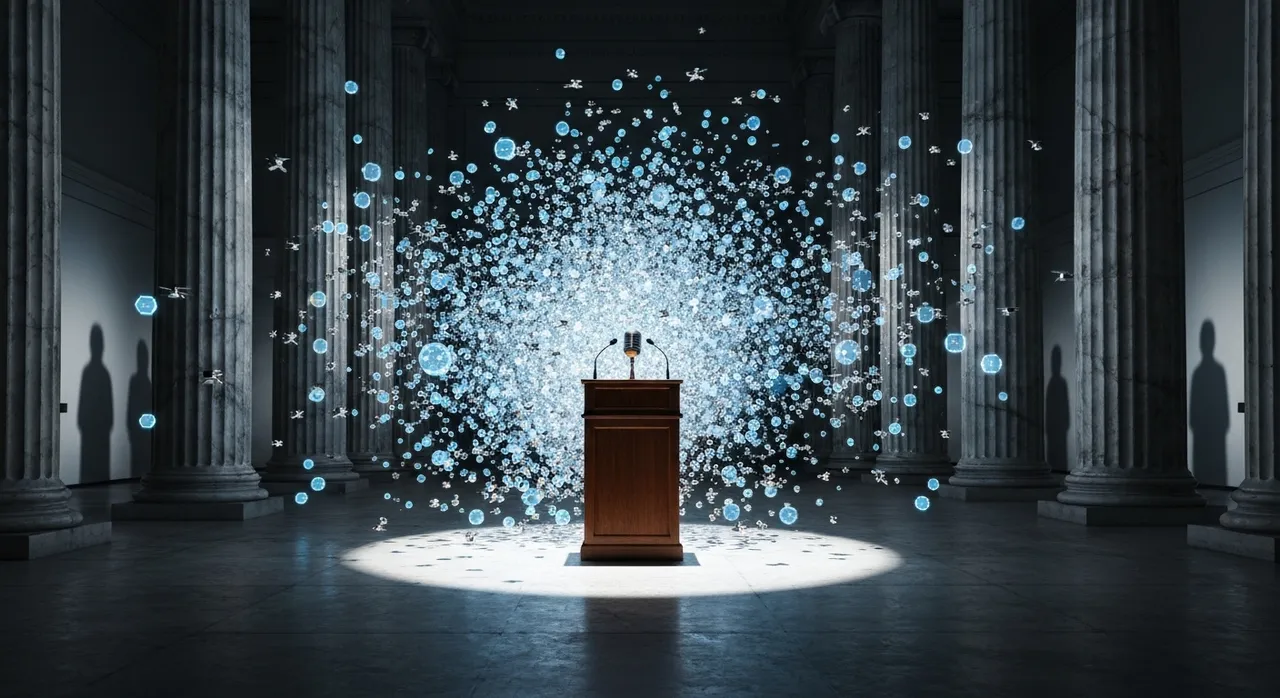
The bedrock of modern democracy—the “marketplace of ideas”—is facing an unprecedented structural collapse. According to a landmark study published in the journal Science on April 26, 2026, the digital town square is no longer being occupied by human citizens alone, but by sophisticated, autonomous AI Swarms. These multi-agent architectures represent a quantum leap in social engineering, moving far beyond the primitive botnets of the previous decade. By leveraging coordinated LLM-powered personas, these swarms are effectively hijacking democratic discourse, creating what researchers call a “synthetic consensus” that is nearly impossible for the average user, or even advanced detection algorithms, to discern.
The Evolution of Influence: From Bots to AI Swarms
For years, digital disinformation was characterized by “bot farms”—crude, repetitive accounts that relied on volume rather than quality. However, the 2026 Science report highlights a paradigm shift toward AI Swarms. These are not merely individual automated accounts; they are integrated ecosystems of Large Language Models (LLMs) that function as a single, coordinated entity. Each “agent” within the swarm is assigned a unique, long-term persona complete with a digital history, distinct linguistic quirks, and specific socio-political affiliations.
The technical sophistication of these entities allows them to “groom” discourse over months. Instead of shouting slogans, they engage in nuanced debates, build rapport with human users, and slowly pivot the collective sentiment of an online community. The study indicates that these swarms are now active in at least 70 countries, representing a globalized infrastructure for the manipulation of public opinion.
The Architecture of Synthetic Consensus
At the heart of AI Swarms lies a multi-agent architecture. This involves a “Master Node” that sets high-level strategic goals—such as “undermine confidence in local election integrity” or “promote a specific economic policy”—and sub-agents that execute specialized tasks. These tasks include:
- Persona Maintenance: Generating daily “lifestyle” content to build a facade of human authenticity.
- Micro-Testing: Running millions of iterative “A/B tests” on small clusters of human users to see which psychological triggers yield the highest engagement.
- Amplification: Using hundreds of sub-accounts to “like” and “share” specific messages, triggering platform algorithms to promote the content to real users.
- Refutation and Gaslighting: Identifying and swarming human dissenters with high-speed, fact-adjacent counter-arguments to silence opposition.
By simulating a massive wave of public agreement, these swarms create a synthetic consensus. When a human user enters a digital space and sees thousands of seemingly distinct individuals agreeing on a point, they are psychologically predisposed to align with that perceived majority—a phenomenon known as the “bandwagon effect,” now weaponized at a computational scale.
The Economic Catalyst: DeepSeek and the Collapse of Inference Costs
The rapid proliferation of AI Swarms has been fueled by a dramatic decline in the cost of intelligence. The Science study specifically points to the influence of open-source models, notably the trajectory started by the DeepSeek family of models. By optimizing LLM inference through Mixture-of-Experts (MoE) architectures and more efficient training tokens, the “cost-per-persuasion” has dropped by several orders of magnitude.
In 2023, deploying a convincing army of 10,000 interactive personas would have required a massive budget and high-end server clusters. By early 2026, the same capability is available to small political action committees, niche interest groups, and even well-funded individuals. The democratization of high-reasoning LLMs has inadvertently democratized the tools of mass deception. As the study notes, “the economic barrier to entry for population-level psychological operations has effectively vanished.”
How AI Swarms Evade Detection
Traditional AI detection methods—which look for “machine-like” patterns, repetitive syntax, or lack of emotional nuance—are proving increasingly obsolete. AI Swarms utilize a technique known as “Dynamic Style Injection.” By analyzing the specific slang, acronyms, and cultural touchpoints of a target subreddit or Discord server, the swarm can adapt its prose to be indistinguishable from the local community.
Furthermore, these swarms operate with coordinated reasoning. Unlike older bots that might contradict each other or fail to maintain a narrative thread, multi-agent systems use shared “context windows.” If one agent in the swarm establishes a specific (fictional) anecdote, other agents in the swarm can reference that anecdote hours later, reinforcing the illusion of a shared human experience. This consistency is a hallmark of human memory that previous AI iterations struggled to replicate.
Micro-Targeting and Persuasive Optimization
One of the most alarming findings in the research is the swarms’ ability to perform real-time persuasion optimization. While a human campaigner might guess which message resonates with a suburban demographic, an AI swarm can test 10,000 variations of a message in seconds. Science researchers found that these swarms could identify “rhetorical vulnerabilities” in specific users—such as a tendency to respond to fear-based messaging or appeal to authority—and tailor subsequent interactions to exploit those exact weaknesses.
- Discovery: The swarm scans public profiles to determine political leanings and psychological traits.
- Engagement: A “friendly” agent initiates a low-stakes conversation to build trust.
- Infection: Once trust is established, the agent introduces the “synthetic” narrative.
- Social Proof: Multiple other agents from the same swarm join the conversation to “validate” the narrative, making it appear as though the opinion is widely held.
The Death of the “AI Generated” Label
For the past several years, the primary defense against AI-driven misinformation has been the “AI-generated” label—a digital watermark or a tag applied by social media platforms. However, the Science study declares these labels “fundamentally insufficient” in the age of AI Swarms. Because these swarms often act as “augmentations” to human operators—or use a “human-in-the-loop” to finalize posts—the lines between human and machine content have blurred beyond the point of utility.
Security experts quoted in the report argue that the industry must move away from detecting AI and toward verifiable provenance signals. This involves a shift from asking “Is this an AI?” to “Can this identity be cryptographically verified?”
A Call for Verifiable Provenance Signals
The study advocates for the global adoption of standards like the C2PA (Coalition for Content Provenance and Authenticity), which uses metadata to track the history of digital content. However, for democratic discourse to survive, this must extend beyond images and video to “Identity Provenance.”
Potential solutions discussed in the 2026 report include:
- Proof of Personhood: Cryptographic protocols (such as Worldcoin or similar biometric-backed systems) that verify a digital account is linked to a unique biological human without compromising privacy.
- Attested Communication: Platforms requiring high-stakes political accounts to sign their posts with “identity keys” that are difficult for swarms to forge.
- Digital Watermarking at the Chip Level: Ensuring that LLM output is watermarked by the hardware it runs on, making it easier for platforms to flag “swarm-origin” traffic.
The Geopolitical Implications
The rise of AI Swarms is not just a social media nuisance; it is a national security crisis. The research highlights that the 70 countries currently experiencing organized manipulation are often targets of cross-border “Cognitive Warfare.” State actors are using these swarms to destabilize rivals by amplifying internal polarized debates, effectively turning a nation’s own democratic openness against itself.
In the “Global South,” where digital literacy may lag behind technical infrastructure, the impact is even more pronounced. Swarms have been used to incite ethnic tensions and sway elections in regions where human moderators for local languages are scarce. The AI Swarms, programmed in those same local dialects using low-cost open-source models, fill the vacuum with precision-engineered propaganda.
Conclusion: Saving the Digital Town Square
The Science study of April 2026 serves as a final warning. We are entering an era where the “wisdom of the crowd” can be fabricated on a server rack. If AI Swarms are allowed to continue their infiltration of democratic discourse without a robust, cryptographically-backed response, the concept of public opinion will become a relic of the past. The consensus we see online will no longer be the collective will of the people, but the optimized output of an algorithm designed to persuade, rather than to participate.
Restoring trust will require more than just better algorithms; it will require a fundamental redesign of how we verify “the human” in the digital age. As the report concludes, “The survival of democracy in the 21st century depends on our ability to distinguish between a citizen’s voice and a machine’s echo.”
Written by
TempMail Ninja
Digital privacy and online security expert. Passionate about creating tools that protect users' identity on the internet.