iPhone RCS Encryption: Apple Secures Cross-Platform Messaging
Article Content
The long-standing “cold war” of mobile messaging has officially reached a historic détente. On May 5, 2026, Apple released the Release Candidate (RC) for iOS 26.5, providing the first definitive technical changelogs for the implementation of iPhone RCS encryption. This milestone marks the end of the “cleartext era” for cross-platform communication, effectively bridging the security chasm that has existed between iOS and Android users since the inception of the smartphone.
The Engineering of iPhone RCS Encryption: A New Standard
For years, the primary friction point in mobile privacy was the “green bubble” problem—not because of the color itself, but because of the archaic SMS and MMS protocols running beneath it. When an iPhone messaged an Android device, the conversation defaulted to a standard created in the 1990s, lacking encryption, high-resolution media support, and modern group chat features. With the rollout of iOS 26.5, Apple is leveraging the GSMA RCS Universal Profile 3.0 to bring end-to-end encryption (E2EE) to these interactions.
The core of this breakthrough is the adoption of the Messaging Layer Security (MLS) protocol. Unlike previous proprietary attempts to secure RCS, MLS is an open, IETF-standardized cryptographic protocol (RFC 9420) designed for high-performance, asynchronous, and scalable messaging. By integrating MLS, Apple has ensured that iPhone RCS encryption is not a walled garden but an interoperable bridge that allows different operating systems to speak the same secure language without sacrificing user privacy.
Technical Specifications of the RCS 3.0 Implementation
The technical details provided in the iOS 26.5 RC changelog reveal a sophisticated backend architecture. Key technical pillars of this implementation include:
- Protocol: Messaging Layer Security (MLS) via GSMA Universal Profile 3.0.
- Cryptographic Primitives: Use of X25519 Elliptic Curve Diffie-Hellman (ECDH) for key exchange and Ed25519 for digital signatures.
- Symmetric Encryption: AES-GCM (128-bit or 256-bit) for message payload protection.
- Identity Verification: Integration with carrier-level SIM-based authentication to prevent spoofing.
- Scalability: Optimized “TreeKEM” structures for group key management, reducing the computational overhead for large group chats.
Why MLS Matters: Moving Beyond the Signal Protocol
To understand the significance of iPhone RCS encryption, one must look at why Apple chose the MLS protocol over the widely-used Signal Protocol. While the Signal Protocol (used by iMessage and WhatsApp) is the gold standard for one-on-one and small group messaging, it struggles with “fan-out” efficiency in massive group environments. In a traditional pairwise system, a message sent to a group of 100 people requires the device to encrypt and send that message 100 separate times ($O(n)$ complexity).
Messaging Layer Security (MLS) utilizes a binary tree structure known as TreeKEM. In this model, the complexity of adding, removing, or updating group members is reduced to $O(\log n)$. This means that even in a group of 1,000 users, the overhead for updating keys is significantly lower than in pairwise systems. For Apple, this was a prerequisite for bringing RCS into the modern age, ensuring that cross-platform group chats—often the clunkiest part of the “green bubble” experience—are as fluid and secure as native iMessage threads.
Interoperability: The Death of Proprietary Silos
Previously, Google Messages utilized a proprietary extension of the Signal Protocol to encrypt Android-to-Android RCS chats. Apple, true to its history of emphasizing industry standards over third-party extensions, refused to adopt Google’s non-standard implementation. The emergence of Universal Profile 3.0 provided the neutral ground both giants needed. By moving to MLS, Google and Apple have created a unified cryptographic standard that allows an iPhone 17 and a Pixel 10 to establish a secure handshake without either company controlling the underlying keys.
The Visual Language of Security: The Lock Icon and “Encrypted” Label
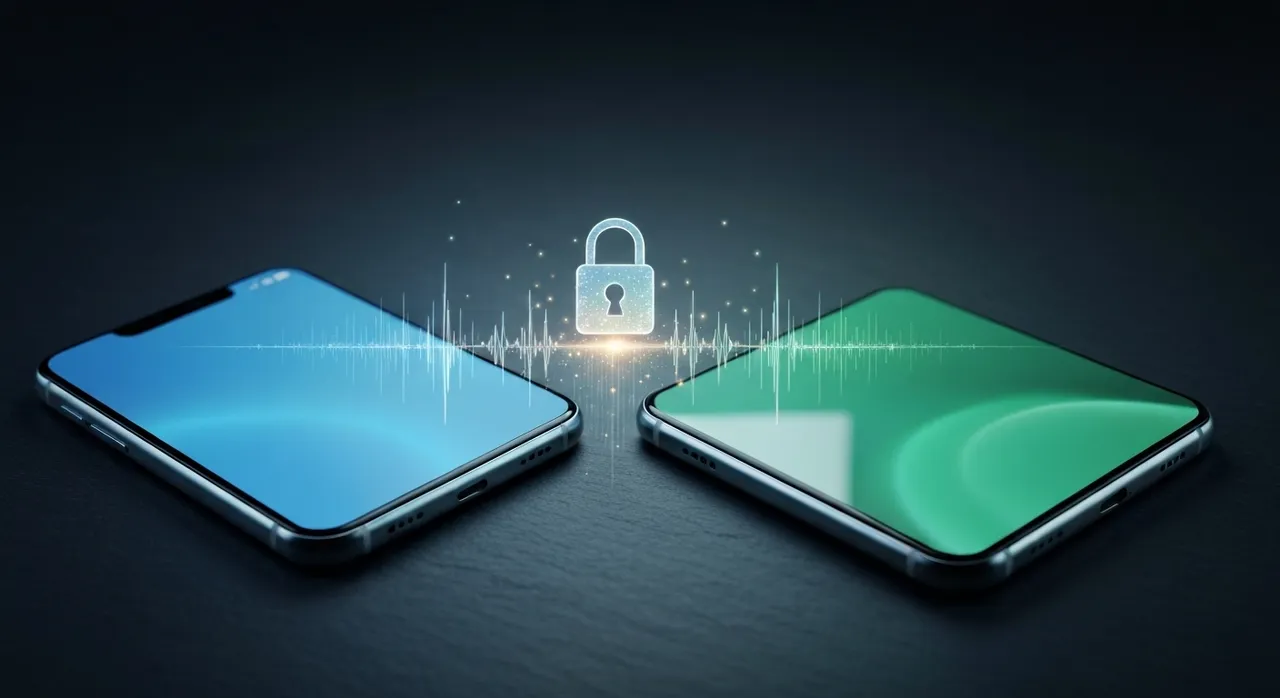
Apple has always maintained that the user interface should reflect the underlying state of the technology. In iOS 26.5, while the bubbles remain green to distinguish RCS from the proprietary iMessage service, a new lock icon appears next to the timestamp or within the message bubble itself. Furthermore, an “Encrypted” label is prominently displayed at the top of the thread.
These visual indicators are critical for user transparency. Because RCS depends on carrier infrastructure, the encryption status can be dynamic. If a user moves into an area with poor data coverage and the phone falls back to legacy SMS, the iPhone RCS encryption lock icon will disappear. This provides an immediate, real-time warning to the user that their conversation is no longer protected by end-to-end encryption and is susceptible to traditional cellular interception.
Neutralizing Legacy Threats: SS7, IMSI Catchers, and SIM Swapping
The shift to E2EE RCS is not just about features like read receipts or typing indicators; it is a vital defensive upgrade against sophisticated network attacks. SMS is fundamentally broken from a security perspective. Because it is sent in plain text across the Signaling System No. 7 (SS7) network, it is vulnerable to several high-level threats:
- SS7 Exploits: State actors and sophisticated hackers can exploit the global roaming backbone to intercept SMS messages, often used for two-factor authentication (2FA) codes.
- IMSI Catchers (Stingrays): Rogue cell towers can trick phones into connecting to them, allowing the interceptor to read SMS traffic in real-time.
- SIM Swapping: By taking over a user’s phone number through social engineering at a carrier, attackers gain access to their SMS-based accounts.
By implementing iPhone RCS encryption, Apple effectively neutralizes these “middle-man” threats. Even if an attacker intercepts the data packets at the carrier level or through a rogue tower, the content remains unreadable without the private keys held exclusively on the sender’s and receiver’s devices. This brings cross-platform messaging parity to the security levels previously reserved only for siloed apps like Signal or iMessage.
The Carrier Bottleneck: A Phased Global Rollout
Despite the software being ready in iOS 26.5, the universal availability of iPhone RCS encryption is not instantaneous. Because RCS is a carrier-based protocol, the network provider must support the Universal Profile 3.0 standard for the E2EE handshake to occur. Apple’s release notes explicitly state that the feature is available only through “supported carriers” and will roll out over time.
Major carriers in the US, Europe, and Japan have been testing UP 3.0 since early 2025, but smaller regional carriers may take longer to upgrade their IMS (IP Multimedia Subsystem) cores. This creates a temporary “patchwork” of security where a user might have encryption with one friend on a major network but not with another on a budget carrier. However, the default “Enabled” status in iOS 26.5 ensures that as soon as a carrier flips the switch, the protection activates automatically without user intervention.
Conclusion: The New Baseline for Mobile Privacy
The integration of iPhone RCS encryption in 2026 represents one of the most significant leaps in consumer digital privacy in over a decade. By moving the global baseline from the insecure SMS standard to a robust, MLS-powered E2EE protocol, Apple and Google have collectively secured the communication of billions of people. While the “blue vs. green” bubble debate will likely continue as a marketing distinction, the fundamental right to private communication is no longer a platform-exclusive luxury. With iOS 26.5, the green bubble is no longer a security risk—it is a secure, standardized, and sophisticated peer to iMessage.
Written by
TempMail Ninja
Digital privacy and online security expert. Passionate about creating tools that protect users' identity on the internet.