Nvidia Lancium Investment: $3 Billion Deal for AI Power Infrastructure
Article Content
The global artificial intelligence race has reached a structural inflection point where the ultimate constraint on technological progression is no longer chip architecture or memory bandwidth, but sheer electrical power. In a landmark transaction that redefines the relationship between semiconductor designers and power utilities, Nvidia has agreed to invest up to $3 billion in Texas-based power infrastructure developer Lancium. Valuing Lancium at an enterprise value of approximately $10 billion, the strategic Nvidia Lancium investment marks a decisive shift in how chip giants manage their supply chains, expanding their focus from fab capacity at TSMC to high-voltage transmission lines, substation transformers, and grid interconnections across North America.
Under the terms of the structured transaction, Nvidia will initially deploy $2 billion in equity capital to acquire a 20% stake in the Blackstone-backed firm. The agreement incorporates a performance-contingent milestone tranche of $1 billion, which would elevate Nvidia’s total holding toward 30% upon Lancium securing critical power grid interconnections and energization rights for mega-scale data center facilities. By directly funding the physical energization of future server campuses, Nvidia is addressing the primary headwind facing its hyperscale and neocloud customers: the multi-year backlog in utility interconnection queues that threatens to leave billions of dollars in advanced GPUs sitting idle in unpowered warehouses.
Financial Architecture and Enterprise Valuation Dynamics
The deal provides Lancium with liquidity to accelerate its ambitious infrastructure pipeline ahead of a planned Initial Public Offering (IPO) targeted for 2027. Backed substantially by private equity titan Blackstone—which previously committed over $500 million to gain a controlling stake—Lancium has transformed from an energy management firm into one of the premier power brokers for high-density computing in the United States. Nvidia’s direct equity participation validates Lancium’s asset portfolio, which encompasses proprietary grid management software, thousands of acres of strategically located land, and secured rights to gigawatts of electrical capacity.
The multi-stage investment highlights the disciplined, risk-mitigated capital allocation framework favored by modern tech balance sheets. The initial capital injection provides Lancium with immediate balance sheet expansion, while the second tranche aligns Nvidia’s investment directly with operational execution within regulated power markets.
- Initial Equity Injection: $2 billion upfront capital in exchange for approximately 20% equity ownership in Lancium.
- Milestone-Contingent Capital: $1 billion additional funding contingent upon Lancium achieving designated power interconnection thresholds and grid approvals.
- Enterprise Valuation: Approximately $10 billion, reflecting Lancium’s current land holdings, energized assets, and multi-gigawatt interconnection pipeline.
- Key Institutional Backer: Blackstone, maintaining a primary co-investment position alongside Nvidia.
- Operational Capital Target: Accelerating multi-site grid buildouts ahead of a planned 2027 public listing.
This capital deployment is part of a broader, aggressive asset-accumulation campaign by Nvidia. During the first quarter of 2026 alone, Nvidia directed more than $18 billion into private technology firms, infrastructure vehicles, and specialized cloud providers. Rather than allowing its cash reserves to yield standard treasury rates, Nvidia is systematically deploying capital into peripheral bottlenecks—such as power transmission, custom liquid cooling, and optical networking—to ensure that the physical ecosystem can absorb its expanding hardware roadmap.
The Stargate Nexus: Energizing the Abilene Super-Campus
At the center of the strategic thesis is Lancium’s flagship asset: the 1,000-acre Clean Campus in Abilene, Texas. This site serves as the primary physical hub for “Stargate,” the multi-hundred-billion-dollar joint artificial intelligence initiative involving OpenAI, SoftBank, Oracle, and MGX. The project represents one of the largest concentrated infrastructure buildouts in modern industrial history, requiring power levels that rival the peak demand of major metropolitan areas.
Modern high-density compute architectures, such as Nvidia’s Blackwell and subsequent system platforms, require unprecedented electrical power per rack. Legacy enterprise data centers typically operated at 10 to 15 kilowatts per cabinet; by contrast, current liquid-cooled AI clusters demand 100 to 120 kilowatts per rack, with next-generation platforms projecting power demands exceeding 250 kilowatts per enclosure. Delivering thousands of megawatts to a single continuous site like Abilene requires specialized substation engineering, direct connection to high-voltage transmission backbones, and redundant power feeds.
Building for Next-Generation GPU Density
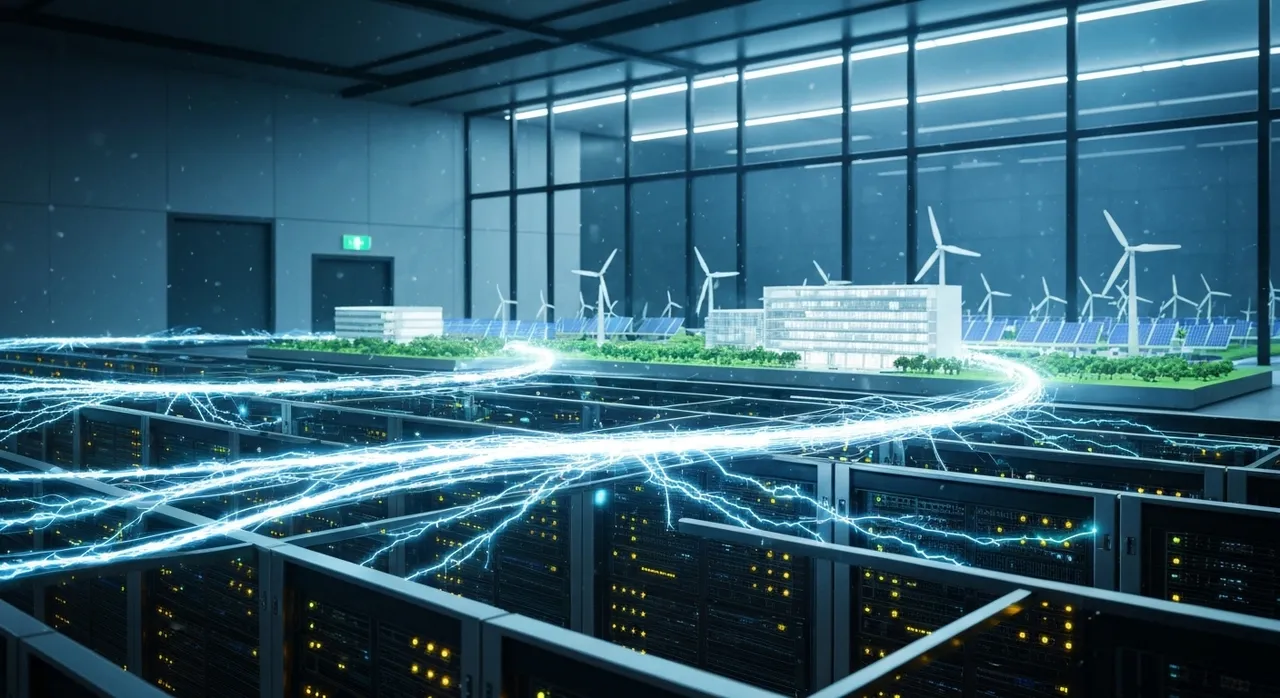
To support the compute density demanded by Stargate, Lancium’s Abilene infrastructure is designed around customized electrical topology. The facility incorporates high-voltage step-down substations situated directly adjacent to data halls, minimizing low-voltage distribution line losses. Furthermore, to overcome the protracted delays associated with regional transmission upgrades, the site is integrating on-site natural gas generation alongside local renewable sources, creating a hybrid power architecture capable of providing continuous baseload reliability with lower carbon intensity.
By securing an equity stake in Lancium, Nvidia ensures that its primary cloud partners, including Oracle Cloud Infrastructure (OCI) and specialized operators like Crusoe Energy, encounter no power delivery delays when installing tens of thousands of Blackwell GPUs. This alignment minimizes idle inventory risk and ensures that compute hardware begins generating high-margin software and inference revenue immediately upon delivery.
Decoding the Nvidia Lancium Investment: Overcoming Grid Interconnection Bottlenecks
Across the United States, electrical grid congestion has replaced supply chain shortages as the defining hurdle for technology expansion. Regionally, grid operators such as the Electric Reliability Council of Texas (ERCOT), PJM Interconnection, and MISO face historic queues for new high-volume service requests. Securing a major interconnection agreement can routinely take between four to seven years due to required environmental impact assessments, grid stability modeling, and long-lead utility transformer procurements. The execution of the Nvidia Lancium investment provides Nvidia with a direct operational vehicle to navigate these structural utility bottlenecks.
Lancium possesses a substantial competitive advantage through its established ERCOT pipeline. The firm currently controls 4 gigawatts of secured power capacity on the Texas grid, with an additional 15 gigawatts of interconnection applications in active development stages across multiple states. Moreover, Lancium’s origin story as a flexible load manager for energy-intensive applications yielded proprietary grid software known as “Smart Response.”
Grid Optimization via “Smart Response” Technology
Unlike conventional data centers that demand uninterrupted, flat power draw regardless of grid strain, Lancium-designed facilities can dynamically interact with the electrical grid. Utilizing real-time automated telemetry, Lancium’s power management systems can dynamically adjust non-critical compute loads or shift auxiliary systems during periods of extreme thermal stress or local grid spikes. This dynamic load control capability offers distinct operational benefits:
- Accelerated Interconnection Approvals: Utility providers approve grid hookups more readily when end-users possess proven automated curtailment and load-balancing systems.
- Economic Power Sourcing: Facilities can monetize demand-response capabilities, absorbing low-cost surplus renewable energy during off-peak hours and reducing grid draw during peak pricing windows.
- Dual-Fuel Resilience: Integrating fast-ramping on-site natural gas turbines allows campuses to isolate entirely from the main grid during emergency conditions without interrupting critical training runs.
Silicon Verticals: Strategic Control of the AI Ecosystem
Nvidia’s capital commitment to Lancium illustrates a broader paradigm shift across the global technology sector: the complete vertical integration of artificial intelligence infrastructure. Tech leaders are no longer operating strictly as isolated semiconductor designers, software creators, or cloud hosting vendors. Instead, maintaining market leadership requires controlling the entire value chain—from silicon photolithography and liquid cooling manifolds to primary energy generation and high-voltage grid connections.
In recent quarters, rival hyperscalers have pursued aggressive energy procurement strategies, negotiating long-term power purchase agreements with nuclear power plants and utility-scale solar developers. Nvidia’s strategy differs by prioritizing capital equity in the core power infrastructure developer itself. Rather than merely purchasing power as an off-taker, Nvidia is acquiring ownership of the platforms that design, construct, and interconnect the energy assets.
This operational model creates a self-reinforcing flywheel. By supplying capital to Lancium, Nvidia expedites grid-connection schedules. Accelerated grid connections allow partners like Oracle, OpenAI, and SoftBank to bring mega-data centers online years ahead of competitors. Rapid data center commissioning drives immediate demand for Nvidia’s high-margin server racks, effectively locking customers into the Nvidia hardware and software ecosystem before competing hardware architectures can secure powered facility space.
The New Infrastructure Blueprint for Global AI Deployments
The transaction between Nvidia and Lancium establishes a new operational blueprint for the deployment of compute infrastructure globally. As artificial intelligence models scale in size and complexity, compute requirements are shifting from isolated corporate facilities to multi-gigawatt energy hubs. Power access, grid queue positioning, and utility partnership strategies are now as vital to technology companies as semiconductor design and software architecture.
By forging a $3 billion partnership with Lancium, Nvidia has secured a strategic position in energy infrastructure. The agreement mitigates key power availability risks for the flagship Stargate project in Abilene, Texas, while establishing a repeatable model for expanding AI compute capacity. As Lancium moves toward its targeted 2027 initial public offering, the collaboration demonstrates that in the modern artificial intelligence economy, the enterprise that controls the grid holds the key to the future of compute.
Written by
TempMail Ninja
Digital privacy and online security expert. Passionate about creating tools that protect users' identity on the internet.