Phishing-Resistant Authentication: Microsoft’s Urgent Security Alert to Phase Out Passwords
Article Content
On May 8, 2026, the global cybersecurity landscape reached a definitive tipping point. In an unprecedented move, Microsoft issued a critical security alert signaling the immediate obsolescence of traditional passwords and SMS-based two-factor authentication (2FA). This was not merely a routine patch or a minor policy update; it was a strategic declaration of war against an industrialized threat landscape now dominated by generative AI. As the digital giant moves to mandate phishing-resistant authentication for its billions of users, the message to organizations and individuals is clear: the era of “secret strings” is over.
The Industrialization of Deception: Why AI Broke the Human Firewall
The primary driver behind Microsoft’s urgent warning is the alarming efficacy of AI-powered phishing. Historically, security training focused on identifying “red flags”—typos, awkward phrasing, or suspicious sender addresses. In 2026, those markers have vanished. Microsoft’s data reveals that AI-generated phishing campaigns now achieve click-through rates as high as 54%, more than quadruple the success rate of human-authored lures from just two years ago.
These sophisticated attacks use large language models (LLMs) to perform automated reconnaissance, scraping public data and previous breach repositories to craft hyper-personalized messages. When an email looks, sounds, and references internal context as accurately as a legitimate colleague, human intuition fails. This is where phishing-resistant authentication becomes the only viable line of defense. Unlike legacy methods that rely on a user’s ability to discern a fake site, phishing-resistant protocols use cryptographic handshakes that are mathematically bound to the legitimate domain, making them immune to even the most convincing AI-generated lures.
The Rise of the “Adversary-in-the-Middle” (AiTM)
Traditional MFA, once the gold standard, has been systematically dismantled by “Adversary-in-the-Middle” (AiTM) attacks. Modern phishing kits no longer just steal passwords; they act as real-time proxies between the user and the legitimate service. When a user enters their password and subsequent SMS code into a fraudulent page, the attacker’s proxy forwards those credentials to the real site in real-time, captures the resulting session cookie, and gains full access. Because the session is already authenticated, the attacker effectively bypasses the 2FA layer entirely.
- Industrialized Phishing: 82.6% of phishing emails in 2026 are now AI-generated.
- Velocity of Compromise: The median time from a phishing click to credential submission is now just 21 seconds.
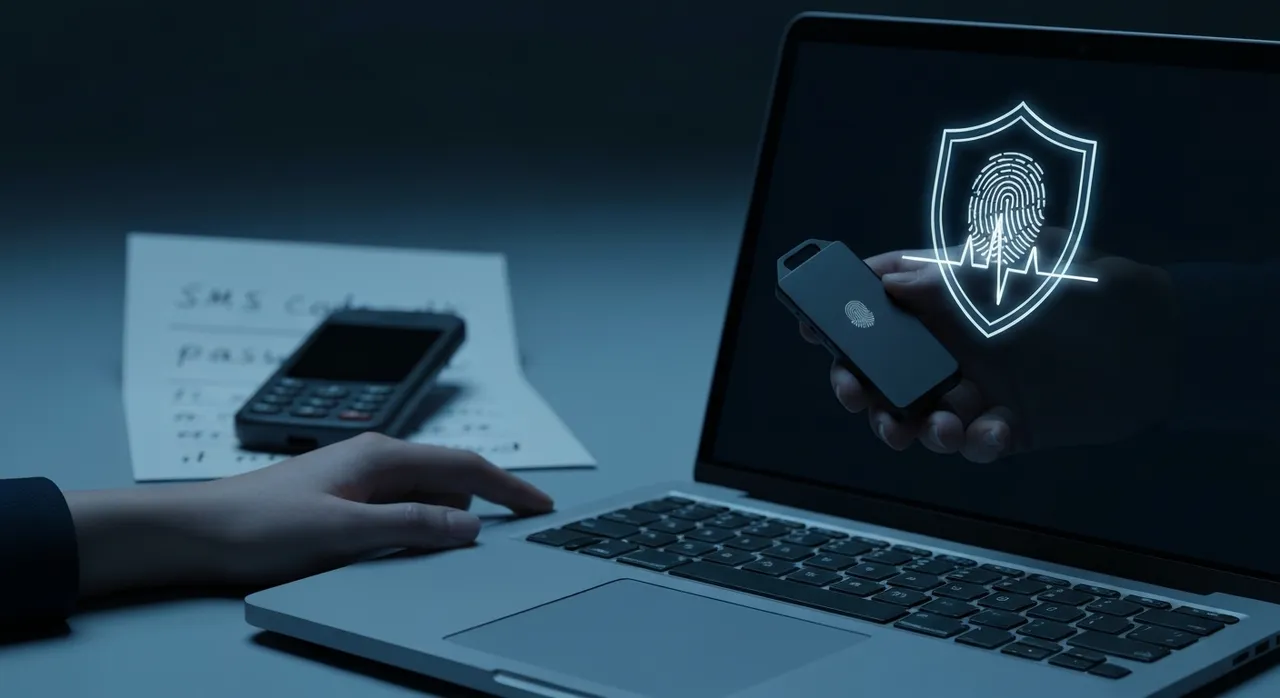
- Failure of Legacy 2FA: SMS and push-based codes are vulnerable to SIM swapping, SS7 interception, and session proxying.
The Mechanics of Phishing-Resistant Authentication
To understand why Microsoft is forcing a migration to passkeys, one must look at the underlying FIDO2 and WebAuthn standards. Phishing-resistant authentication replaces the “shared secret” (the password) with asymmetric cryptography. When a user registers a passkey, their device generates a mathematically linked public-private key pair.
The private key is stored securely within the device’s Trusted Platform Module (TPM) or a dedicated hardware security key (like a YubiKey). It never leaves the device. The public key is shared with Microsoft’s servers. During a login attempt, the server sends a “challenge” that the device signs using the private key. This signature is only valid if the device is communicating with the specific domain (e.g., login.microsoft.com) for which the key was created. If an attacker lures a user to a fake domain (e.g., login-microsoft-verify.com), the browser or OS will recognize the domain mismatch and refuse to sign the challenge. This “origin-checking” is the technical foundation that makes passkeys truly phishing-resistant.
Device-Bound vs. Synced Passkeys
Microsoft’s 2026 update highlights two primary implementations of this technology:
- Device-Bound Passkeys: These are locked to a specific piece of hardware. They offer the highest level of security, as the credential cannot be moved or copied. High-assurance roles in government and finance typically mandate these via hardware security keys.
- Synced Passkeys: These are managed by a platform’s keychain (like Windows Hello, Apple iCloud, or Google Password Manager). While they can be synced across a user’s devices for convenience, they remain phishing-resistant because the underlying cryptographic exchange still requires origin-checking and local biometric/PIN unlock.
Microsoft’s Strategic Rollout: OneDrive, Xbox, and Copilot
As of May 2026, Microsoft has enabled phishing-resistant authentication for over 99% of its consumer and enterprise user base. This covers critical services including OneDrive, Xbox, and Copilot. The inclusion of Copilot is particularly significant; as AI agents begin to act on behalf of users—executing workflows, accessing sensitive databases, and managing communications—the “Identity Perimeter” becomes the only barrier preventing an AI agent from being weaponized against its owner.
Microsoft is actively encouraging users to delete their passwords entirely. In a “Passwordless” account configuration, the password is removed from the database, leaving no secret for an attacker to steal via a breach. This move effectively “shrinks the attack surface” by eliminating the primary vector for credential stuffing and brute-force attacks.
The Deprecation of Security Questions
A notable technical detail in the May 8 alert is the firm deadline for legacy recovery methods. Microsoft announced that starting in early 2027, security questions will be entirely removed as a recovery option for Microsoft Entra ID. Citing their vulnerability to AI-driven social engineering and data scraping, Microsoft argues that a user’s “mother’s maiden name” or “first pet” is no longer a secret in an era where AI can synthesize a person’s life history from fragmented web data.
Treating Identity as the Primary Security Perimeter
The shift to phishing-resistant authentication represents a fundamental change in security philosophy. For decades, the network perimeter (firewalls and VPNs) was the focus. Today, in a world of remote work and cloud-native services, Identity is the new perimeter. If an attacker compromises a user’s identity, they inherit that user’s permissions across the entire ecosystem.
Microsoft’s warning emphasizes that simply having 2FA enabled is no longer a defense if phishable “backdoors” exist. If an account allows for a “fallback” to an SMS code or an email-based reset, the security of the passkey is undermined. Attackers will simply target the weakest link in the recovery chain. Microsoft is urging organizations to audit their Account Recovery Paths and remove these legacy fallbacks immediately.
The Agentic Risk Factor
The urgency is compounded by the rise of “Agentic AI.” In 2026, AI agents are increasingly autonomous, capable of making decisions and executing financial transactions. Microsoft warns that if an identity is compromised, an adversary can leverage these AI agents to perform industrial-scale data exfiltration or execute complex workflows without a single further prompt to the human user. Ensuring that the “hand on the wheel” is authenticated via phishing-resistant methods is no longer optional; it is a prerequisite for the safe use of AI in the enterprise.
Roadmap for Transitioning to a Phishing-Resistant Future
For IT leaders and security-conscious individuals, the transition from legacy 2FA to phishing-resistant authentication should follow a structured path:
- Audit Existing Credentials: Identify accounts still relying on passwords, SMS, or voice-call 2FA.
- Deploy Platform Passkeys: Enable Windows Hello for Business or platform-native passkeys to provide a seamless, biometrically-backed login experience.
- Implement Hardware Keys for High-Risk Roles: Provide YubiKeys or similar FIDO2-certified hardware to administrators and executives who handle sensitive data.
- Harden Recovery Workflows: Ensure that “Account Recovery” does not revert to phishable methods. Transition to Microsoft Entra Verified ID or other verifiable credential systems for identity restoration.
- Eliminate Legacy Fallbacks: Actively remove passwords from the user experience, moving toward a “Passwordless” architecture where the device itself is the primary proof of identity.
Conclusion: The End of the Password Era
Microsoft’s May 2026 alert is the final nail in the coffin for traditional credential management. As generative AI continues to democratize sophisticated cyberattacks, the technical debt of the “password” has become an existential threat. By mandating phishing-resistant authentication and phasing out legacy recovery methods, Microsoft is setting a new global standard for digital resilience. For the modern user, the directive is clear: embrace the passkey, delete the password, and recognize that in the age of AI, your physical device and your biometrics are the only secrets left that can truly be kept.
Written by
TempMail Ninja
Digital privacy and online security expert. Passionate about creating tools that protect users' identity on the internet.