Artificial Intelligence Ethics: Pope Leo XIV Releases Magnifica Humanitas
Article Content
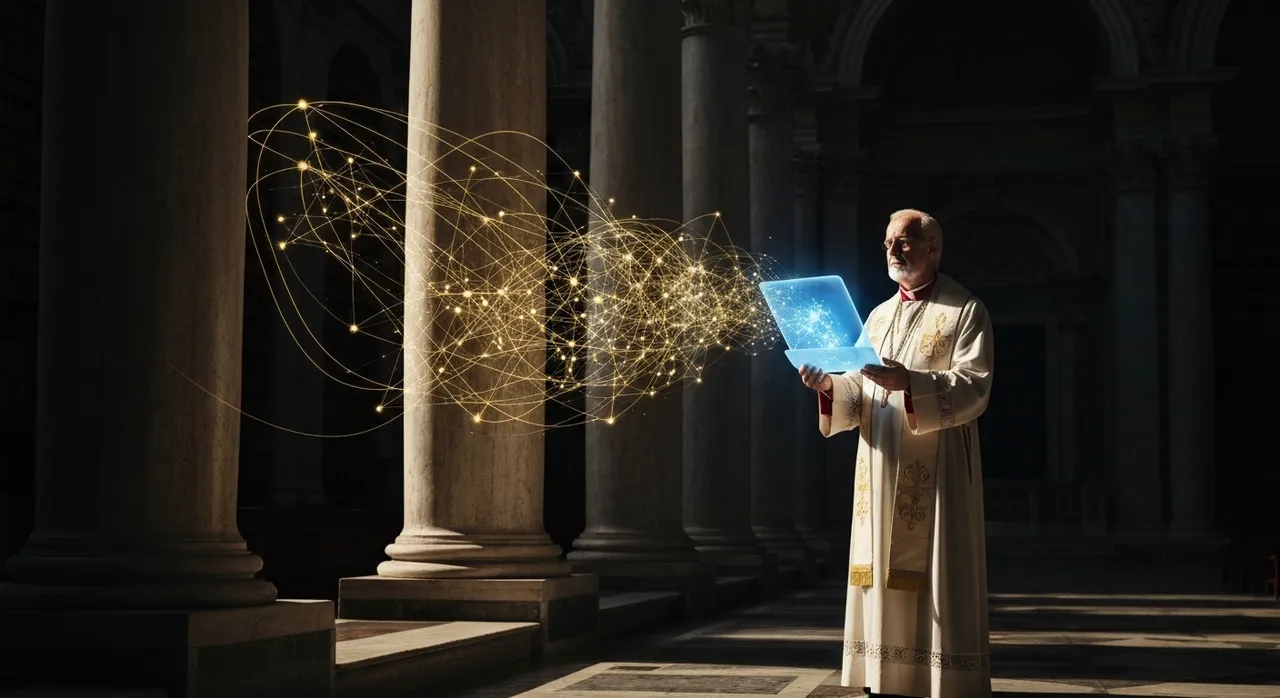
On Monday, May 25, 2026, the majestic halls of the Vatican witnessed an unprecedented moment in modern ecclesiastical history. Pope Leo XIV formally released and promulgated Magnifica Humanitas (“Magnificent Humanity”), the first papal encyclical of his pontificate, elevating the ethical and moral dimensions of artificial intelligence to a paramount religious imperative. Spanning roughly 42,000 words, this landmark text marks the most authoritative document of his young papacy. It establishes a defining moral framework for the global Catholic Church, signaling a tectonic shift in how the Vatican engages with technological advancement. In a dramatic departure from centuries of rigid Vatican protocol, history’s first U.S.-born pontiff personally presented the encyclical in the New Synod Hall. Rather than limiting the stage to Curial cardinals and theologians, Pope Leo XIV shared the platform with Christopher Olah, a co-founder of the prominent AI research laboratory Anthropic and the leader of its AI interpretability team.
This unprecedented presentation represents the culmination of a decade of quiet, strategic diplomacy between the Holy See and Silicon Valley. It establishes a direct, high-stakes dialogue between the moral teachings of the Church and the creators of frontier language models like Claude. Rather than issuing passive, retrospective critiques, the Pope’s actions demonstrate an intention to actively shape the design and deployment of cognitive technologies from the ground up.
The Silicon Valley Alliance: Regulating Artificial Intelligence from the Outside
The presence of Christopher Olah on the Vatican stage was far more than a symbolic gesture; it represented a critical alignment on the boundaries of technological stewardship. Olah delivered a remarkably candid address, asserting that the development of frontier artificial intelligence cannot be left solely in the hands of the corporate labs designing it. He conceded that AI companies operate within “a set of incentives and constraints that can sometimes conflict with doing the right thing,” making external moral and regulatory oversight from religious bodies, governments, and civil society absolutely vital.
This high-profile alliance highlights the growing geopolitical and ethical friction surrounding frontier technologies:
- The Conflict of Incentives: Silicon Valley’s drive for rapid commercialization and market dominance frequently conflicts with safety and ethical safeguards, necessitating external, independent frameworks.
- Anthropic’s Stance: The company’s recent public clashes with the U.S. administration over refusing to loosen safeguards against utilizing its models for mass surveillance or lethal warfare underscore the real-world stakes of the Pope’s treatise.
- Dialogue and Expansion: Pope Leo XIV’s move builds on years of engagement between the Vatican, Microsoft, Google, and academic institutions, positioning the Church as a leading global authority on the ethics of the digital revolution. This is further reflected in Anthropic’s recent expansion, including opening a new office in Milan.
The Limits of Cold Codes: Changing the Human Heart
At the heart of this collaborative effort is a shared understanding that ethical codes alone are insufficient. As Bishop Antonio Staglianò, president of the Pontifical Academy of Theology, noted ahead of the launch, a code of ethics in isolation is merely a “cold code of regulations” that profit-driven tech giants can easily manipulate or bypass. Magnifica Humanitas seeks to go deeper, aiming to “change the human heart” by reshaping how society views progress, solidarity, and the common good.
The “Babel Syndrome” and the Rise of Digital Monopolies
In Chapter Three, the encyclical takes direct aim at the “technocratic paradigm” that dominates the modern digital landscape. Pope Leo XIV warns of a highly aggressive “culture of power” fueled by corporate centralization. He expresses deep concern that sovereign nations have abdicated their responsibilities, allowing the vital infrastructure of computing power and data storage to slip into the hands of a few private oligopolies.
The Pope uses two stark biblical images to frame this contemporary crisis:
- The Tower of Babel (Genesis 11): Used as a metaphor for the hubristic pretense of the modern tech sector, which seeks to translate the complex mystery of the human soul, human relationship, and existential experience entirely into performance metrics, profit margins, and data points.
- The Rebuilding of Jerusalem (Nehemiah 1-2): Offered as a counter-narrative of hope, emphasizing a collaborative model that “rebuilds relationships before rebuilding with stones,” prioritizing human solidarity and the common good over raw technological efficiency.
The Pope declares that technology is never morally neutral. It inevitably takes on the ethical, social, and economic characteristics of those who fund, design, and regulate it. To treat the human person as a mere optimization problem is, in the Pope’s words, to succumb to the “Babel syndrome”—a dangerous idolatry of profit that inevitably sacrifices the weak and the marginalized on the altar of progress.
Redefining Labor and the Historic Apology for Slavery
One of the most emotionally resonant and intellectually complex dimensions of Magnifica Humanitas is its connection between historic human suffering and modern economic exploitation. In a historic first, Pope Leo XIV offers an explicit apology in the name of the Church for the Holy See’s historical role in legitimizing the trans-Atlantic slave trade. He specifically cites 15th-century papal bulls—such as Nicholas V’s Dum Diversas of 1452—that granted European monarchs the authority to subjugate non-Christian populations.
By addressing this “wound in Christian memory,” the Pope establishes the moral authority necessary to critique what he defines as “new forms of slavery” in the digital age. He links the historical subjugation of human bodies to the contemporary exploitation driving the global tech economy:
- Resource Exploitation: The unregulated, often hazardous labor practices used to extract rare minerals required for high-performance AI hardware.
- Data Labeling Sweatshops: The invisible, underpaid labor force in developing nations tasked with labeling and cleaning massive datasets under brutal conditions.
- White-Collar Displacement: The threat of massive, unregulated unemployment that devalues intellectual labor and treats human workers as disposable assets.
To combat these inequities, the encyclical calls for “shared standards of social justice” and a concerted political effort to ensure that technological advancements elevate the dignity of work rather than reducing human beings to raw data inputs.
Autonomous Lethal Force and the Outdatedness of “Just War”
In Chapter Five, the Pope confronts the terrifying integration of autonomous algorithms into modern warfare. He warns of a rapid transformation in the “grammar of war,” where the use of military force is becoming increasingly fast, distant, and completely decoupled from human conscience. Pope Leo XIV explicitly declares that it is “not permissible” to delegate irreversible decisions of life and death to autonomous machines.
In a sweeping theological development, Magnifica Humanitas declares that the traditional Catholic “just war” theory is now obsolete. The Pope writes that the sheer destructive capacity of modern weapons systems, combined with algorithmic decision-making, renders the concept of a “just war” a dangerous realpolitik illusion that normalizes conflict and treats peace as a utopian fantasy. He urges global leaders to completely “disarm” artificial intelligence in military applications and calls for the establishment of rigorous, legally binding international treaties to ban autonomous weapons.
The Ontological Line: A Call to “Fast from AI”
Ultimately, Magnifica Humanitas draws a clear, unyielding line between the machine and the human spirit. Pope Leo XIV asserts that “so-called artificial intelligences do not undergo genuine experiences, do not possess a body, do not feel joy or pain, and do not know from within what love, friendship, or responsibility mean”.
To protect the next generation from the psychological and relational erosion caused by excessive screen time and algorithmic dependency, the Pope proposes an “educational alliance” and introduces a radical concept: the spiritual duty to “fast from AI”. He challenges families, schools, and communities to actively disconnect from digital mediation to preserve the human capacity for deep contemplation, unmediated relationship, and the pursuit of truth. Technology must serve human solidarity, the encyclical concludes, rather than accelerating the dehumanization of the global family.
Written by
TempMail Ninja
Digital privacy and online security expert. Passionate about creating tools that protect users' identity on the internet.