Biological Neural Network: Princeton Unveils 3D Computing Breakthrough
Article Content
For the past decade, the trajectory of artificial intelligence has been defined by a relentless pursuit of “more”: more parameters, more data centers, and more electricity. However, as the global energy consumption of large language models (LLMs) begins to rival the output of entire nations, the silicon ceiling has become impossible to ignore. On April 28, 2026, researchers at the Princeton Materials Institute officially signaled a departure from this brute-force paradigm, unveiling a breakthrough that merges the crystalline precision of electronics with the fluid complexity of life. Their “micro-instrumented” 3D biological neural network represents not just a new type of computer, but a fundamental shift toward “organoid intelligence” that could redefine the limits of energy-efficient computing.
The Inside-Out Revolution: Architecture of a Biological Neural Network
Historically, the field of bioelectronics has been constrained by a “surface-level” approach. Previous “brain-on-a-chip” systems were typically 2D cultures grown on flat petri dishes or 3D organoids that were probed from the outside. While these models provided some insight, they lacked the structural integrity and signal fidelity required for high-level computation. The Princeton team, led by Assistant Professor Tian-Ming Fu and postdoctoral researcher Kumar Mritunjay, solved this by working “from the inside out.”
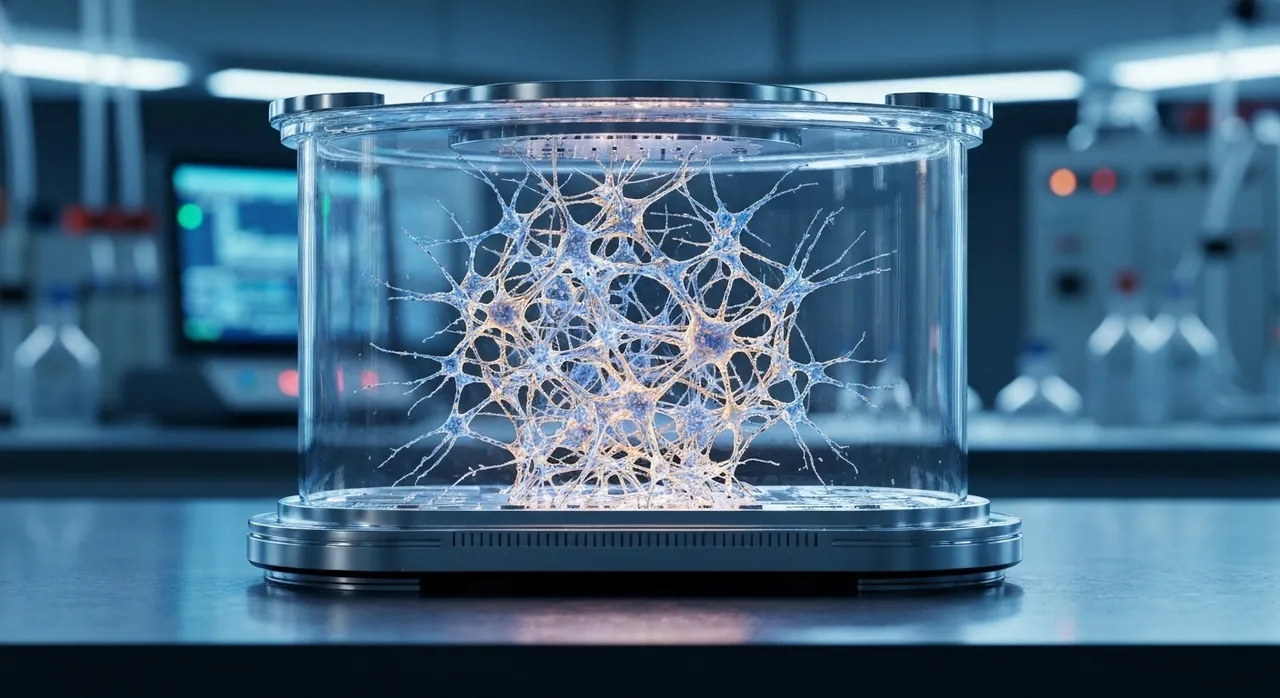
The device is built upon a revolutionary scaffold: a microscopic, three-dimensional mesh composed of ultra-fine metal wires and gold electrodes. This mesh is coated in a specialized, flexible epoxy layer—less than 100 nanometers thick—that provides the structural support for biological neural network growth while remaining soft enough to interface with delicate living tissue. Unlike silicon, which is rigid and foreign to biological cells, this mesh acts as a mechanical mimic of the brain’s extracellular matrix.
- Scale of Integration: The current iteration supports roughly 70,000 living neurons, far exceeding the density of typical 2D bio-hybrid experiments.
- Wire Precision: The electrodes and wires within the mesh have a diameter of approximately 10 micrometers—roughly ten times thinner than a human hair.
- Temporal Durability: In a feat of bio-engineering, the researchers maintained these functional networks for over six months, allowing for long-term observation of synaptic development.
By allowing tens of thousands of neurons to twine through the electronic framework, the researchers created a seamless interface where every individual cell is within reach of a sensing or stimulating electrode. This “inside-out” architecture allows for a level of signal granularity never before achieved in a 3D biological system.
Synaptic Plasticity as an Algorithmic Engine
The true genius of the Princeton device lies in how it learns. Traditional AI relies on backpropagation—a mathematically intensive process of adjusting weights in a digital matrix. In contrast, the biological neural network utilizes synaptic plasticity, the same mechanism the human brain uses to encode memory and learn new skills.
Through the mesh’s microscopic gold electrodes, the researchers can record action potentials from multiple planes within the 3D volume. More importantly, they can stimulate specific clusters of neurons to “train” the network. By applying chronic electrical pulses, they were able to strengthen or weaken connections between specific neurons, effectively programming a biological “reservoir” to perform computational tasks.
Spatial vs. Temporal Pattern Recognition
To test the computational capacity of the wetware-hardware hybrid, the team presented the network with two distinct types of challenges:
- Spatial Pattern Recognition: The network was trained to distinguish between different geometric configurations of electrical signals, mimicking the way a visual cortex might process shapes.
- Temporal Pattern Recognition: The device successfully differentiated between complex sequences of pulses over time, proving its ability to process “rhythmic” or time-dependent data.
The system’s success in both categories suggests that 3D biological neural networks are capable of multimodal processing that mirrors the natural versatility of organic brains.
The One-Millionth Power Factor: AI’s Energy Crisis
The primary driver for this research is the unsustainable energy appetite of modern silicon-based AI. Large Language Models, while impressive, are notoriously inefficient. An LLM performing a pattern-recognition task may consume millions of times more power than a biological brain performing the same operation.
“The real bottleneck for AI in the near future is energy,” noted Assistant Professor Tian-Ming Fu. The Princeton team’s findings highlighted a staggering discrepancy in efficiency. While a modern GPU cluster might draw kilowatts of power to process a single complex prompt, the Princeton biological neural network operates on a milliwatt scale.
Several factors contribute to this “biological advantage”:
- Sparse Activity: Silicon chips are largely “always on” or require complex power-gating. Biological networks exhibit sparse activity, where only 1% to 4% of neurons are active at any given time, drastically reducing idle power consumption.
- Analog Processing: Unlike digital bits that are either 0 or 1, neurons process information using analog gradients and temporal spikes, allowing for a much richer information density per unit of energy.
- Self-Healing and Adaptation: When a connection in a silicon chip fails, it is permanent. The biological network is self-healing, naturally rerouting signals and maintaining efficiency even as individual cells age or expire.
According to the paper published in Nature Electronics, this 3D-BNN is approximately 1,000 times more energy-efficient than state-of-the-art silicon chips designed specifically for pattern recognition. For the future of edge computing and decentralized AI, this leap is not just incremental—it is transformative.
From Computing to Cure: The Dual Promise of 3D-BNNs
While the computing world eyes this technology for its efficiency, the medical community sees a different kind of potential. Because the 3D mesh is “micro-instrumented,” it serves as a high-fidelity laboratory for studying the brain in its most naturalistic state. Traditional 2D cultures fail to replicate the complex 3D signal propagation seen in neurological disorders.
The Princeton device allows scientists to model neurodegenerative diseases, such as Alzheimer’s or Parkinson’s, by observing how connections degrade in real-time within a controlled 3D environment. By introducing pharmacological agents and monitoring the response via the gold electrodes, researchers can test drug efficacy with a level of precision that animal models cannot match.
Furthermore, this research is a major milestone in the emerging field of Organoid Intelligence (OI). As we move toward 2030, the integration of biological tissue into the global computing infrastructure could provide a way to bypass the physical limits of Moore’s Law. The goal is not to replace silicon entirely, but to create “biocomputers” that handle specific, high-complexity, low-power tasks that are currently crippling our electrical grids.
The Road to Scalability and Ethical Frontiers
Despite the triumph of the Princeton Materials Institute, scaling a biological neural network for commercial use remains a formidable challenge. Maintaining a living culture of 70,000 neurons for six months is a masterpiece of laboratory management, but scaling that to millions or billions of neurons—as would be required to compete with human-level intelligence—requires breakthroughs in microfluidics and automated life-support systems.
There are also profound ethical questions that the researchers, and society at large, must address. As we move from “brain-inspired” algorithms to “brain-integrated” hardware, the line between machine and organism blurs. The Princeton team has been proactive in emphasizing that their current models use mouse-derived stem cells, but the eventual transition to human-derived neurons is a logical next step for maximizing computational performance. This brings “Organoid Intelligence” into a complex moral landscape regarding the rights of biocomputational systems and the potential for “synthetic consciousness.”
Key Technical Specifications of the Princeton 3D-BNN
- Material: Flexible epoxy mesh scaffold with embedded gold micro-electrodes.
- Cell Density: ~70,000 neurons per chip reservoir.
- Sensing Mode: Inside-out, 3D volumetric recording and stimulation.
- Training Method: Chronic electrical stimulation (Synaptic Plasticity).
- Efficiency Benchmark: 1/1,000,000th the power of modern LLM hardware.
The Dawn of the Bio-Hybrid Era
The announcement on April 28, 2026, marks the end of the “flat-world” era of biocomputing. By engineering a 3D interface that truly speaks the language of the brain, Princeton researchers have opened a door that cannot be closed. We are no longer merely copying the brain’s architecture in code; we are recruiting its physical matter to solve our most pressing technical challenges.
The biological neural network developed at the Princeton Materials Institute is a testament to the power of interdisciplinary science—a marriage of electrical engineering, materials science, and cellular biology. As the global AI industry faces a reckoning with its own carbon footprint and power requirements, the solution may not lie in bigger chips, but in the elegant, low-power wisdom of the neuron itself. The biocomputer has arrived, and it is living, breathing, and learning in three dimensions.
Written by
TempMail Ninja
Digital privacy and online security expert. Passionate about creating tools that protect users' identity on the internet.