Anthropic Implements Global Text Watermarking and C2PA Provenance on Claude
Article Content
On August 11, 2026, Anthropic formally unveiled a comprehensive, platform-wide transparency framework that embeds machine-readable content provenance markers across its Claude artificial intelligence platform. Prompted by statutory obligations under Article 50(2) of the European Union’s landmark Artificial Intelligence Act, the enterprise AI provider has instituted model-level invisible text watermarking alongside Coalition for Content Provenance and Authenticity (C2PA) digital signatures for generated digital assets. Unlike previous voluntary efforts or localized compliance experiments, Anthropic’s architecture applies globally across every deployment vector—including consumer chat interfaces, enterprise API endpoints, automated software engineering agents, and third-party hyperscale cloud platforms. By weaving cryptographic and statistical signals directly into the generation layer, Anthropic establishes a new benchmark for structural transparency in frontier generative AI models, while highlighting the complex technical realities of synthetic content attribution.
The Regulatory Driver: EU AI Act Article 50(2) and Global Deployment
The immediate catalyst for Anthropic’s implementation is the enforcement of Article 50(2) under the EU AI Act, which requires providers of generative AI systems to ensure that synthetic outputs—whether textual, visual, or audio—are technical, machine-readable, and reliably identifiable as AI-generated. To satisfy the accompanying Code of Practice on Transparency of AI-Generated Content, AI providers must deliver mechanism-level proof of content origin.
Rather than engineering a fragmented, region-gated infrastructure that activates exclusively for European IP addresses or EU-domiciled tenants, Anthropic made the strategic choice to deploy its provenance architecture globally. Effective for all Claude models launched on or after August 2, 2026, the marking protocols operate uniformly across every access point in the Anthropic ecosystem:
- Claude Web & Mobile Applications: Consumer-facing conversational environments operating at scale.
- Claude Platform (API): Developer-facing REST APIs and streaming endpoints serving enterprise production workflows.
- Claude Code, Claude Cowork, & Claude Tag: Specialized agentic tools engineered for automated software development, enterprise messaging, and collaborative task management.
- Cloud Infrastructure Partners: Managed enterprise hosting environments including Amazon Web Services (AWS) Bedrock, Google Cloud Vertex AI, and Microsoft Foundry.
By enforcing compliance at the model layer rather than the application layer, Anthropic ensures that enterprise clients and third-party developers cannot disable, opt out of, or bypass the embedded markers. Existing models launched prior to August 2 are subject to a regulatory transition period, with retrofitting efforts currently underway.
Technical Deep Dive: How Neural Text Watermarking and C2PA Function
The technical architecture of Anthropic’s transparency system is divided into two distinct technical domains based on output modality: statistical token-level text watermarking for prose and code, and cryptographic C2PA metadata tagging for binary digital assets.
1. Model-Level Token Distribution Modulation
In text generation, standard metadata standardizations (such as EXIF or file header fields) are ineffective because raw text strings lack auxiliary storage containers; pasting raw text into a plain text editor strips away any surrounding metadata. To overcome this fundamental constraint, Anthropic implements an algorithmic text watermarking scheme operating directly within the model’s token-generation loop during the inference forward pass.
The underlying mechanism relies on pseudo-random vocabulary partitioning driven by a secret cryptographic seed key and prior token context (n-grams):
- Context-Keyed Pseudorandom Hash: During next-token prediction, the model evaluates the preceding context window (an n-gram sequence). This context is processed through a cryptographic hash function seeded with a private key maintained by Anthropic.
- Vocabulary Partitioning (Green/Red Lists): The hash output deterministically splits the model’s total vocabulary into a target “green list” and a restricted “red list” for that specific positional token.
- Logit Bias Adjustment: A mathematical bias ($\delta$) is added to the logit scores of tokens residing on the green list. During nucleus (top-p) or temperature sampling, the model is subtly biased toward selecting green-list tokens without distorting semantics.
- Statistical Invariance: Because the green-list bias is calibrated to be extremely mild, the overall semantic quality, fluency, reasoning depth, and syntactic coherence of the output remain entirely indistinguishable to human readers.
- Hypothesis Testing Detection: A specialized statistical detector, possessing the same pseudorandom seed and hashing algorithm, checks suspect text by computing how many tokens fall on green lists relative to red lists. In un-watermarked or human-written text, the distribution follows standard random probability; in Claude-generated text, the proportion of green tokens deviates significantly above chance, yielding a statistically definitive detection signal.
2. Cryptographic C2PA Provenance for Visual and Vector Files
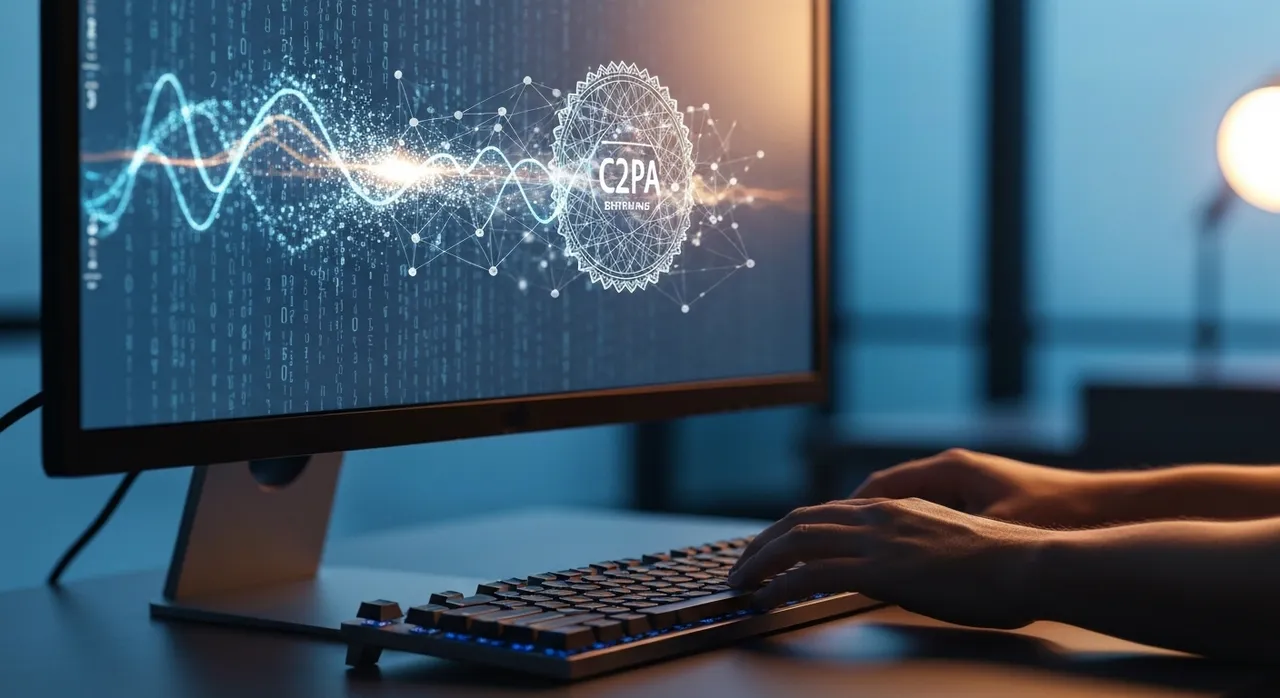
For non-textual artifacts generated by Claude—specifically structured vector diagrams (.svg) and visual image files (.png, .jpg)—Anthropic integrates the Coalition for Content Provenance and Authenticity (C2PA) open standard. This system embeds an immutable, digitally signed metadata manifest directly into the binary file container headers.
The C2PA manifest contains key cryptographic assertions, including:
- Model Origin Claims: Signatures identifying the specific Claude model variant, generation timestamp, and processing parameters.
- Cryptographic Hashes: SHA-256 hash digests of the asset payload to make post-generation pixel or vector tampering immediately detectable.
- X.509 Digital Certificates: Public-key infrastructure (PKI) certificates issued by a trusted Certificate Authority (CA), verifying that the asset was generated directly on Anthropic infrastructure.
Enterprise Implications and Non-Opt-Out Architecture
Anthropic’s decision to embed text watermarking directly into the core neural model weights and sampling engines carries major strategic implications for enterprise software engineering and corporate compliance:
- Zero Enterprise Exemption: Unlike optional logging features or opt-in safety filters, enterprise customers utilizing Claude via high-throughput API keys or cloud partner platforms (such as AWS Bedrock, Google Cloud, or Microsoft Foundry) cannot turn off text watermarks.
- Automated Code Provenance: For developers utilizing agentic tools like Claude Code, generated code snippets inherit the statistical watermark across variable naming conventions, structural choices, and inline comments. This allows enterprise Security and Intellectual Property (IP) teams to audit internal codebases for AI-generated contributions.
- Data Pipeline Transparency: Content creation workflows, corporate reporting, and automated translation pipelines leveraging Claude will automatically transmit downstream machine-readable markers, aiding organizations in meeting legal disclosure mandates under global regulatory regimes.
Vulnerabilities, Limitations, and the Attribution Dilemma
Despite the technical sophistication of neural statistical watermarking, Anthropic explicitly acknowledged several fundamental limitations inherent to text steganography and synthetic detection.
Degradation Under Transformation and Rewriting
Because invisible text watermarking depends on the precise sequential ordering of specific tokens, aggressive text manipulation can degrade or eliminate the detection signal:
- Copy-Paste Persistence: The statistical watermark effortlessly survives standard copy-paste operations, minor space alterations, character encoding shifts, and basic punctuation tweaks.
- Degradation via Paraphrasing: Extensive manual rewriting, heavy synonym replacement, structural restructuring, or passing the text through a secondary, non-watermarked language model disrupts the token sequence, causing the green-token ratio to decay below the statistical detection threshold.
- Translation Stripping: Translating watermarked text into another language completely resets the token sequence, stripping the watermark entirely unless the downstream translation engine applies its own marker.
The “Processing vs. Authorship” Ambiguity
A critical technical caveat highlighted by Anthropic is that positive watermark detection does not equate to absolute proof of autonomous synthetic authorship. Because the watermarking pass occurs during generation regardless of prompt context, the system marks any output produced by Claude—including human-authored prose submitted to the model for basic copy editing, grammatical correction, document reformatting, or summarization. Consequently, a positive mark confirms only that content was processed by Claude, not that it was originally authored by AI.
Future Roadmap: Verification Tools and Ecosystem Impact
To fulfill the verification requirements set forth by Article 50(2) of the EU AI Act, Anthropic has confirmed that public technical documentation, API detection endpoints, and third-party verification guidance are currently in development. These tools will enable platform trust-and-safety teams, academic institutions, media organizations, and regulatory bodies to programmatically verify content origin.
As competitors like Google (with SynthID) and Meta align their architectures with the EU AI Act Code of Practice, Anthropic’s global deployment of invisible model-level text watermarking marks a decisive shift in artificial intelligence governance. By integrating cryptographic provenance and token-level steganography into global production systems, the enterprise AI ecosystem takes a crucial step toward algorithmic accountability, balancing high-performance generative capabilities with verifiable digital authenticity.
Written by
TempMail Ninja
Digital privacy and online security expert. Passionate about creating tools that protect users' identity on the internet.