WhatsApp Username Privacy: The New Standard for Secure Communication
Article Content
For over a decade, the mobile phone number has been the “Original Sin” of digital identity on WhatsApp. To communicate, you had to reveal a ten-digit identifier that, in the modern era, is essentially a master key to your digital life—linked to bank accounts, two-factor authentication (2FA), and government registries. On April 17, 2026, that paradigm officially shifted. With the rollout of the WhatsApp username privacy system, the platform has finally decoupled communication from the SIM card, introducing a “stealth layer” that brings it into direct parity with privacy-first competitors like Signal and Telegram.
The update, which began its phased global rollout this week, represents more than just a cosmetic change to user profiles. It is a fundamental re-architecting of how nearly 3 billion people discover and interact with one another. By allowing the creation of unique pseudonyms, WhatsApp is attempting to solve the “stranger danger” problem of the digital age: how to participate in a global marketplace, join community groups, or engage in professional networking without surrendering the keys to your personal security.
The Technical Anatomy of the 2026 Username Rollout
The implementation of WhatsApp username privacy is governed by a strict set of technical parameters designed to prevent impersonation while maintaining the platform’s trademark simplicity. Unlike display names, which can be duplicated and changed at will, these usernames are unique, global identifiers held in a new directory layer of the Meta infrastructure.
According to technical documentation and early beta reports, the system follows these specific constraints:
- Character Length: Usernames must be between 3 and 35 characters. This range was selected to accommodate short, punchy handles while allowing for descriptive names for businesses or niche creators.
- Alphanumeric Rules: The character set is restricted to lowercase letters (a–z), numbers (0–9), periods (.), and underscores (_).
- Integrity Filters: Usernames cannot start with “www.” or end in domain extensions like “.com” or “.net.” This is a critical security measure to prevent phishing attacks where a user might be tricked into thinking they are chatting with a verified web portal.
- Validation Requirements: Every username must include at least one alphabetical character. This prevents the creation of usernames that are purely numeric, which could be confused with actual phone numbers.
Under the hood, when a user selects a username, it is mapped to their internal WhatsApp ID (WID). This allows the backend to route messages using the handle as a lookup key, effectively acting as a proxy. When you search for a user via their handle, the system performs a translation that avoids exposing the MSISDN (the mobile station international subscriber directory number) of the recipient.
The “Stealth Layer”: How Phone Number Masking Operates
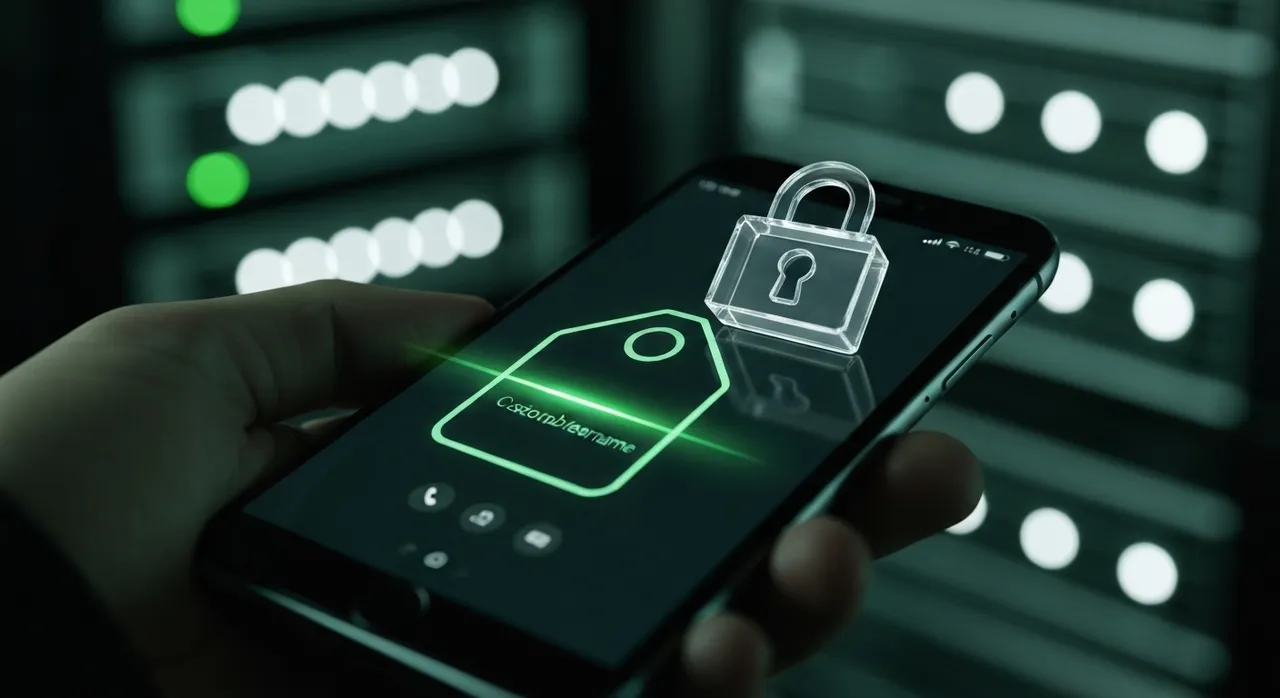
The core utility of the new system is “phone number masking.” In previous iterations of WhatsApp, your phone number was visible to everyone in a group chat and anyone you messaged. Under the new WhatsApp username privacy settings, users can toggle a “Hide Phone Number” visibility mode. When enabled, your profile will only display your unique handle to individuals who do not already have your number saved in their physical phone contacts.
This creates a tiered privacy model:
- Trusted Contacts: People who already have your number in their address book see no change. The experience remains intimate and number-based.
- New Acquaintances: When you start a chat with a stranger via their username, your number remains a secret. The chat header shows only the handle.
- Group Participants: In large communities or “Communities” (the WhatsApp feature for organized groups), your phone number is shielded from the general membership, preventing mass “scraping” of phone numbers by malicious actors.
The 4-Digit Username Key: A New Defense Against Spam
One of the most innovative technical additions in the 2026 update is the Username Key (or “PIN”). Privacy advocates have long complained that usernames, while great for privacy, can lead to increased spam. If anyone can find you by typing “@john_doe,” you are suddenly vulnerable to a different kind of unsolicited contact.
To mitigate this, WhatsApp has introduced an optional 4-digit security code linked to the username. If a user enables this feature, a stranger cannot simply find their handle and send a message. Instead, the sender must enter the correct 4-digit key to initiate the first conversation. This acts as a digital gatekeeper, ensuring that you can share your username on a public forum or business card without opening the floodgates to automated bots. Once the first message is accepted, the key is no longer required for that specific thread, maintaining the fluid nature of ongoing conversations.
The Meta Ecosystem Paradox: Syncing vs. Sovereignty
Because WhatsApp is part of the broader Meta family, the username system integrates with the Meta Account Center. This presents a unique choice for users: sync or compartmentalize?
The system allows users to sync their WhatsApp handle with their Instagram or Facebook identities. For businesses and influencers, this is a branding masterstroke—one handle across the entire social stack. However, from a WhatsApp username privacy perspective, experts suggest caution. Linking these identifiers allows Meta to bridge metadata between platforms with even greater precision. If you use “@tech_analyst_2026” on both Instagram and WhatsApp, the “cross-platform tracking” surface increases.
Security researchers recommend choosing a distinct username for WhatsApp if your goal is operational security (OpSec). By using a unique handle that has no digital footprint on other social media platforms, you maintain the “stealth layer” that the 2026 update was designed to provide. Meta has clarified that even if accounts are linked in the Account Center, the contents of WhatsApp messages remain protected by end-to-end encryption (E2EE), but the *existence* of the connection becomes a data point in the Meta advertising graph.
Signal vs. WhatsApp: A New Era of Privacy Parity
For years, Signal was the gold standard for username-based privacy. WhatsApp’s 2026 move is a direct response to the “Privacy Migration” that saw millions of users flee to Signal and Telegram during previous policy updates. While Signal pioneered the use of ephemeral usernames that can be deleted and recreated, WhatsApp’s implementation focuses on identity persistence.
While Signal’s usernames are designed to be temporary “throwaways” for specific tasks, WhatsApp usernames are intended to be a semi-permanent part of your digital identity. The WhatsApp username privacy system is built on top of the Signal Protocol (the encryption standard WhatsApp uses), but it adds a layer of “Discoverability” that Signal lacks. WhatsApp’s search function is more robust, allowing for easier business discovery—a necessity given Meta’s push toward “Business Messaging.”
BSUID: The Behind-the-Scenes Business Pivot
For businesses, the shift to usernames is not just a privacy feature; it is a structural mandate. Meta has introduced the Business-Scoped User ID (BSUID). When a customer messages a business via a username, the business does not receive the customer’s phone number. Instead, they receive a BSUID—a persistent identifier that is unique to *that* business.
This means if a user messages “Company A” and “Company B,” both companies see a different ID for the same user. This prevents businesses from sharing or selling customer lists to build “shadow profiles” based on phone numbers. It is a massive win for consumer privacy, but it requires businesses to completely overhaul their CRM (Customer Relationship Management) integrations by the June 2026 deadline set by Meta.
Security Foundations: Rust and Encryption in the Username Era
To support this massive shift in identity, WhatsApp has quietly upgraded its underlying codebase. Recent technical audits reveal that WhatsApp has expanded its use of the Rust programming language for its media-sharing libraries and identity-routing services. Rust’s memory-safety features provide a hardened defense against the type of “zero-day” exploits that historically targeted messaging apps to extract contact lists or metadata.
Furthermore, the WhatsApp username privacy system does not weaken the end-to-end encryption. The cryptographic handshake that occurs when two users start a chat now happens using the Identity Key associated with the username rather than the phone number. This ensures that even if a government agency or a hacker intercepts the directory search, they cannot see the content of the messages or the underlying phone number of the participants without physical access to the device.
Final Thoughts: Navigating the Post-Number Landscape
The arrival of usernames on WhatsApp marks the end of the “Phone Number Hegemony” in mobile messaging. In a world where our mobile digits have become overly exposed, the WhatsApp username privacy system provides a necessary retreat into anonymity. Whether you are a professional looking to keep your personal life separate, a seller on a digital marketplace, or an individual living under a regime where privacy is a matter of life and death, this “stealth layer” is the most significant update to the platform in a decade.
However, the responsibility now shifts to the user. To maximize the benefits of this new system, users should:
- Select a unique handle that does not reveal their real name or other social media identities.
- Enable the 4-digit Username Key to prevent becoming a target for automated spam.
- Regularly audit their “Privacy” settings to ensure that “Phone Number Visibility” is set to “My Contacts” or “Nobody.”
As we move deeper into 2026, the way we “WhatsApp” will feel less like a phone call and more like a global, encrypted social network. The phone number is still there—quietly verifying your account in the background—but for the first time, it no longer has to be your public face to the world.
Written by
TempMail Ninja
Digital privacy and online security expert. Passionate about creating tools that protect users' identity on the internet.