Wireless Android Auto: OpenAutoLink Project Updates for 2026
Article Content
The landscape of automotive infotainment is undergoing a quiet, yet profound, revolution. For years, drivers seeking the seamless integration of their smartphones into their vehicles have been forced to rely on either factory-installed limitations or opaque, proprietary third-party hardware dongles. These commercial solutions often function as “black boxes,” tethering user data and device behavior to closed-source ecosystems. However, the paradigm is shifting, and the OpenAutoLink project, which received a major update this April 2026, stands at the forefront of this movement toward reclaiming user agency over in-car digital environments.
As the automotive industry increasingly adopts Android Automotive OS (AAOS), many drivers—particularly those in newer electric vehicles—have found themselves frustrated by the removal of legacy support for projection systems like Android Auto. OpenAutoLink offers a robust, end-to-end open-source solution, effectively replacing restrictive proprietary hardware with a standard Single Board Computer (SBC). By leveraging fully open-source software, this project enables wireless Android Auto connectivity without the privacy concerns or feature limitations inherent in closed-source alternatives.
Understanding the Architecture: Bridging the Gap
At its core, OpenAutoLink is designed to bridge the gap between a user’s mobile device and the vehicle’s head unit, specifically targeting AAOS environments. Traditional dongles often rely on reverse-engineered, undocumented protocols that are inherently fragile and limited by the hardware’s capabilities. In contrast, OpenAutoLink utilizes a custom, fully documented protocol that allows both the bridge software (running on an SBC like a Raspberry Pi 5 or an Orange Pi) and the client app (installed on the vehicle head unit) to evolve independently.
The technical workflow is remarkably efficient:
- Handshake & Connection: The user’s smartphone establishes a secure link to the SBC via Bluetooth and high-speed 5GHz Wi-Fi.
- Data Relay: The SBC manages the Android Auto projection session, processing video, audio, and control inputs.
- Transmission: The processed data is transmitted over Ethernet to a specialized app running on the car’s Android Automotive display via a USB-C connection.
- VHAL Integration: Critically, the system interacts with the vehicle’s Vehicle Hardware Abstraction Layer (VHAL), allowing the projection system to access real-time telemetry such as vehicle speed, gear position, battery levels, and ambient temperature.
Technical Depth: Recent Advancements
The April 2026 update to OpenAutoLink represents a significant leap in maturity for the project. By focusing on deep integration and user-centric features, the developers have moved well beyond simple proof-of-concept status.
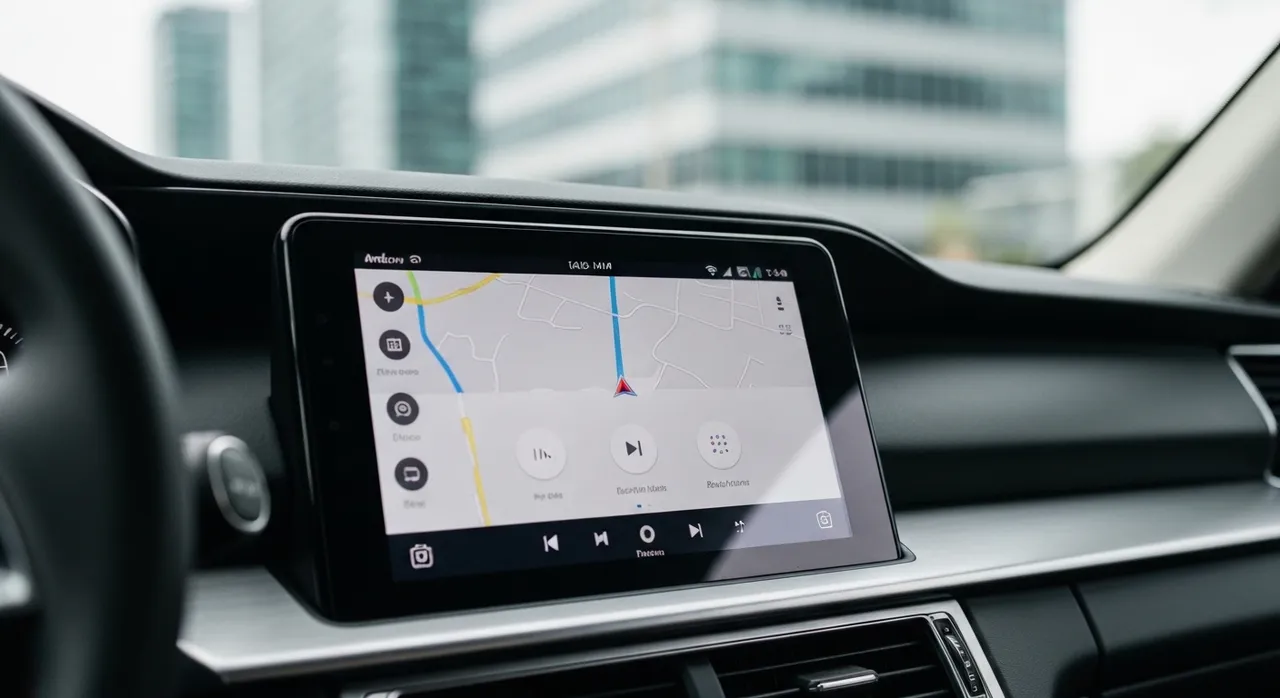
Cluster Navigation stands out as a flagship improvement. Previously, projection systems were largely confined to the primary infotainment screen. With this update, OpenAutoLink can forward navigation metadata directly to the vehicle’s instrument cluster, providing turn-by-turn directions within the driver’s immediate line of sight. This level of integration—previously reserved for factory-integrated mapping systems—is a game-changer for usability.
Furthermore, the introduction of Bridge OTA (Over-the-Air) Updates addresses one of the most common friction points in DIY automotive tech. Users no longer need to manually flash firmware or pull the SBC from their vehicle to apply patches. When a new version is released on GitHub, the in-car app detects the update upon connection and seamlessly applies the bridge binary, complete with automated rollback functionality should any instability occur. This level of software lifecycle management is rarely seen in enthusiast projects, signaling a level of engineering rigor rarely matched by generic commercial dongles.
Reclaiming Control in a Connected World
The necessity of projects like OpenAutoLink stems from a broader issue in modern automotive design: the enclosure of the dashboard. When manufacturers force users into a single, proprietary software path, they strip away the ability to choose how information is presented or how a personal device interacts with the car. Proprietary dongles, while useful, often act as intermediaries that collect telemetry data or impose artificial limits on resolutions and codecs.
By moving to a wireless Android Auto solution that is 100% open-source, the OpenAutoLink project provides several distinct advantages:
- Hardware Independence: Users are not tied to the lifespan or compatibility of a single company’s proprietary chipsets. If the SBC becomes obsolete, it can be replaced without changing the car-side app.
- Privacy by Design: Because the protocol is transparent and the code is open, users can audit the data transmission. There is no hidden tracking or data exfiltration common in “cloud-connected” commercial adapters.
- Performance Optimization: OpenAutoLink supports modern video codecs (H.264/H.265/VP9) and offers auto-negotiation. The system probes the hardware capabilities of both the phone and the car, selecting the optimal resolution and codec tier to ensure a smooth, low-latency experience up to 1080p60, with experimental support for higher resolutions.
- Customization: Users can configure “display safe zones” or insets. This is particularly vital for modern vehicle displays that feature curved or tapered edges, ensuring that the Android Auto interface renders cleanly and avoids being cut off by non-rectangular bezels.
Implementation: The DIY Path for Enthusiasts
While OpenAutoLink is a highly sophisticated piece of engineering, the developers have focused on accessibility for the end user. The “one-command” installation process—triggered by a simple `curl` command—automates the complex setup of the SBC environment, drastically lowering the barrier to entry for users who want to avoid proprietary hardware.
To implement this system, a user typically requires:
- SBC Hardware: An ARM64-based board with onboard Ethernet and 5GHz Wi-Fi (Raspberry Pi 5 is the recommended starting point).
- Connectivity: A USB-C Ethernet adapter to facilitate the high-speed data stream to the car’s head unit.
- Software Deployment: A $25 Google Play Console account fee (often necessary for sideloading the custom app into certain locked-down automotive head units) and the open-source software provided via the project’s GitHub repository.
The total cost, often falling between $90 and $150, is competitive with premium commercial dongles, yet offers vastly superior performance and transparency.
The Future of Open Automotive Interfaces
The success and growth of OpenAutoLink reflect a growing trend in the automotive enthusiast community. As vehicles become more like mobile computing platforms, the demand for “open” standards that allow for personalization and hardware interoperability will only increase. By creating a modular bridge, the project is essentially future-proofing the user’s connection to their car. Even as new versions of Android or new vehicle head unit software are released, the modularity of the OpenAutoLink architecture allows for quick adaptations to keep the connection alive.
Furthermore, the project’s success highlights the limitations of the current proprietary approach to infotainment. When a project developed by a small group of open-source contributors can outperform commercial solutions in terms of feature set, integration depth, and reliability, it serves as a wake-up call to manufacturers. Connectivity should be a standard, extensible feature, not a locked-down system that requires workarounds to be functional.
Looking ahead, the development team has expressed interest in exploring similar functionality for other projection protocols. While the primary focus remains on perfecting the wireless Android Auto experience—ensuring that every frame is rendered smoothly and every steering wheel command is mapped with millisecond precision—the underlying protocol has been designed with flexibility in mind. If the project can maintain its current trajectory, it could eventually serve as the blueprint for an entirely new standard in how smartphones and vehicles communicate, proving once and for all that open-source software can effectively navigate the complex, safety-critical environment of the modern automobile.
In conclusion, the OpenAutoLink update represents more than just a list of new features. It is a fundamental declaration that our in-car digital experience should be ours to own and modify. By providing a stable, high-performance alternative to proprietary hardware, the project empowers drivers to take back control, ensuring that their vehicle’s technology serves them, not the other way around.
Written by
TempMail Ninja
Digital privacy and online security expert. Passionate about creating tools that protect users' identity on the internet.