AI Infrastructure Investment Surges Amidst Growing Energy Concerns
Article Content
The relentless march of artificial intelligence is reshaping industries, economies, and indeed, the very fabric of our digital world. This transformative power is underpinned by an unprecedented surge in AI infrastructure investment, driving innovation at a breakneck pace. Yet, this technological marvel casts a growing shadow: a rapidly escalating energy footprint that threatens to overwhelm existing grids and exacerbate environmental concerns. Navigating this dual reality—the boundless promise of AI against the urgent need for sustainability—is arguably the defining challenge of the current technological era.
The Trillion-Dollar Tsunami: Unpacking AI Infrastructure Investment
The scale of capital flowing into AI infrastructure is nothing short of staggering. Morgan Stanley estimates that nearly $3 trillion will be invested in AI-related infrastructure by 2028, with a substantial portion of this growth still on the horizon. This massive deployment of resources is a powerful engine for economic expansion, contributing significantly to GDP growth by enhancing efficiency, enabling new product development, and fostering innovation across sectors.
Leading the charge are the hyperscale cloud providers— Meta, Microsoft, Alphabet (Google), Amazon, and Apple—who are projected to commit colossal sums. While estimates vary slightly, the consensus points to a dramatic acceleration in spending. Jamie Dimon, CEO of JPMorgan Chase, projects that the top five hyperscalers alone will escalate their annual AI-driven capital spending from $450 billion in 2025 to an astounding $725 billion in 2026, marking a more than 60% increase. Other analyses from Goldman Sachs suggest 2026 capital expenditure by AI hyperscalers could reach $527 billion, with potential for further upside to $700 billion, driven by robust balance sheets and a willingness to invest. The Futurum Group also noted that five major US cloud and AI infrastructure providers plan to spend between $660 billion and $690 billion on capital expenditure in 2026. These investments primarily target the construction and upgrade of data centers, alongside the acquisition of cutting-edge chips, servers, and fiber connectivity—the foundational elements of the AI economy.
The economic impact extends beyond direct investment. Macroeconomic modeling by the International Monetary Fund suggests that AI-driven productivity gains could boost global GDP by approximately 1.3% to 4% over the next decade. This growth is not merely concentrated in a single industry but diffuses across various sectors, underscoring the role of robust digital infrastructure in unlocking AI’s full potential.
The Engine Room: Innovations in AI Hardware and Systems
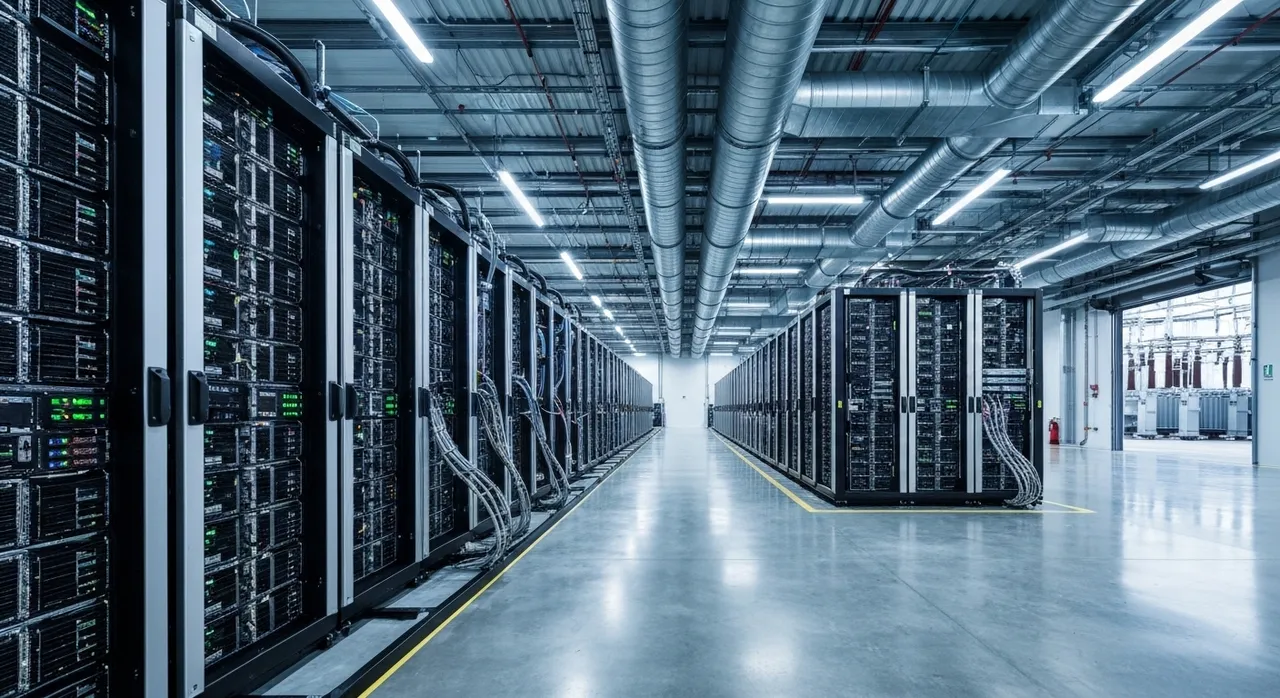
At the heart of this AI revolution are advanced data centers, serving as the digital factories that process, train, and deploy AI models. These facilities demand an ever-evolving ecosystem of hardware and software innovations to meet the insatiable computational appetite of modern AI.
Intel and Google’s Strategic Alliance for Next-Gen AI Infrastructure
In a significant development on April 9, 2026, Intel and Google announced a multiyear collaboration aimed at advancing the next generation of AI and cloud infrastructure. This partnership reinforces the crucial role of diverse processing units in scaling modern, heterogeneous AI systems.
Google will continue to deploy Intel® Xeon® processors across its global infrastructure for a variety of workloads, including large-scale AI training coordination, latency-sensitive inference, and general-purpose computing. Xeon CPUs remain central to orchestrating data processing and delivering system-level performance in complex AI environments.
Crucially, the collaboration also involves an expanded co-development of custom ASIC-based Infrastructure Processing Units (IPUs). These specialized co-processors are designed to significantly improve efficiency, utilization, and performance at scale within heterogeneous AI systems.
Technical Deep Dive: IPUs and ASICs
Understanding the technical nuances of IPUs and ASICs is key to appreciating their role in optimizing AI infrastructure.
-
Infrastructure Processing Units (IPUs): These are specialized programmable devices designed by Intel to offload infrastructure tasks from the main Central Processing Units (CPUs). In hyperscale data centers, CPUs traditionally manage not only application logic but also vital infrastructure services like networking, storage virtualization, and security. This can create bottlenecks and reduce the effective compute capacity available for AI workloads. IPUs take over these infrastructure duties, accelerating functions such as:
- Packet processing and traffic routing.
- Storage virtualization.
- Security functions and tenant isolation.
- Load balancing and data encryption.
By freeing up CPU cycles, IPUs enable greater effective compute capacity, allowing cloud providers to run more AI workloads with fewer CPUs, thus enhancing overall system efficiency and delivering more predictable performance. IPUs typically combine FPGAs, ASICs, and other accelerators with processor cores to achieve hardware-speed processing of infrastructure chores.
-
Application-Specific Integrated Circuits (ASICs): Unlike general-purpose CPUs or GPUs, ASICs are custom chips meticulously optimized for a specific task or application. For AI, ASICs are tailor-made to accelerate particular operations commonly found in machine learning, such as matrix multiplications and tensor operations. This specialization offers several compelling advantages:
- Superior Performance: Custom-tuned circuitry executes AI operations significantly faster, leading to higher throughput and lower latency.
- Exceptional Power Efficiency: By eliminating unnecessary components and optimizing for precise workloads, ASICs consume less energy, resulting in a much better performance-per-watt ratio compared to general-purpose processors. This also leads to less heat generation and reduced cooling requirements.
- Space Savings: Integrating multiple functions into a single, compact chip reduces the overall device footprint.
- Cost-Effectiveness at Scale: While initial design costs are high, ASICs become economically advantageous for high-volume manufacturing and large-scale deployments due to lower per-unit costs and long-term operational savings.
- Enhanced Security: Their customized design makes reverse engineering more challenging, protecting intellectual property.
In essence, the move towards heterogeneous AI systems, combining robust CPUs with purpose-built ASICs and IPUs, represents a strategic shift towards maximizing both computational power and operational efficiency in the age of AI.
The Growing Shadow: AI’s Staggering Energy Footprint
While the AI infrastructure investment boom fuels unprecedented innovation, it simultaneously ignites a critical environmental and logistical challenge: immense energy consumption. AI operations, particularly within massive data centers, are already consuming staggering amounts of electricity.
According to the International Energy Agency (IEA), AI systems and data centers globally consumed approximately 415 terawatt hours (TWh) of power in 2024, representing about 1.5% of global electricity consumption. In the United States, this figure is even more pronounced, with AI and data centers already accounting for over 10% of total U.S. electricity usage in 2024-2025.
The demand is only accelerating. Projections indicate that global data center electricity consumption is set to double by 2030, reaching around 980 TWh. The U.S. data center electricity usage alone is projected to rise significantly, potentially accounting for between 6.7% and 12% of total U.S. electricity consumption by 2028. Bluefield Research estimates this could reach 8.9% by 2030. A considerable portion of this increase is driven by AI-optimized servers, which Gartner forecasts will account for 44% of data center power consumption by 2030, up from 21% in 2025.
The widespread adoption of large language models (LLMs) and generative AI tools further intensifies this demand. Each interaction with a generative AI model, such as a text prompt, consumes energy—around 0.34 watt-hours per prompt. While seemingly small individually, the cumulative impact is enormous. ChatGPT, for instance, with its estimated 1 billion queries per day, has an estimated annual energy usage of 391,509 MWh, exceeding the electricity consumption of 35,000 U.S. residential households. Moreover, inference (the “use phase” of the model) can quickly surpass the energy consumption of training, with Google reporting inference accounting for nearly 60% of their AI workloads’ total energy use, and Meta seeing it take up to 70% of power in their AI infrastructure.
This rapid growth in demand is already straining existing electrical grids in many regions, outpacing available capacity and leading to project delays. Beyond electricity, the water footprint of data centers, both for cooling and for the power generation that fuels them, is also a growing concern. Without proactive measures, the energy demands of AI threaten to become a significant impediment to sustainable technological progress.
Towards a Sustainable AI Future: Breakthroughs and Best Practices
The urgency of AI’s energy challenge has catalyzed significant research and development into more sustainable approaches. These efforts span hardware, software, and data center operations, aiming to decouple AI’s exponential growth from an equally exponential increase in energy consumption.
Tufts University’s Neuro-Symbolic AI: A Paradigm Shift in Efficiency
A groundbreaking development from Tufts University offers a compelling vision for radically more efficient AI. Researchers have unveiled a neuro-symbolic AI approach that could reduce AI energy use by up to 100 times while simultaneously improving accuracy. This innovative method combines:
- Neural Networks: Excelling at pattern recognition and learning from vast datasets.
- Human-like Symbolic Reasoning: Introducing higher-level cognitive processes that allow the AI to break down problems into steps, apply logical rules, and categorize concepts, similar to how humans think.
The benefits of this hybrid approach are profound. In tests, the neuro-symbolic system achieved a remarkable 95% success rate on complex tasks like the Tower of Hanoi puzzle, compared to just 34% for standard systems. When faced with a more complex, unseen version of the puzzle, the hybrid system still managed a 78% success rate, while traditional models failed entirely. Furthermore, the energy savings are staggering:
- Training time was slashed from over 36 hours for conventional models to a mere 34 minutes for the neuro-symbolic system, consuming only 1% of the energy.
- During execution, the neuro-symbolic model used just 5% of the energy required by standard Visual-Language-Action (VLA) models.
This research not only points towards massive energy reductions but also addresses issues like “hallucinations” often associated with purely data-driven LLMs, offering a more dependable and low-energy foundation for future AI systems.
Broader Strategies for Sustainable AI
Beyond such fundamental breakthroughs, the industry is exploring a multi-faceted approach to sustainable AI:
-
Hardware and Software Optimization:
- Efficient Architectures: Continuous development of more energy-efficient chip designs, including the custom ASICs and IPUs discussed earlier, is critical.
- Advanced Cooling: Innovations like chip-level liquid cooling, adopted by companies such as Microsoft and Amazon, significantly reduce mechanical energy consumption during peak cooling periods without increasing water usage.
- Smarter Models: Research shows that using smaller, tailored LLMs for specific tasks can reduce energy consumption by up to 90% compared to large, general-purpose models. Optimizing inference processes, which account for a significant portion of energy use, is also a key area of focus.
-
Sustainable Data Center Design and Operations:
- Renewable Energy Integration: Data centers are increasingly integrating renewable energy sources such as solar photovoltaic systems, wind turbines, fuel cells, and microgrids to offset their carbon footprint. Hyperscalers are among the largest corporate purchasers of renewable energy.
- Demand Response: Strategies like Alphabet’s demand response method allow data centers to reduce power demand during periods of grid stress by shifting non-urgent computing tasks to alternative times or locations, minimizing the need for new power infrastructure investment.
- Efficient Operations: Real-time energy and water monitoring, predictive maintenance, and AI-driven optimization help dynamically adjust energy consumption and cooling based on real-time demand.
- Circular Economy Practices: Embracing practices like heat reuse (where waste heat from data centers is used for heating nearby buildings) and comprehensive hardware recycling programs are vital for minimizing environmental impact and promoting resource efficiency.
- Modular Construction: Building data centers in controlled environments can reduce waste, shorten timelines, and allow for better tracking and prioritization of eco-friendly materials.
- Transparency and Standards: Calls for greater transparency from AI companies regarding the energy usage and carbon emissions of their models, along with the development of standardized protocols for reporting, will empower users and drive more informed, sustainable choices.
The Imperative for Balanced Growth
The ongoing explosion of AI infrastructure investment stands as a testament to humanity’s drive for innovation and progress. The economic benefits are clear, and the transformative potential of AI is undeniable. However, the accompanying surge in energy consumption presents a critical juncture. The path forward demands a delicate balance: continuing to push the boundaries of AI while simultaneously embedding sustainability into every layer of its development and deployment.
From groundbreaking neuro-symbolic architectures to intelligent data center operations and collaborative industry efforts, the collective endeavor must be to ensure that the intelligence we create does not come at an unsustainable cost to our planet. The future of AI must be both intelligent and ecological, delivering profound benefits without compromising the health of our global environment.
Written by
TempMail Ninja
Digital privacy and online security expert. Passionate about creating tools that protect users' identity on the internet.