Algorithmic Archaeology: AI Agents Solve Lost Roman Game Mystery
Article Content
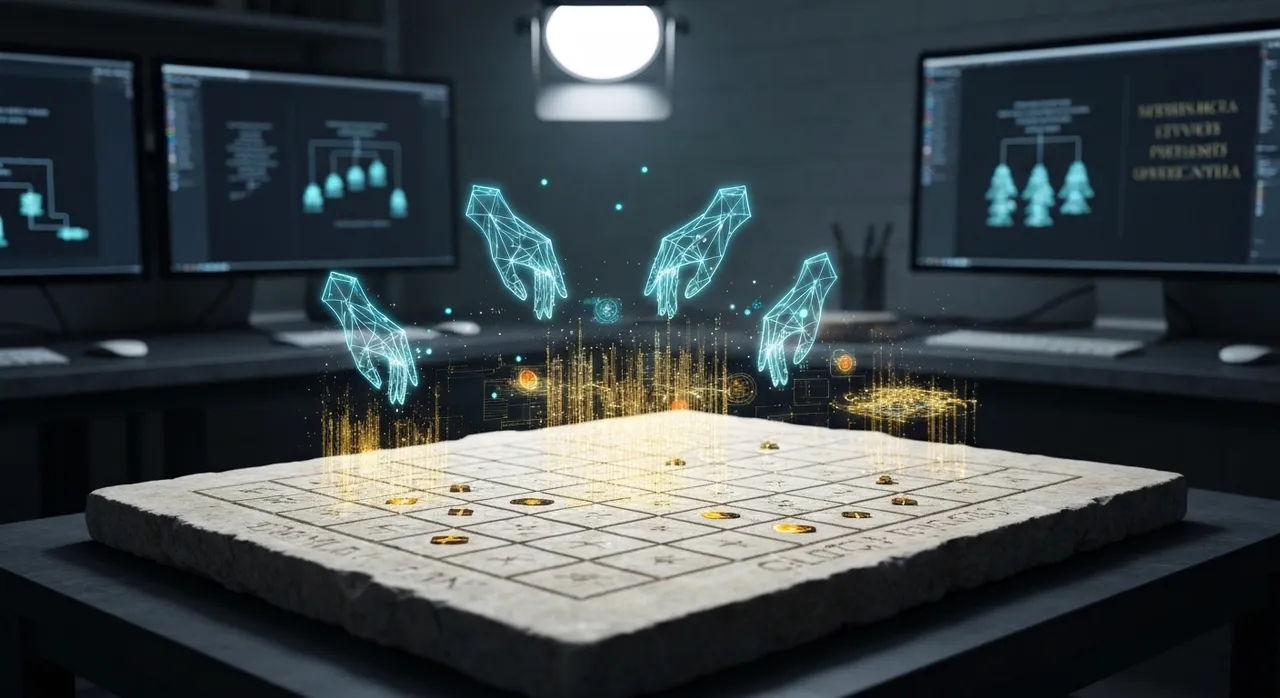
In the quiet galleries of the Het Romeins Museum in Heerlen, the Netherlands, an unassuming slab of limestone had spent decades essentially “glitched” out of the historical record. Unearthed from the site of Coriovallum, a bustling Roman hub known for its sophisticated baths and strategic location at the crossroads of the Via Belgica, the stone was etched with a series of intersecting diagonal and straight lines. For over a century, scholars debated its purpose: was it an architectural sketch, a decorative tile, or a primitive tally sheet? The mystery remained frozen in stone until the May/June 2026 issue of Archaeology Magazine revealed a breakthrough that has since become a landmark in the burgeoning field of Algorithmic Archaeology.
By deploying autonomous AI agents to “play” the past, an international team of researchers has successfully reverse-engineered the rules of a lost Roman pastime. This process, which contemporary tech circles are calling the “debugging” of ancient history, has not only resurrected a 1,700-year-old game but has also fundamentally shifted our understanding of European ludology. The discovery proves that “blocking games”—a genre previously thought to have arrived in Europe during the Middle Ages—were actually being enjoyed by Roman citizens centuries earlier.
The Dawn of Algorithmic Archaeology
To understand how a computer can “read” the rules of a game from a scarred rock, one must first understand the framework of Algorithmic Archaeology. This discipline represents the fusion of traditional material analysis with advanced computational simulations. At its heart is the Digital Ludeme Project (DLP), a massive five-year initiative led by Cameron Browne at Maastricht University. The project treats games not as static objects, but as evolving systems composed of “ludemes”—the fundamental units of game-related information, akin to genes in a biological organism.
When the Coriovallum artifact was presented to the DLP team, they didn’t just look at the lines; they treated the stone as a hardware interface for which the software (the rules) had been lost. The challenge was to find the “source code” that would have generated the specific wear patterns observed on the artifact’s surface. This is where the AI agents entered the fray.
The Ludii System and Game Description Language
The researchers utilized Ludii, a general game system that uses a specialized “Game Description Language” to model nearly any strategy game ever devised. To solve the Coriovallum mystery, the AI was programmed with a library of over 100 known ancient game mechanics from Northern Europe and the Mediterranean. These included:
- Haretavl: A Scandinavian “hare game” involving asymmetric pieces.
- Gioco dell’orso: An Italian “bear game” where hunters try to trap a central piece.
- Ludus Latrunculorum: The classic Roman “game of mercenaries.”
The software didn’t just guess; it utilized Monte Carlo Tree Search (MCTS)—a simplified relative of the technology behind DeepMind’s AlphaGo—to simulate millions of matches. Two AI agents played against each other repeatedly, testing 130 different rule combinations to see which set of moves resulted in a game that was not only functional and balanced but also consistent with the physical reality of the stone.
Tribology: The Physical Hash of Ancient Play
The most innovative aspect of this study was the use of use-wear analysis, or tribology, to verify the AI’s theories. Using high-resolution 3D imaging provided by the restoration studio Restaura, archaeologists mapped the microscopic depth and friction markers on the limestone. They found that certain diagonal lines were significantly smoother than others, suggesting a high frequency of “sliding” movements along specific vectors.
Algorithmic Archaeology effectively turned these wear patterns into a “physical hash.” The AI agents ran simulations for each rule set, tracking the frequency of movement across every line on the digital board. When a rule set involving a “blocking” mechanic was applied, the resulting digital heat map of movement matched the physical erosion on the limestone with startling accuracy. This was the “Eureka” moment: the AI had found the only set of rules that could have produced that specific pattern of damage over years of human play.
Decoding the Rules of Ludus Coriovalli
The researchers have officially dubbed the game Ludus Coriovalli (The Coriovallum Game). It is a “blocking game” where the objective is not to capture the opponent’s pieces—as in Chess or Checkers—but to restrict their movement until they have no legal moves left. The AI’s reconstruction suggests several key features of the game:
- Two-Player Strategy: The board size (approx. 20 cm) and piece configurations suggest a 1v1 duel.
- Asymmetric Starting Positions: One player likely controlled “blocking” units while the other attempted to navigate through a corridor.
- No Luck Element: Like modern Tic-Tac-Toe or the medieval game Mu Torere, the game relies entirely on mental acumen rather than dice.
The discovery that a blocking game existed in the Roman era is a major disruption to the history of games. Previously, it was believed that these types of abstract strategy games didn’t gain a foothold in Europe until the 10th or 11th centuries. Ludus Coriovalli suggests a much deeper, more continuous lineage of European strategy gaming than historians ever dared to hypothesize.
Debugging the Human Experience
For the digital culture community, the Coriovallum breakthrough is more than just a win for history; it’s a validation of the idea that technology can bridge the gap between human eras. By using AI to “debug” the mysteries of ancient entertainment, we are acknowledging that human play follows logical structures that remain consistent across millennia. The Roman soldier sitting in the Coriovallum baths 1,700 years ago was engaging in the same cognitive “loops” that a modern gamer might experience when playing a high-level strategy title on a smartphone.
Dr. Walter Crist, the lead archaeologist from Leiden University, noted that this approach allows us to see ancient people not as abstract historical figures, but as “ancient nerds”—individuals who valued strategic depth, dramatic tension, and the thrill of a well-played game. The AI agents found that the rules for Ludus Coriovalli were “deceptively simple but thrilling,” optimized for a low frequency of draws and a high level of strategic engagement.
Future Horizons of the Digital Past
The success of the Coriovallum project has opened the floodgates for similar investigations. Algorithmic Archaeology is now being applied to “graffiti” found on the steps of the Parthenon and scratched into the floors of Egyptian temples—marks that were previously dismissed as vandalism but are now suspected to be complex, lost game boards.
The implications of this technology extend beyond ludology. If AI can reconstruct the rules of a game from a pattern of wear, could it also reconstruct the workflow of a Roman pottery workshop? Could it “debug” the social hierarchies of a prehistoric village by simulating the movement patterns within a reconstructed longhouse? We are entering an era where the data-driven precision of the future is the only tool sharp enough to carve through the fog of the deep past.
As of May 2026, Ludus Coriovalli is no longer just a museum curiosity. It has been integrated into the Ludii software portal, allowing modern players to compete against the very AI that rediscovered the game. In doing so, the digital and the ancient have finally merged, proving that while the stones of Coriovallum may crumble, the rules of the game are eternal.
Key Takeaways from the Coriovallum Discovery:
- Technology: Reconstructed via the Ludii system using Monte Carlo Tree Search.
- Verification: 3D micro-topography used to match digital “heat maps” with physical stone wear.
- Historical Impact: Proves “blocking games” existed in Europe 1,500 years earlier than previously recorded.
- Context: Found in the Roman bath-house town of Coriovallum (modern-day Heerlen).
By treating archaeology as an algorithmic puzzle, researchers have given a voice back to the silent stones of the Roman Empire. The “blocking game” of Coriovallum is a testament to the enduring human spirit of competition—and a reminder that sometimes, the best way to understand our ancestors is to sit down and play a game with them.
Written by
TempMail Ninja
Digital privacy and online security expert. Passionate about creating tools that protect users' identity on the internet.