PokéPark Fishing Contest DS Lost Media Resurfaces on eBay
Article Content
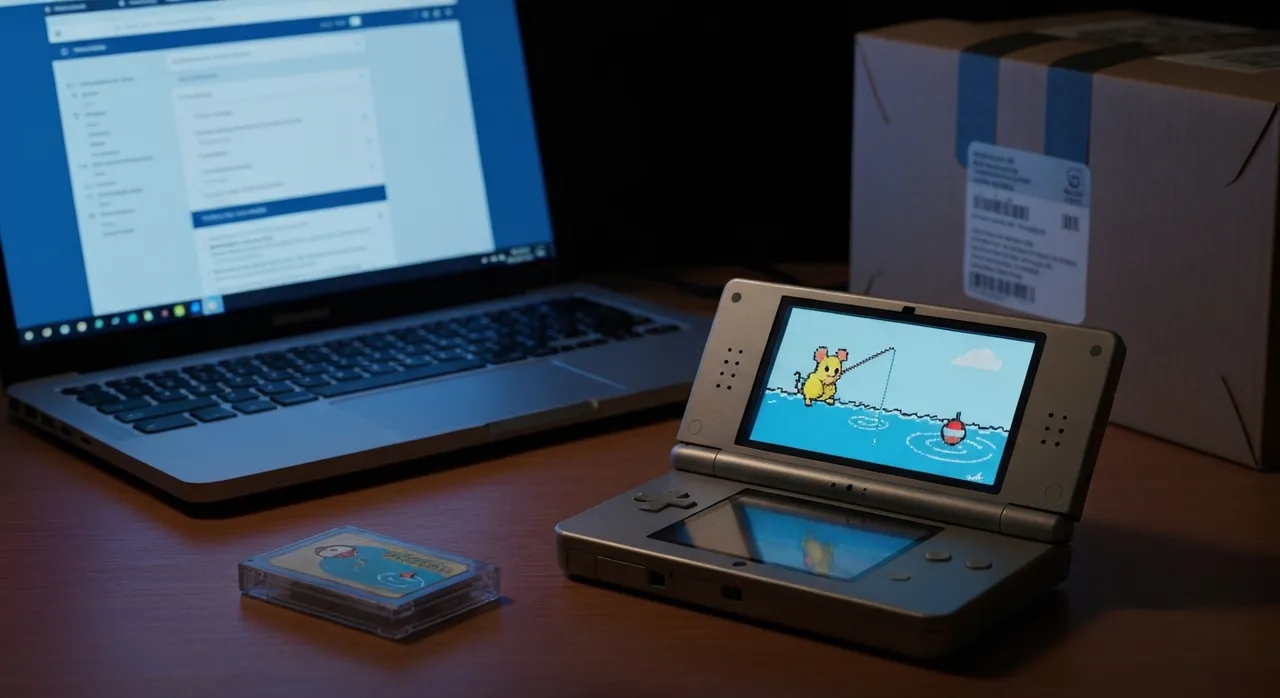
In the vast canon of video game preservation, few titles hold the mythical status of PokéPark Fishing Contest DS. Released in the spring of 2005 as an ephemeral, venue-exclusive experience across Japan, the game stood for decades as a legendary piece of lost media—an interactive snippet of Pokémon history that technically ceased to exist the moment a player powered down their handheld console. Because Nintendo never produced a commercial retail release, archivists long assumed the original binaries were lost forever to the ether of volatile memory. However, on July 29–30, 2026, the preservation community was thrown into high alert when an ultra-rare, official Nintendo DS development cartridge connected to PokéPark Fishing Contest DS surfaced on eBay with an asking price of €7,999 (approximately $9,100 USD). Spurred by prominent collector and preserver Professor Rex, digital archaeologists rapidly organized a community effort to verify the listing, mobilize group-buy funding, and dump its precious ROM data before it vanished into a private collection.
The Genesis of PokéPark Fishing Contest DS and Its Limited Venue Era
To understand why this discovery sent shockwaves through the emulation and archival communities, one must examine the unique operational history of PokéPark Fishing Contest DS (also referred to in Japanese documentation as PokéPark Tsuri Taikai DS or PokéPark Fishing Rally DS). The minigame was conceived as a location-based interactive attraction for PokéPark 2005, a short-lived Pokémon-themed amusement park operating in Sasashima, Nagoya, Japan, between May 16 and September 25, 2005. It was later made available during brief promotional windows at Pokémon Festa 2005, select physical Pokémon Center retail locations, and a subsequent PokéPark event in Taiwan in 2006.
Unlike conventional handheld spin-offs, Nintendo never manufactured retail cartridges or offered the title on digital storefronts. Instead, attendees carrying an original Nintendo DS (model NTR-001) could connect wirelessly to local distribution kiosks. These host stations transmitted the minigame directly to surrounding systems using short-range wireless signals.
The gameplay was designed to showcase the novel dual-screen and touch interface capabilities of the Nintendo DS, which had launched late the previous year:
- Dual-Screen Display: The top screen rendered real-time shadows of aquatic Pokémon swimming beneath the water, while the bottom touch screen housed the fishing rod, cast controls, and reel mechanics.
- Species and Environmental Variety: Players navigated changing river and ocean zones over timed sessions, angling for species such as Magikarp, Goldeen, Corphish, Barboach, and rare targets like Gyarados or Dratini.
- Scoring Formula: Each caught Pokémon awarded points determined by its weight, length, level, and species rarity rating.
- Wireless Leaderboards: High scores were wirelessly submitted back to venue servers, updating master ranking leaderboards displayed on kiosk screens throughout participating Pokémon Centers.
Technical Architecture: DS Download Play and Ephemeral Volatile RAM
The core technical mechanism that elevated the software to lost media status lies within the architecture of Nintendo DS Download Play. Designed for single-card multiplayer and localized demo distribution, DS Download Play operated over a modified 802.11 wireless protocol on a proprietary 2.4 GHz spectrum. When a client console initiated a Download Play request, the host unit streamed an unencrypted binary directly into the client handheld’s system RAM.
The original Nintendo DS hardware contained 4 Megabytes of Main Static RAM (PSRAM), alongside ARM7 and ARM9 tightly-coupled instruction memory modules. Because Download Play executables resided entirely within volatile memory without writing data to physical flash storage, the software had strict hardware constraints:
- Volatile Memory Retention: The binary existed exclusively in active RAM. Turning off the power switch instantly cut current to the RAM chips, permanently clearing the game code from memory.
- 12-Hour System Expiration: Nintendo embedded a firm expiration timer inside the Download Play client code. Even if a user kept the handheld powered continuously via AC adapter, the software automatically self-terminated after 12 hours.
- Absence of Non-Volatile Storage: Operating without a cartridge in Slot-1 meant there was no onboard EEPROM, FRAM, or Flash memory available to store save data or preserve the executable.
Consequently, when the distribution period ended in late 2005, every distributed client copy vanished. For two decades, public evidence of the game’s actual execution was limited to low-resolution camcorder footage, promotional brochures, and archival screenshots preserved by early Japanese fansites.
Inside the €7,999 eBay Discovery: Deconstructing the Developer Hardware
The landscape changed on July 29, 2026, when German eBay seller catbearpaws listed a physical item titled “Nintendo DS Development/Test Cartridge” priced at €7,999 (~$9,100 USD). Rather than a standard retail cartridge, the item photographed was an official, oversized Nintendo DS developer/test cart featuring an elongated upper plastic shell housing specialized debug microcode components.
Development cartridges of this nature were produced in limited quantities by Nintendo’s engineering divisions and issued exclusively to internal development units or certified partner studios. Under standard corporate policies, such hardware was covered by strict non-disclosure agreements and typically required to be returned or destroyed after a project concluded.
Listing photographs confirmed the physical cartridge booting successfully on an original Nintendo DS console. The system initialized to a Japanese interface labeled “Poke Park Let’s Play DS” (ポケパーク あそびにいくDS)
Written by
TempMail Ninja
Digital privacy and online security expert. Passionate about creating tools that protect users' identity on the internet.