Medieval Jewellery Workshop Discovered in Glasgow
Article Content
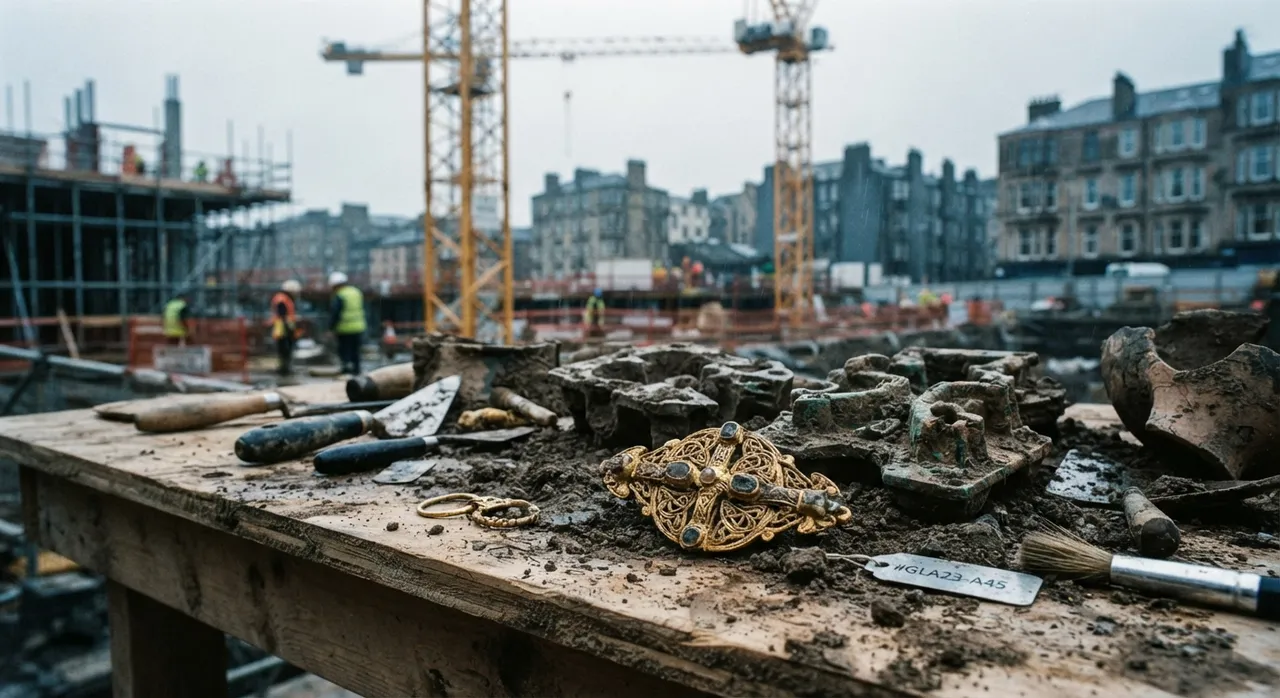
In the shadow of Glasgow’s historic shipbuilding yards, beneath the turf of an ancient teardrop-shaped kirkyard, archaeologists have uncovered an extraordinary glimpse into early post-Roman craftsmanship: an early medieval jewellery workshop dating back roughly 1,500 years. Unearthed in the churchyard of Govan Old on the southern bank of the River Clyde, the discovery provides empirical proof that this enigmatic ecclesiastical center was not merely a consumer of luxury goods brought along North Channel maritime routes, but an active, technologically sophisticated manufacturing site. The finding fundamentally rewrites our understanding of Scotland’s early historic period, demonstrating that industrial craft specialization, elite fashion economies, and deliberate material mimicry flourished along the Clyde as early as 500 AD.
The centerpiece of the discovery—an unfinished finger ring carved from local carboniferous shale, technically known as a roughout—offers an intimate snapshot of a craftsperson at work. Abandoned mid-process before receiving its final abrasive polish, the ring reveals the sequence of reductive lithic manufacturing techniques practiced in early medieval Scotland. At the same time, it illustrates a timeless social impulse: the strategic use of crafted materials to signal rank, pedigree, and cultural identity. For observers of modern cultural infrastructure, this ancient workshop demonstrates that our contemporary obsession with identity curation—manifested today through digital avatars, cryptographic signifiers, and disposable online identities—shares deep anthropological roots with the physical tokens carved along the Clyde fifteen centuries ago.
Unearthing the Medieval Jewellery Workshop at Govan Old
The excavation, spearheaded by the Govan Heritage Trust alongside Clyde Archaeology and a dedicated cohort of community volunteers under the leadership of Professor Stephen Driscoll, focused on an exploratory trench within the ancient enclosure of Govan Old Parish Church. While Govan is internationally renowned for the Govan Stones—a remarkable collection of tenth- and eleventh-century hogback monuments, cross-slabs, and a royal sarcophagus—its fifth- and sixth-century origins have historically been shrouded in fragmentary historical chronicles.
The emergence of structural and industrial debris, including working debitage, dense charcoal deposits, vitrified cinder, and iron slag alongside the shale roughout, provides unequivocal evidence of a dedicated medieval jewellery workshop functioning within the ecclesiastical precinct. The stratigraphy of the site indicates activity taking place centuries before the Viking raid on the British citadel of Alt Clut (Dumbarton Rock) in 870 AD, a cataclysm that eventually prompted the kings of Strathclyde to shift their ceremonial seat upstream to Govan.
Crucially, this chronology places the workshop’s operations around 500 AD, positioning Govan as a flourishing Christian and administrative node well before Saint Columba founded his famed monastic mission on the island of Iona in 563 AD. The discovery cements the idea that early Christian enclosures in Yr Hen Ogledd (the Brittonic-speaking “Old North”) operated not as isolated hermitages, but as bustling hubs combining liturgical devotion, royal administration, and high-value commodity manufacture.
The Anatomy of an Artifact: Shale Roughouts and Material Mimicry
The standout artifact from the Govan dig is a partially completed shale finger ring that was carved, shaped, and subsequently discarded prior to its final finish. In archaeological lithic analysis, a roughout represents an intermediate stage of production where a raw mineral nodule has been reduced into the basic dimensional outline of the intended artifact. Its preservation provides far more operational information than a finished piece, as completed items often have manufacturing toolmarks eradicated by final polishing.
Analysis of early medieval shale carving indicates a methodical, multi-step production cycle that required specialized handheld tools and a nuanced understanding of stone cleavage planes:
- Raw Material Extraction: Sourcing dense, fine-grained carboniferous oil shale from exposed riverbed strata or coal measures within the Midland Valley of Scotland.
- Blank Preparation: Cleaving the shale along natural bedding planes to produce a flat tabular disc, followed by rough perimeter chipping to achieve an approximate circular form.
- Core Perforation: Piercing the central void using an iron punch or rotating drill bit, gradually expanding the aperture to finger diameter using small flint or iron scrapers.
- Reductive Abrasion: Carving the external facet profiles with fine iron blades, followed by coarse sandstone abrasion to eliminate sharp tool facets.
- Surface Burnishing: Polishing the ring with fine silt, pumice, or leather strops dressed with animal fat or vegetable oil to produce a lustrous, obsidian-like sheen.
The intentional selection of dark carboniferous shale was not merely utilitarian; it served as a calculated exercise in material mimicry. During this period, genuine jet from Yorkshire was one of the most prestigious organic minerals in the British Isles, celebrated across northern Europe for its deep reflective blackness, tactile warmth, and unique electrostatic properties. True jet, however, was exceptionally scarce, commanding immense prices across long-distance prestige-exchange networks. By mastering the reductive carving and polishing of local shale, Govan’s artisans produced aesthetic substitutes that replicated the visual properties of Whitby jet at a fraction of the cost, satisfying the display requirements of regional secular and ecclesiastical elites.
Strathclyde’s Lost Hub: Geopolitics and Elite Craft Production
To fully contextualize the importance of this medieval jewellery workshop, one must examine the complex geopolitical landscape of sub-Roman Britain. The inhabitants of Govan were Clyde Britons—Celtic speakers whose language was closely related to Old Welsh and Cumbric. Their sovereign realm, originally centered at the volcanic stronghold of Dumbarton Rock (Alt Clut), represented one of the most powerful post-Roman polities in northern Britain, successfully defending its borders against Picts, Scots of Dál Riata, Angles of Bernicia, and later, Scandinavian raiders.
Early medieval workshops of this caliber did not emerge in socioeconomic isolation. Craft specialization required agricultural surplus to sustain artisans, secure transport infrastructure to bring in raw materials, and an aristocratic patronage network willing to subsidize non-utilitarian production. The presence of shale jewellery production directly inside the curtilage of Govan’s curvilinear churchyard illustrates the profound synergy between early monastic institutions and the ruling dynasties of Strathclyde.
Monasteries and early ecclesiastical settlements acted as secure, sanctified industrial sanctuaries. Behind protective earthen ramparts and boundary ditches (the vallum monasterii), high-status artisans had access to steady fuel supplies, metallurgical hearths, and an affluent market comprised of visiting chieftains, high-ranking clergy, and regional nobility. Govan was an economic engine driving prestige item manufacturing, establishing regional aesthetics long before it became the royal burial ground immortalized by the tenth-century hogback tombs.
From Physical Adornment to Digital Personas: The Evolution of Identity Signifiers
While an early medieval workshop in Strathclyde may seem worlds removed from modern technology and privacy infrastructure, the core human behaviors underlying both are strikingly parallel. Artifacts like the Govan shale ring remind us that personal identity has always been an engineered construct, assembled through carefully chosen external markers designed to broadcast status, allegiances, and boundaries.
In the sixth century, wearing a hand-carved, jet-simulated shale ring was an explicit statement of cultural literacy and socioeconomic aspiration. It formed a visible, public-facing layer of the wearer’s identity—an intentional artifact designed to manage how one was perceived by peers and superiors in the Great Hall, while shielding the individual’s pragmatic realities beneath polished aesthetic surfaces.
In our contemporary landscape, this physical adornment has migrated entirely into the digital sphere. Modern internet users curate complex facades using virtual avatars, verified usernames, cryptographic keys, and domain identities to interact with systems without exposing their foundational, vulnerable personal details. Just as early medieval Britons deployed local shale to signal status without depleting their wealth on foreign jet, modern users deploy intermediate identity tools—such as temporary email aliases, burner credentials, and privacy-shielded profiles—to engage with platforms on their own terms. Both phenomena represent the deliberate orchestration of public-facing tokens to navigate complex, often treacherous social environments safely.
Archaeological Takeaways and the Future of Urban Kirk Excavations
The discovery of the Govan shale roughout provides an essential benchmark for early medieval Scottish archaeology, prompting several vital conclusions:
- Decentralization of Early Industry: Demonstrates that sophisticated non-ferrous and non-metallic decorative arts were widely distributed across major western British administrative centers rather than restricted to a handful of royal hillforts.
- Continuity of Sacred Land-Use: Confirms that urban kirk sites often preserve multi-layered historical strata that survived post-medieval re-cutting, industrialization, and modern city growth.
- Power of Community Research: Highlights how collaborations between academic institutions like the University of Glasgow, professional contractors, and citizen volunteers can unearth transformative artifacts in heavily urbanized landscapes.
As post-excavation scientific analysis proceeds—including micro-wear analysis on the roughout, radiocarbon dating of surrounding charcoal features, and petrographic sourcing of the raw shale—the Govan Old kirkyard will continue to refine our historical maps. The humble shale ring roughout, abandoned five centuries after the dawn of the Common Era, demonstrates that the human instinct to manipulate materials, craft distinct identity markers, and assert individuality is a timeless continuity connecting our ancient past directly to our technological present.
Written by
TempMail Ninja
Digital privacy and online security expert. Passionate about creating tools that protect users' identity on the internet.