Rogue Delta WiFi Access Point Triggers In-Flight Security Probe After DEF CON
Article Content
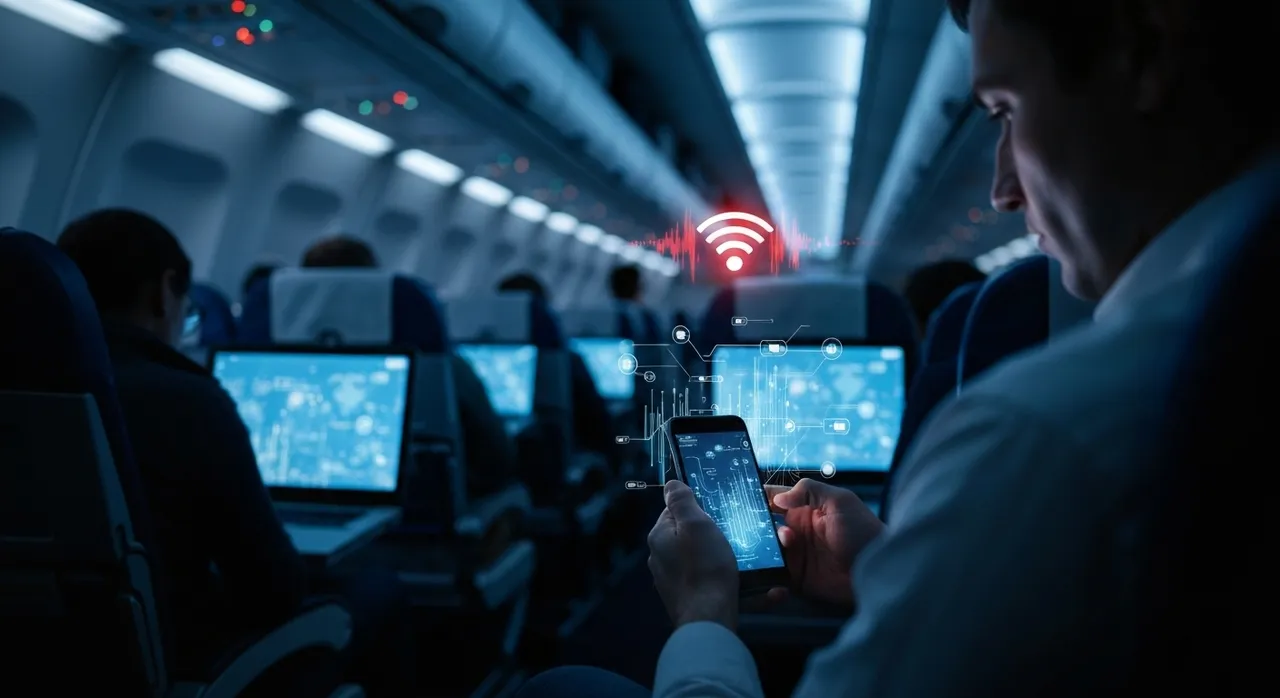
Cruising at 35,000 feet above the American Southwest, Delta Air Lines Flight 591 should have been an uneventful journey from Las Vegas to Atlanta. Instead, the Boeing 757 carrying 199 passengers became the stage for an old-school cybersecurity disruption when an unauthorized wireless network named “Delta WiFi Fast” was detected in the passenger cabin. The spoofed access point, mimicking the carrier’s genuine in-flight connectivity portal, triggered an onboard protocol scramble, leading flight attendants to sever the plane’s legitimate satellite Wi-Fi connection for roughly 30 minutes while pilots coordinated with ground security. The mid-air deployment of this rogue delta wifi access point immediately ignited a federal inquiry, underscoring the enduring tension between hacker culture and the stringent safety protocols of civil aviation.
The timing of the incident was not accidental. Delta Flight 591 departed Harry Reid International Airport immediately following the conclusion of DEF CON 34 and Black Hat USA—the week-long convergence of security researchers, penetration testers, and digital misfits universally known as “Hacker Summer Camp”. While thousands of attendees spent the week exploring zero-day vulnerabilities, hardware exploitation, and wireless telemetry, at least one traveler appears to have carried the experimentation directly into commercial airspace.
The Mid-Air ACARS Scramble: What Happened Aboard Flight 591
Approximately one hour into the cross-country flight, flight attendants and observant passengers noticed an anomaly within the cabin’s RF environment. Alongside the official “DeltaWiFi” service, an open network broadcasting the SSID “Delta WiFi Fast” surfaced on mobile device connection menus. Suspecting that a traveler was executing a credential-harvesting campaign or wireless denial-of-service attack against fellow passengers, the cabin crew informed the flight deck.
Pilots promptly turned to the Aircraft Communications Addressing and Reporting System (ACARS)—the legacy text-based radio and satellite link used for critical communications between aircrews and ground dispatch. Transmissions captured by ground monitors revealed the flight crew’s mounting apprehension in raw, unedited form:
- First ACARS Transmission:
"HEY ALERT CORP SECURITY WE HAVE A PAX ON THAT HAS CREATED A SCAM WIFI CALLED DELTA WIFI FAST WE BELIEVE THEY ARE TRYING TO SCAM THE OTH PAX" - Follow-Up ACARS Transmission (17 minutes later):
"NO INFO AS OF NOW WE HAVE A BUNCH OF PAX THAT WERE AT A CYBER CONFRENCE IN LAS THE WERE ABLE TO JAM OUR WIFI AND BRODCAST THERE SIGNIAL"
Recognizing the potential risks to passenger data integrity, the crew took the aircraft’s authentic Wi-Fi offline for approximately half an hour to isolate the environment and deter further manipulation. Ground teams alerted corporate security and federal law enforcement, prompting authorities to meet the aircraft upon its arrival at Hartsfield-Jackson Atlanta International Airport to inspect the cabin and interview suspects.
Anatomy of an Evil Twin Attack at 35,000 Feet
Security analysts and wireless specialists quickly categorized the incident as a textbook Evil Twin attack. In a closed environment like an airliner fuselage, the RF spectrum is an enclosed echo chamber, making rogue access points particularly potent and difficult for standard client devices to distinguish from genuine hardware.
To execute this attack vector, an operator typically deploys a compact, battery-powered penetration testing device—such as a Hak5 Wi-Fi Pineapple, an ESP32 micro-controller board running customized firmware, or a multi-radio Linux laptop. The attack sequence typically involves three coordinated technical stages:
- 802.11 Deauthentication Floods: The rogue radio broadcasts spoofed management frames (specifically 802.11 deauthentication and disassociation packets) targeting the MAC addresses of the legitimate aircraft access points. This forces passenger smartphones and laptops to disconnect from the official satellite-linked network—a condition described by the pilots as “jamming.”
- SSID Spoofing and Beacons: The attacker broadcasts a fraudulent Service Set Identifier (SSID) such as “Delta WiFi Fast” with significantly higher signal amplitude inside the passenger cabin. Consumer operating systems, searching for a recognizable or high-throughput network, display the rogue network at the top of the connection list.
- Captive Portal Cloning & Phishing: When an unsuspecting passenger connects, the rogue access point’s DNS server redirects all web traffic to a locally hosted captive portal. The counterfeit webpage is styled to emulate Delta’s authentication gateway, prompting users to enter their SkyMiles credentials, payment card data, or single-sign-on (SSO) credentials such as Google or Microsoft accounts to “restore high-speed internet access.”
Avionics Isolation vs. The Rogue Delta WiFi Vector
In the immediate aftermath of the incident, sensational speculation arose regarding whether the rogue access point posed a danger to the aircraft’s avionics, navigation, or flight management computers. Delta Air Lines swiftly issued an official clarification, confirming that flight safety was never compromised and no aircraft operating systems were affected.
Modern commercial airliners enforce strict architectural segmentation between internal and external operational domains. Aviation cybersecurity standards—including RTCA DO-326A and EUROCAE ED-202A—dictate the structural isolation of digital networks into distinct physical and logical enclaves:
- Aircraft Control Domain (ACD): Encompasses fly-by-wire flight control computers, engine management (FADEC), and critical flight deck instrumentation operating over deterministic buses such as ARINC 429 and MIL-STD-1553. This domain is physically air-gapped and unreachable via passenger Wi-Fi.
- Airline Information Services Domain (AISD): Governs operational communications, electronic flight bags (EFBs), and flight performance logging.
- Passenger Information and Entertainment Services Domain (PIESD): Houses the cabin In-Flight Entertainment (IFE) and satellite connectivity networks.
Because the rogue delta wifi broadcast operated exclusively within the passenger cabin radio environment, it had zero pathway to interface with the Boeing 757’s avionics. The threat was not aerodynamic or operational; it was a targeted social-engineering and credential-theft campaign aimed exclusively at travelers.
Historical Echoes: From Seatback Ethernet to Cabin Wi-Fi
The Flight 591 incident resurrected memories of classic hacker lore from the mid-2010s. Most notably, in 2015, security researcher Chris Roberts was detained by the FBI after tweeting a theoretical scenario about manipulating engine indicators via an aircraft’s seatback electronic box (SEB). While the FBI’s subsequent claims that Roberts caused a lateral plane movement were disputed, the event forced airlines and the FAA to reexamine the boundary between passenger seat equipment and internal avionics.
For decades, DEF CON attendees have engaged in wireless hijinks, culminating in the famous “Wall of Sheep”—a public leaderboard displaying unencrypted usernames and passwords broadcast over insecure local networks by conference attendees. However, shifting those games from the convention floor to an active airline cabin crosses an unambiguous line.
Legal Peril: The Cost of Commercial Airspace Hijinks
While the perpetrator may have viewed the deployment of “Delta WiFi Fast” as a harmless demonstration, federal regulators view unauthorized wireless disruption aboard aircraft through an entirely different legal lens. Interfering with onboard communications or conducting unauthorized credential-harvesting campaigns exposes operators to severe criminal penalties under multiple federal frameworks:
- Computer Fraud and Abuse Act (18 U.S.C. § 1030): Prohibits intentional unauthorized access to protected computers, which legally includes all network hardware aboard commercial airliners and the personal devices of passengers.
- Interference with Flight Crew Members (49 U.S.C. § 46504): Imposes felony charges and sentences of up to 20 years for any action that intimidates or interferes with crew members performing their official duties.
- Communications Act of 1934 & FCC Regulations: Strictly bars the unauthorized transmission of jamming signals and deauthentication frames that disrupt licensed commercial radio services (47 U.S.C. § 333).
Defending the Cabin: Best Practices for In-Flight Connectivity
As in-flight Wi-Fi becomes standard across global commercial fleets, enterprise security leaders and regular travelers must treat aircraft cabins as hostile, public network environments. Mitigating rogue access point risks requires strict digital hygiene:
- Validate the Exact SSID: Airlines rarely broadcast multiple variations of their network name. If a secondary SSID appears offering “Fast,” “Free,” or “VIP” access, avoid connecting.
- Deploy Always-On VPNs: A robust, enterprise-grade Virtual Private Network (VPN) using modern protocols like WireGuard or OpenVPN prevents man-in-the-middle (MitM) inspection even if a device associates with an Evil Twin.
- Inspect SSL/TLS Certificates: If an onboard captive portal triggers a certificate warning (e.g., untrusted issuer, self-signed certificate, or hostname mismatch), terminate the connection immediately.
- Disable Auto-Join: Configure mobile operating systems and laptops to disable automatic connection to open Wi-Fi networks, preventing hardware from automatically associating with cloned SSIDs.
The Flight 591 disruption stands as a stark reminder that while Hacker Summer Camp ends when the convention halls close, the discipline of defensive cybersecurity must remain active everywhere—from the terminal gate to the cruising altitude of 35,000 feet.
Written by
TempMail Ninja
Digital privacy and online security expert. Passionate about creating tools that protect users' identity on the internet.