Andromeda321 Radio Mystery: New Insights into Saturn’s Hexagon Theory
Article Content
On April 24, 2026, the digital landscape of space enthusiasts and amateur sleuths was set ablaze by a single, meticulously detailed deep dive from the popular internet culture podcast Endless Thread. The episode, titled “Close Encounters of the Hexagonal Kind,” acted as a catalyst for a massive online investigation into what has become known as the Andromeda321 radio mystery. At the heart of this storm is a convergence of two of the cosmos’ most baffling enigmas: a newly detected “long-period radio transient” and the geometric perfection of Saturn’s north pole hexagon.
The mystery gained significant traction following a viral Reddit thread in the r/space community. Leading the discourse was renowned radio astronomer Yvette Cendes, known to millions by her digital handle Andromeda321. Cendes, who recently joined the University of Oregon’s physics department, has long been the internet’s favorite “Astronomer here!” voice, providing high-level technical clarity to a public hungry for answers. When she confirmed the detection of a signal with a stable pulse profile over a staggering 36-minute period, the web did what it does best: it began connecting the dots, however improbable they might be.
Decoding the Andromeda321 Radio Mystery: The Signal That Defies Physics
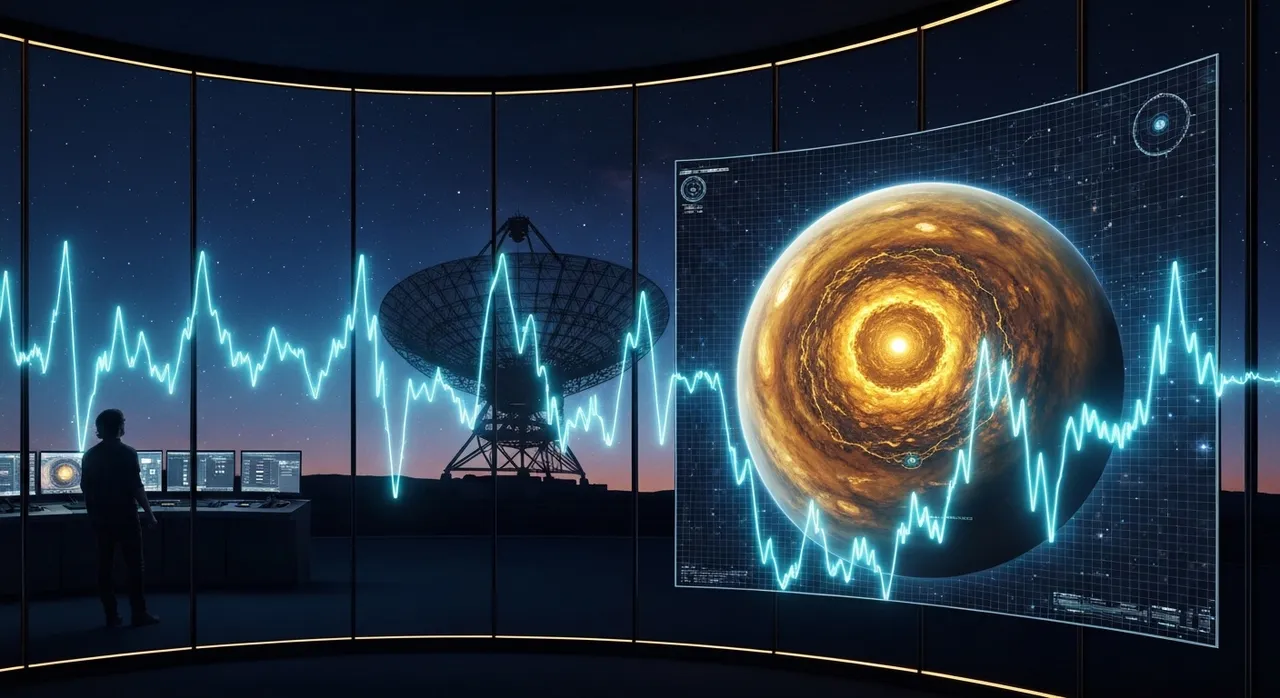
The Andromeda321 radio mystery centers on a class of objects known as Long-Period Radio Transients (LPTs). Traditionally, radio astronomy focuses on millisecond-scale events like pulsars or fast radio bursts (FRBs). However, this new signal, currently being monitored by arrays like ASKAP (Australian Square Kilometre Array Pathfinder) and MeerKAT in South Africa, pulses at a cadence that should be physically impossible for a standard neutron star.
- Periodicity: The signal repeats every 36 minutes, far exceeding the typical 10-to-12-second limit for most known pulsars.
- Polarization: The emission is 100% circularly polarized, meaning the radio waves twist in a perfect spiral as they propagate through the interstellar medium.
- Luminosity: Despite its long period, the signal is incredibly bright, rivaling the energy output of “burping” black holes seen in Tidal Disruption Events (TDEs).
Technical observers have pointed to the “Great Galactic Burper” (GPM J1839–10) as a predecessor, but the 2026 discovery is even more peculiar. According to Cendes, while the signal likely originates from a highly magnetized white dwarf pulsar or an ultra-long-period magnetar, the sheer stability of its 36-minute cycle has led amateur investigators to suggest something more structural. This is where the “geeky sleuthing” of the internet community shifts its gaze toward the gas giant, Saturn.
The Saturn Hexagon Connection: Geometry or Signal?
The Endless Thread deep dive highlighted a fringe but fascinating theory: could the bizarre geometric precision of Saturn’s north pole hexagon be a natural resonator or a planetary-scale radio emitter? The timing of this resurgence is no coincidence. In April 2026, Saturn’s north pole is beginning its descent into a 15-year winter darkness. This transition marks the final opportunity for high-resolution visible light data of the hexagon before it is shrouded in shadow until the late 2030s.
The Fluid Dynamics of the Hexagon
Scientifically, the Saturnian hexagon is understood as a persistent Rossby wave—a jet stream phenomenon where atmospheric gases move at speeds of 320 km/h (200 mph). The sides of the hexagon are roughly 14,500 km (9,000 mi) long, wider than the diameter of the Earth. However, the mystery deepens when looking at the rotation. The hexagon rotates with a period of exactly 10 hours, 39 minutes, and 24 seconds—the same period as Saturn’s radio emissions from its interior.
Speculative theorists on platforms like Reddit and Bluesky have posited that the Andromeda321 radio mystery might not be a distant star, but a signature of similar “geometric harmonics” occurring in other stellar systems. If a planet or a brown dwarf possessed a hexagonal polar vortex of sufficient scale, could its magnetic interaction with its host star create the long-period pulses we are now seeing? While professional astronomers remain skeptical, the “ribbon wave” anomaly—a transient feature detected in Saturn’s atmosphere in early 2026—has provided fresh data for those looking to link planetary weather with radio transients.
Sleuthing in the Dark: The Rise of Citizen Science
What makes the Andromeda321 radio mystery a defining moment in 2026 digital culture is the democratization of astronomical data. Amateur detectives are no longer just looking at grainy photos; they are accessing Gaia DR3 datasets, analyzing light curves, and using open-source tools to map radio frequency interference (RFI).
The tools of the modern “Geeky Sleuth” include:
- Aladin Sky Atlas: Used for cross-referencing radio coordinates with optical counterparts.
- Python Notebooks: To run periodograms on public radio data releases from the VLA (Very Large Array).
- Discord Communities: Where real-time collaboration occurs between hobbyists and early-career researchers.
This “sleuthing culture” has a dual effect. On one hand, it fuels myths about “alien beacons” or “celestial megastructures.” On the other, it provides a massive volunteer workforce for debunking. Cendes herself often uses these threads to teach the community about Synchrotron Emission—the process where electrons spiraling in magnetic fields generate the radio waves we detect. By explaining that these “ghost signals” are likely the death rattles of highly magnetized stars, she bridges the gap between internet mystery and hard science.
Technical Depth: The Physics of “Burping” Black Holes
To understand why the Andromeda321 radio mystery is so significant, one must look at Cendes’ broader research on Tidal Disruption Events (TDEs). In her 2025-2026 papers, Cendes highlighted that as many as 40% of black holes that “shred” stars (TDEs) exhibit a delayed radio onset. This phenomenon, colloquially termed “burping,” involves a black hole emitting a sudden burst of radio energy months or even years after the initial event.
One famous example is AT2018hyz, nicknamed “Jetty McJetface.” This TDE remained radio-silent for over 700 days before suddenly brightening at 40 times its initial detection level. The 2026 long-period transient shares this “delayed” and “unexpected” profile. If the new signal is indeed a delayed outflow from a cosmic “shredder,” it would provide critical data on the density of galactic dust and the velocity of relativistic blast waves in the deep universe.
Is There a “Geometric” Radio Source?
The “Saturn Hexagon Theory” as applied to the Andromeda321 radio mystery suggests that we may be looking at the first evidence of Magnetospheric-Ionospheric Coupling on a galactic scale. Just as Saturn’s hexagon is tied to its radio period, could an exoplanet with a 36-minute rotation (or a binary system with a 36-minute orbit) be “beaming” its geometric storm toward Earth? While current models favor a white dwarf primary, the “unicorn” nature of the 100% circular polarization keeps the door open for exotic planetary-magnetospheric interactions.
Conclusion: The Shadow Falls on Saturn, But Light Rises on the Mystery
As Saturn’s north pole enters its long winter in late April 2026, the Andromeda321 radio mystery remains a beacon of the unexplained. The Endless Thread investigation has shown that the line between professional astrophysics and internet culture is becoming increasingly blurred. Whether the signal is a “burping” black hole, a magnetized white dwarf, or a manifestation of the geometric principles seen in Saturn’s hexagon, the search for an answer is a testament to human curiosity.
Under the guidance of scientists like Yvette Cendes, the internet’s “geeky sleuthing” is evolving from simple speculation into a sophisticated form of citizen science. As we lose the ability to see Saturn’s hexagon in visible light for the next decade, our reliance on radio “ears” will only grow. The ghost signals of 2026 may be mysterious, but they are also the primary data points for the next generation of astronomers—professional and amateur alike—who are determined to hear the stories the universe is telling through the static.
Written by
TempMail Ninja
Digital privacy and online security expert. Passionate about creating tools that protect users' identity on the internet.