Booking.com Data Breach: Massive Reservation Hijack Scams Reported
Article Content
The global travel industry is currently grappling with one of its most sophisticated cybersecurity crises to date. On April 16, 2026, a massive Booking.com data breach was officially confirmed, signaling a paradigm shift in how cybercriminals exploit the hospitality supply chain. While the Amsterdam-based travel giant has been reticent about the exact number of victims, independent cybersecurity researchers suggest that the exposure could affect as many as five million customers across Europe, North America, and Oceania. Unlike historical breaches that prioritized credit card numbers, this operation focused on “high-fidelity” personal data—information that allows criminals to execute a devastatingly effective “reservation hijack” wave.
The Anatomy of the Booking.com Data Breach
The Booking.com data breach of 2026 did not originate from a direct penetration of the company’s central servers. Instead, it was the result of a coordinated, multi-vector attack on the broader hospitality ecosystem. Investigative reports indicate that threat actors successfully compromised several European hospitality software providers, specifically targeting Chekin (a Spanish automated check-in service) and Gastrodat (an Austrian hotel management provider). By infiltrating these third-party intermediaries, hackers gained a “backdoor” into the internal management portals used by thousands of hotels that list on Booking.com.
The stolen data set is exceptionally granular. According to security firm Cybernews, which uncovered an unprotected server belonging to the threat actors, the breach exfiltrated approximately 6.5GB of files containing:
- Full names and contact information (emails and phone numbers).
- Detailed booking histories, including exact stay dates and property names.
- Reservation IDs and internal PIN codes.
- Historical communication logs between guests and hotel staff.
- In some instances, sensitive ID document details and safety flags used by property managers.
This level of precision has rendered traditional security advice—such as “look for typos” or “check the sender’s email”—virtually obsolete. Because the criminals possess the exact details of a traveler’s upcoming trip, they are able to mimic legitimate customer service interactions with terrifying accuracy.
The Rise of the “Reservation Hijack” Scam
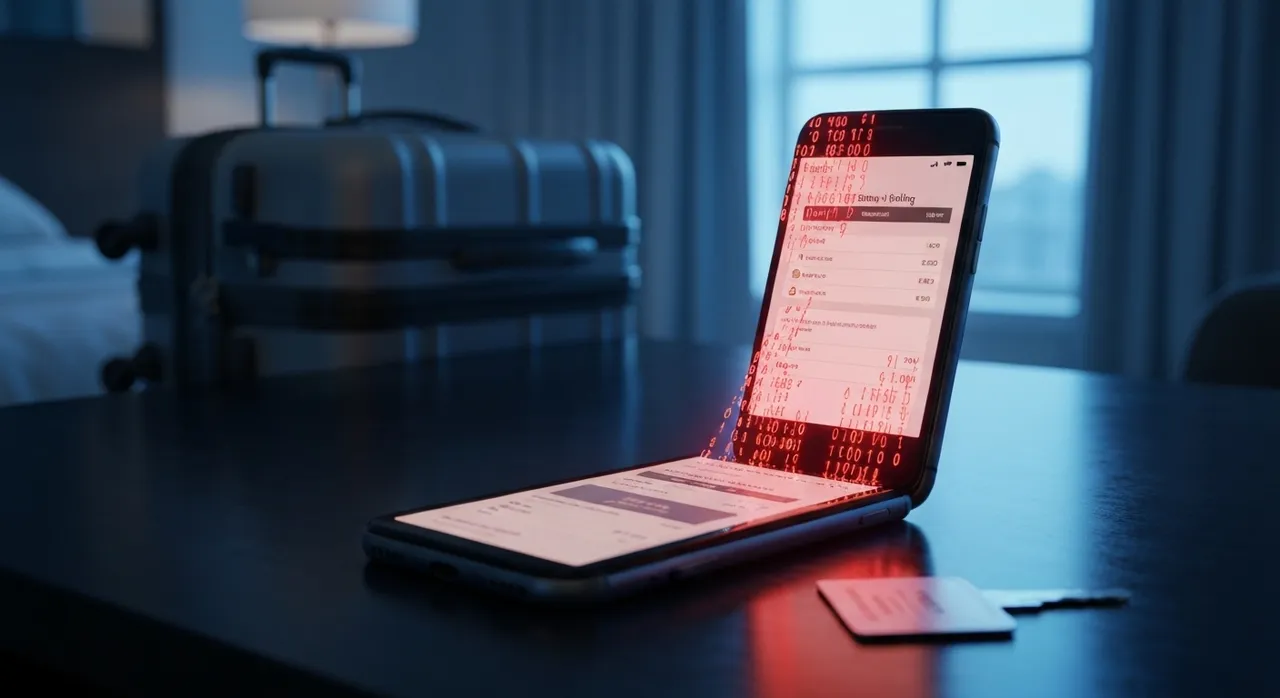
The most alarming consequence of this breach is the “reservation hijack” wave. In this scenario, the stolen data is used to fuel highly targeted social engineering campaigns. Travelers are being contacted directly via the Booking.com app’s internal messaging system or through third-party encrypted apps like WhatsApp.
The scammers pose as front-desk managers or Booking.com “priority support” agents. Referencing the victim’s specific reservation number and hotel name, they claim there is an urgent issue with the payment method. Common pretexts include:
- Payment Verification: Victims are told that a “pre-authorization” failed and they must re-enter their card details on a “secure link” within 12 hours or their room will be released.
- Double-Booking Errors: Scammers claim a technical glitch caused a double-booking, and the guest must send a bank transfer to “guarantee” their specific room tier.
- Local Tax Compliance: A sophisticated variant involves telling international travelers they must pay a newly implemented “city tourism tax” via a provided portal before arrival.
Because these messages often arrive within the official Booking.com communication thread (facilitated by the compromise of hotel-side credentials), users have no reason to suspect foul play. The “hijack” is not of the account itself, but of the trust established between the traveler and the platform.
Technical Deep-Dive: Infostealers and the “ClickFix” Vector
To understand how this breach reached such a “considerable” scale, one must look at the technical tools employed by the attackers. Security researchers at Microsoft and Securonix have linked the operation to a threat group identified as Storm-1865. This group utilized a sophisticated malware delivery method known as “ClickFix.”
The infection chain typically begins with a hotel employee receiving a phishing email disguised as a complaint from an “angry guest.” The email contains a link to what is purportedly a photo of a “bed bug infestation” or a “damaged room.” When the employee clicks the link, they are directed to a fake CAPTCHA or a simulated Windows Blue Screen of Death (BSOD). The page instructs the user to “fix” the error by running a specific command in their terminal (PowerShell).
This command installs a suite of infostealer malware, including Vidar, Lumma, and DCRat. These tools are designed to siphon session cookies, stored browser passwords, and JWT (JSON Web Tokens) directly from the hotel’s computer. With these tokens, the attackers can bypass Multi-Factor Authentication (MFA) and gain full access to the hotel’s Booking.com Extranet portal. Once inside, they use automated Python scripts to scrape guest data via APIs and forward the information in real-time to private Telegram channels for exploitation.
Supply Chain Fragility in the Hospitality Sector
The Booking.com data breach highlights a systemic vulnerability in the travel industry: the reliance on a fragmented network of small-to-medium-sized software providers. While Booking.com maintains robust internal security, its “attack surface” is effectively defined by the security posture of the weakest hotel in its network.
The breach of Chekin and Gastrodat illustrates that regional software providers often lack the enterprise-grade defense mechanisms required to repel state-level or highly organized criminal syndicates. In this instance, the hackers targeted the “staff augmentation” and “automated check-in” layers of the tech stack, knowing these tools have deep read/write access to reservation databases but are often overseen by smaller IT teams with fewer resources.
This incident is not an isolated failure. In 2021, the Dutch Data Protection Authority fined Booking.com €475,000 for a similar lapse in reporting a breach. However, the 2026 event is significantly more dangerous due to the integration of AI-driven phishing tools that can translate the stolen data into perfectly localized, professional messages in any language, further narrowing the window for detection.
Mitigation and Recovery: What Is Being Done?
In response to the 16th of April confirmation, Booking.com has initiated several emergency protocols. The company has forced PIN resets for all current and historical reservations affected by the suspicious activity. They have also implemented a new “Security Signal” feature within the Extranet to alert hotel partners if their login sessions originate from known malicious IP ranges or exhibit “bot-like” scraping behavior.
However, critics argue that the company’s response has been insufficient. On platforms like Reddit and X (formerly Twitter), users have reported receiving breach notifications only after they had already fallen victim to the reservation hijack scam. Furthermore, the lack of transparency regarding the total number of impacted accounts has drawn the ire of European regulators, who are now investigating whether Booking.com violated the General Data Protection Regulation (GDPR) mandates for “timely and transparent” disclosure.
Safety Checklist for Travelers
Given the persistent nature of the Booking.com data breach, travelers are urged to adopt a Zero-Trust approach to their bookings. If you have an active reservation, follow these protocols:
- Verify via Voice: If you receive an urgent request for payment or data verification, do not click any links. Call the hotel directly using a phone number found on their official website—not the number provided in the message.
- Official Portals Only: Never provide credit card details or bank transfers via a link sent in a chat message or email. Legitimate payments on Booking.com are handled through the platform’s checkout page, not through third-party redirectors.
- Monitor Session Activity: Periodically check your “Logged In Devices” on the Booking.com app and terminate any sessions you do not recognize.
- Enable Hardware MFA: Whenever possible, use hardware security keys (like YubiKey) for your travel and email accounts to prevent session hijacking via stolen cookies.
The Future of Travel Security
The 2026 Booking.com data breach serves as a definitive “wake-up call” for the industry. As travelers, we have moved into an era where personal data is the new currency for fraud. The precision of the “reservation hijack” wave demonstrates that criminals no longer need your credit card number to steal your money; they only need your itinerary and your trust.
Moving forward, the hospitality sector must move toward End-to-End Encryption (E2EE) for guest-to-hotel messaging and implement stricter “Least Privilege” access for third-party software integrations. Until then, the burden of security remains largely on the consumer. In the high-stakes world of digital travel, the “Ninja Editor” advice is clear: Trust the booking, but verify the messenger.
Written by
TempMail Ninja
Digital privacy and online security expert. Passionate about creating tools that protect users' identity on the internet.