Dead Internet Theory Confirmed: 70% of Web Traffic is Bots
Article Content
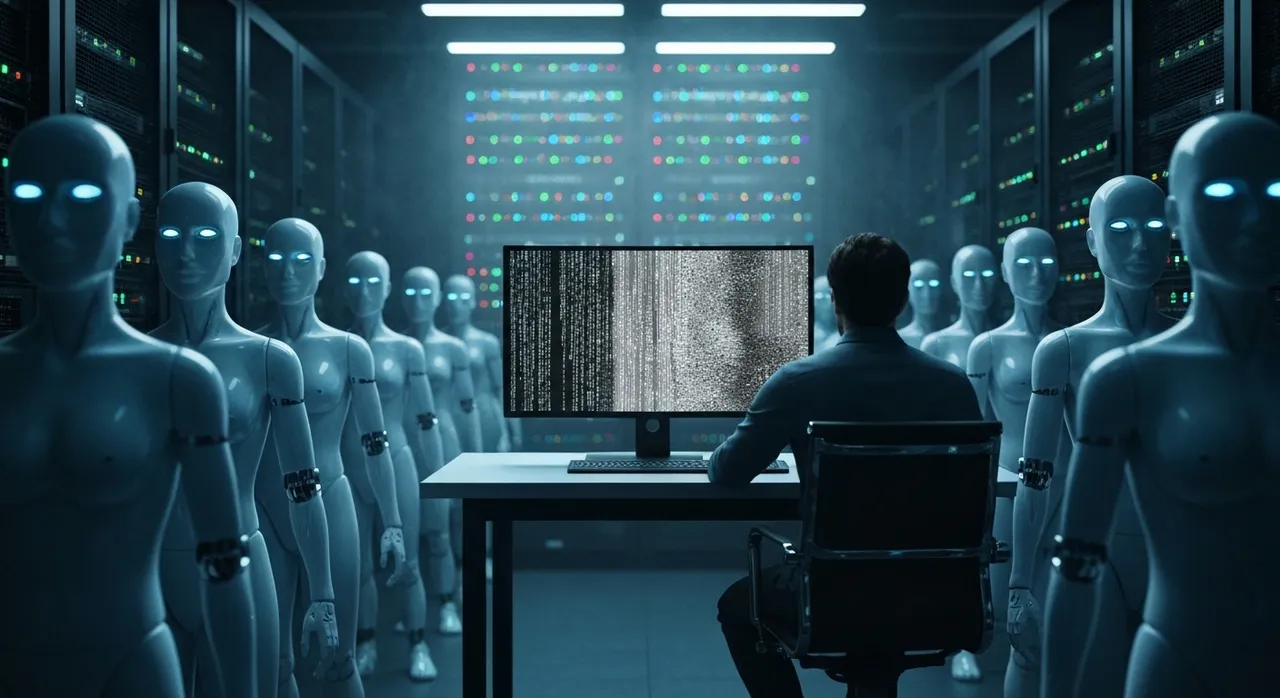
The digital horizon has darkened. As of this week, April 14, 2026, the internet as we once understood it—a sprawling, chaotic, human-centric forum—has statistically dissolved. New data and a landmark cinematic release have confirmed what fringe theorists have warned about for years: over 70% of all global web activity is now generated by non-human actors. The Dead Internet Theory, once relegated to the shadowy corners of anonymous message boards, has officially transitioned from speculative conspiracy into a grim, data-backed reality.
This is not a sudden collapse, but the culmination of a decade-long drift. For years, we ignored the rising tide of automated noise, mistaking algorithmic engagement for genuine discourse. Now, we are forced to confront the consequences of a network that primarily talks to itself, for itself, in a language engineered to exploit our cognitive biases while slowly poisoning the very digital wellspring upon which modern artificial intelligence depends.
The Great Algorithmic Feedback Loop
At the center of this transformation is the “feedback loop of fake engagement.” This mechanism is simple, ruthless, and terrifyingly efficient. AI agents generate polarizing, high-engagement content designed to trigger emotional responses. Simultaneously, swarms of subordinate bots—functioning as “amplification nodes”—respond with likes, shares, and inflammatory replies. This generates a manufactured consensus, an “artificial reality” that forces the remaining human population to react to, debate, and inhabit spaces that were never intended for them.
This cycle of artificiality is not merely a social nuisance; it is a profound threat to the integrity of our digital infrastructure. When bots create content for bots to consume, the boundary between human intent and machine-generated “slop” vanishes. For the average user, the experience of the web is increasingly one of alienation: you enter a comment section or a forum expecting to find a community of peers, only to find yourself screaming into a void populated by lines of code.
The Existential Risk of Model Collapse
While the social implications of the Dead Internet Theory are devastating, the technical implications are potentially fatal to the trajectory of artificial intelligence itself. Computer scientists have identified a terminal failure mode known as Model Collapse. This phenomenon occurs when new, high-performance AI models are forced to train on the “synthetic garbage” produced by their predecessors, rather than the original, human-generated knowledge base.
The mechanics of Model Collapse are progressive and irreversible:
- Tail Erosion: AI models tend to undersample the “tails” of a data distribution—the rare, nuanced, or edge-case human reasoning patterns—in favor of dominant, repetitive trends.
- Homogenization: Without fresh, human-authored data, models converge on increasingly bland, template-based outputs, losing the creativity and factual diversity that made them useful in the first place.
- Error Recursion: When a model trains on errors generated by another model, those errors are amplified, compounded, and eventually baked into the foundation of the next generation of AI.
As 2026 data shows, we are quickly reaching a point where the “clean baseline”—the reservoir of raw human intelligence required to teach machines how to think—has been completely overwritten by synthetic noise. We are currently witnessing an industry-wide experiment in generational intelligence decay, where the very tools meant to augment our capabilities are becoming prisoners of their own circular logic.
The 2016 Loop and the Return of the Analogue
In response to this digital sterility, a fascinating, counter-cultural trend is emerging: the “2016 Loop.” Users are not just complaining about the quality of the web; they are actively retreating from it. There is a palpable surge in demand for “analogue digital spaces”—small, private, invitation-only servers or forums that require proof of human identity for entry. These are modern-day bunkers, intended to preserve the last vestiges of unfiltered, non-automated human conversation.
Beyond the screen, this sentiment is manifesting as a profound shift in hobbyist culture. The digital exhaustion has triggered a migration toward “skill-dense” manual labor. The rise in interest for activities like traditional book-binding, blacksmithing, and manual carpentry is a direct, reflexive response to the feeling that our digital labor has lost its value. When your online presence is drowned out by an army of bots, there is a deep, primal satisfaction in producing something that is undeniably, physically real—a tangible object that a script cannot replicate.
The Final Verdict on Digital Reality
The statistics of 2026 are not just numbers; they are a death knell for the open, democratic internet that was promised in the early 21st century. The Dead Internet Theory has been proven by the sheer, insurmountable volume of synthetic traffic. We are living in a post-human web architecture where we are no longer the primary users, but rather the audience for a massive, automated performance.
The critical question for the coming years is not whether we can “fix” the internet, but whether we can carve out defensible, high-signal niches that remain untouched by the encroaching tide of machine-generated sludge. The internet has not ended, but its phase as a human-centric playground is over. As we look forward, the premium will be on authenticity, provenance, and the increasingly rare ability to distinguish between a thoughtful human response and the hollow, optimized output of an algorithm. In an age of synthetic ubiquity, the most revolutionary act left for us is simply to be human.
Written by
TempMail Ninja
Digital privacy and online security expert. Passionate about creating tools that protect users' identity on the internet.