First On-Screen Robot: Méliès’ Lost Film Gugusse Restored in 4K
Article Content
On April 20, 2026, the Library of Congress (LoC) sent a shockwave through the worlds of cinema and technology by announcing the successful 4K digital restoration of Gugusse and the Automaton (Gugusse et l’Automate). This 1897 silent masterpiece, directed by the legendary Georges Méliès, was long considered a “holy grail” among historians. Lost for over 130 years, its recovery represents a monumental milestone in internet archaeology. More importantly, it provides the world with its first clear look at the First On-Screen Robot, an early cinematic curiosity that predates the very word “robot” by nearly a quarter of a century.
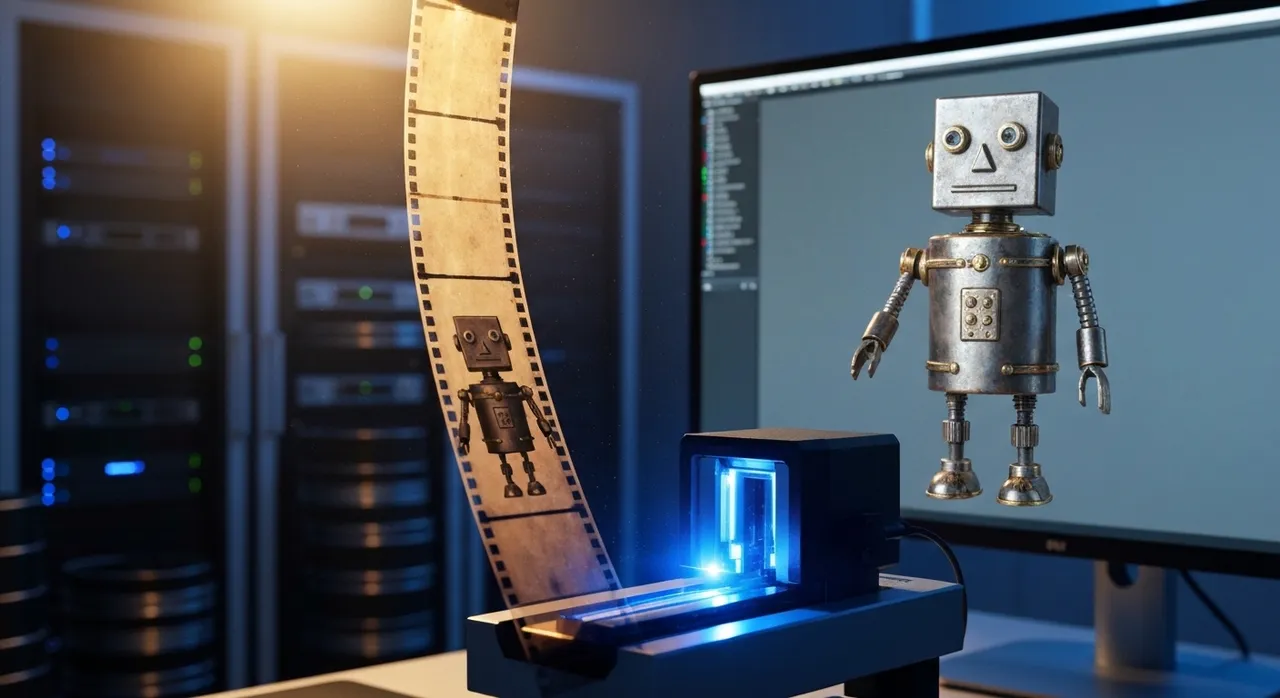
The discovery occurred under almost cinematic circumstances: a batch of deteriorating nitrate film reels was found in a family trunk in rural Michigan, belonging to the descendants of a 19th-century traveling projectionist. Recognizing the potential value of the brittle, silver-halide strips, the family donated the reels to the National Audio-Visual Conservation Center in Culpeper, Virginia. After months of painstaking stabilization and microscopic frame-by-frame reconstruction, the 45-second reel has been resurrected from a state of near-total chemical decay.
The Michigan Trunk Discovery: A Miracle of Preservation
The survival of any film from the 1890s is a statistical anomaly. It is estimated that over 80% of all silent films produced in the early era of motion pictures have been lost to fires, chemical decomposition, or intentional destruction. For decades, *Gugusse and the Automaton* existed only as a numbered entry (No. 111) in the Star Film Company catalog. The 2026 restoration proves that even in the “digital dark age,” physical artifacts can still emerge to fill the gaps in our cultural memory.
Archivists at the Library of Congress noted that the film was found in an advanced stage of nitrate decomposition. Nitrate film, or nitrocellulose, is notoriously unstable. As it ages, it undergoes a series of predictable but devastating chemical changes:
- Stage 1: The film base begins to yellow and the silver image starts to fade.
- Stage 2: The film becomes sticky and emits a pungent, vinegar-like odor (acidic outgassing).
- Stage 3: The layers of the film fuse together, forming a solid, unspoolable mass.
- Stage 4: The material collapses into a brownish, toxic powder.
- Stage 5: The powder becomes highly shock-sensitive and can spontaneously combust at temperatures as low as 100°F.
The Michigan reel was at Stage 3, requiring the LoC team to use specialized vacuum chambers and chemical softening agents to “relax” the celluloid before it could even be placed on a scanner. The result is a stunning 4K image that preserves the organic grain of the original 1897 stock while removing the “veil” of a century’s worth of oxidation.
Dissecting the First On-Screen Robot
The film itself is a 45-second slapstick routine that serves as the blueprint for all science fiction to follow. In the footage, a clown—played by Méliès himself—interacts with a child-sized mechanical figure on a pedestal. As Méliès turns a large crank, the First On-Screen Robot begins to move with stiff, jerky motions. In a feat of early special effects (the “substitution splice”), the automaton grows into an adult-sized figure that proceeds to beat the magician with a stick. The film concludes with the magician bashing the machine back into a small puppet with a mallet.
While we use the term today, the word “robot” did not exist in 1897. It wouldn’t be coined until Karel Čapek’s 1920 play *R.U.R.* Instead, Méliès called his creation an “Automaton.” This was a reflection of the 19th-century obsession with clockwork mechanisms—gears, cams, and levers designed to mimic human life. By capturing this on film, Méliès bridged the gap between Vaucanson’s 18th-century ducks and the digital droids of modern cinema.
The “Stop Trick” and the Birth of Sci-Fi FX
Méliès, a professional magician before becoming a filmmaker, utilized his “substitution splice” or “stop-trick” to achieve the automaton’s growth. This involved stopping the camera, having the actors freeze, swapping the small puppet for a human actor in a costume, and then resuming the crank. This technique, though primitive by 2026 standards, was the pioneer of all modern CGI. The restoration highlights the precision of these splices, showing how Méliès managed to keep the lighting consistent between takes—a technical challenge that often baffled his contemporaries.
Technical Rescue: 4K Liquid-Gate Scanning and AI
The 2026 restoration project employed the most advanced digital tools available to the Library of Congress. Because the original nitrate was severely scratched and brittle, traditional dry-scanning was impossible. Instead, the team utilized Liquid-Gate (Wet-Gate) Scanning. In this process, the film is submerged in a chemical bath with a refractive index similar to the film base just as it passes the scanner lens. This “fills in” the physical scratches and abrasions on the film’s surface, allowing the 4K sensor to capture the underlying image without the interference of physical damage.
The technical specifications of the digital master include:
- 16-bit Scan Depth: Captures the maximum dynamic range of the original silver halide crystals.
- Gate-Weave Stabilization: Digital algorithms were used to correct the “jumpiness” of the image caused by shrunken perforations (sprocket holes).
- AI Frame Interpolation: Early silent films were recorded at roughly 14 to 18 frames per second (fps). To make the First On-Screen Robot appear fluid on modern 60Hz displays, the LoC used MTai FrameGen, a neural network that analyzes the motion between two original frames and generates a “synthetic” middle frame to smooth the action without introducing artifacts.
This hybrid of 19th-century chemistry and 21st-century artificial intelligence has allowed for a level of clarity that audiences in 1897 never experienced. The textures of the “robot” costume—likely made of painted cardboard and tin—are now visible in such detail that historians can identify the individual rivets used in the prop’s construction.
The “Media Dark Age” and the Urgency of Preservation
The restoration of *Gugusse and the Automaton* serves as a stark reminder of the Media Dark Age. This concept refers to the potential loss of historical data due to the fragility of both early physical media (like nitrate) and early digital media (like floppy disks or unreadable server formats). If this Michigan trunk had sat in a garage for one more summer, the heat likely would have triggered a spontaneous combustion, erasing the First On-Screen Robot from history forever.
The Library of Congress is using this discovery to lobby for “Aggressive Preservation.” This initiative argues that digital copies are not enough; we must preserve the physical artifacts while simultaneously upgrading their digital counterparts to the latest resolutions. As 8K and holographic displays become the norm in the late 2020s, 4K scans will eventually feel as “lo-fi” as the grainy YouTube clips of the early 2000s. The 2026 restoration ensures that the “ancestor of all droids” is ready for the next century of viewing technology.
Legacy: From Méliès to the Modern Droid
Why does a 45-second clip of a clown hitting a machine matter so much in 2026? It is because this film established the fundamental human-robot dynamic in fiction. Before *Metropolis*, before *Star Wars*, and before the sentient AI debates of the 2020s, there was Gugusse. The film explores the “Uncanny Valley”—the discomfort of seeing something mechanical mimic human life—and the subsequent human fear (slapstick or not) of the machine rebelling against its creator.
The First On-Screen Robot was not a hero or a villain; it was a “geeky curiosity,” a magic trick that harnessed the new technology of the motion picture to depict an even newer concept: artificial life. Historians of technology argue that Méliès didn’t just film a robot; he helped the public imagine the possibility of a machine with a mind of its own.
A Call to Internet Archaeologists
The success of the *Gugusse* project has ignited a global movement of “closet archaeology.” Archivists are encouraging individuals to check their attics and basements for “old, smelly film cans.” The Library of Congress has set up a dedicated digital portal for the 2026 initiative, providing a safe way for citizens to report potential nitrate finds. With the First On-Screen Robot safely digitized, the hunt is now on for Méliès’ other lost works, such as the 1896 film *A Nightmare*, which is rumored to contain even more surreal technical experiments.
In the end, the digital restoration of Gugusse and the Automaton is more than just a win for film buffs. It is a victory of human ingenuity over the entropy of time. By stabilizing a few ounces of decaying nitrate, we have reclaimed a foundational piece of our technological mythology, ensuring that the First On-Screen Robot will continue to march, wave its stick, and baffle magicians for generations to come.
Written by
TempMail Ninja
Digital privacy and online security expert. Passionate about creating tools that protect users' identity on the internet.