Flipper Zero Black Book: The Rise of Modern Digital Archaeology
Article Content
On May 8, 2026, a document began circulating through the encrypted nodes of the NEON MAXIMA network that would fundamentally shift the trajectory of modern hardware hacking. Titled “The Flipper Zero Black Book: Useful, Strange, and Slightly Concerning Payloads,” the release was authored by the enigmatic researcher Aeon Flex of the Elriel Assoc. 2133 collective. While the title suggests a mere repository of scripts, the “Black Book” has quickly become the manifesto for a new movement known as Digital Archaeology.
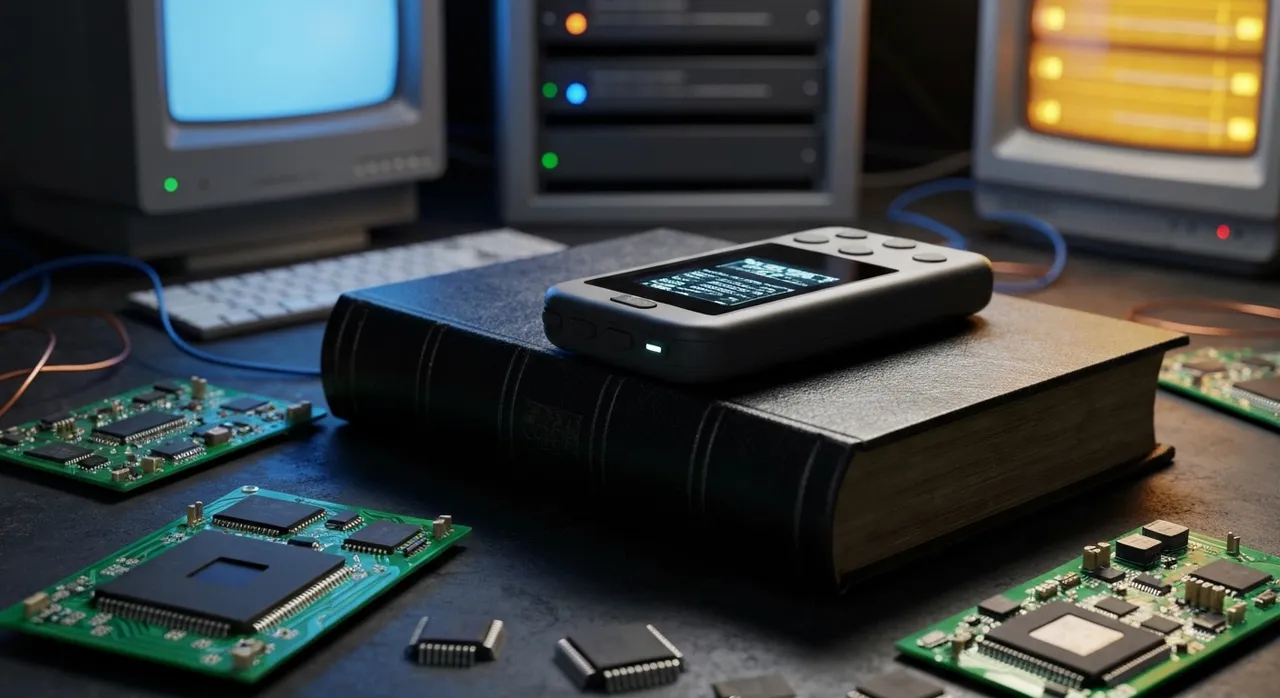
The Flipper Zero Black Book is not just a collection of 37 specialized payloads; it is a technical and philosophical examination of what Flex calls “Technological Sediment.” In a world increasingly obsessed with AI-driven cloud exploits and quantum-resistant encryption, Flex argues that we have ignored the bedrock of our physical reality. Our modern cities—sleek, glass-fronted, and hyper-connected—are actually built upon layers of “forgotten assumptions” and legacy hardware dating back to the mid-2000s. The release of this book marks a definitive shift in digital culture, moving away from abstract code and back toward Layer 1 of the OSI model: the physical, tangible world of radio waves and infrared light.
The Philosophy of Digital Archaeology: Excavating the Sediment
The core premise of the Flipper Zero Black Book is that our digital infrastructure is rarely “replaced”; it is merely built over. Flex uses the metaphor of urban archaeology to describe the process of hardware hacking in 2026. Just as a geologist studies strata of rock to understand the history of the earth, a digital archaeologist uses a device like the Flipper Zero to unearth the protocols that were installed two decades ago and never audited since.
According to Flex, much of the world’s functional infrastructure—ranging from the digital signage in Times Square to the RFID badge systems of Fortune 500 companies—operates on protocols designed around 2007. These systems were built with the assumption that the physical environment would remain a controlled space. In 2007, the barrier to entry for Sub-GHz signal manipulation or NFC sniffing required thousands of dollars in specialized laboratory equipment. Today, that same power is compressed into a pocket-sized device with a pixelated dolphin mascot.
The Assumption Gap
The “Black Book” highlights a critical vulnerability in modern security: the Assumption Gap. This is the space between what a system designer thought was “secure enough” in 2007 and what a curious teenager can do in 2026. Digital Archaeology is the practice of finding these gaps. It is less about “breaking” a system and more about “interacting” with it in ways the original engineers never anticipated. For example, a restaurant ordering tablet might be running a modern Android skin, but it often relies on a 15-year-old local network protocol to communicate with the kitchen—a protocol that leaks unencrypted identifiers like electronic breadcrumbs across the local airwaves.
Technical Deep Dive: The 37 Payloads of the Black Book
The Flipper Zero Black Book categorizes its payloads into three primary “excavation zones”: Sub-GHz Legacy, NFC/RFID Shadowing, and Infrared Chaos. Each payload targets a specific type of technological sediment, treating the modern city as a layered archaeological site.
1. Sub-GHz and Radio Frequency Excavation
The most viral payloads in the repository focus on Sub-GHz frequencies (300-928 MHz). These are the frequencies used by garage doors, gate barriers, and—most famously—the Tesla charge port. The Black Book includes a refined Sub-GHz brute-forcing script that targets the fixed-code protocols still prevalent in commercial parking structures.
- The Tesla Charge Port Trigger: A specific sequence of 315MHz or 433MHz signals that exploits the “trust-on-sight” nature of the charge port’s opening mechanism.
- Commercial Gate Replay: Payloads that capture and re-modulate signals from 20-year-old barrier systems that lack rolling code encryption.
- Digital Signage Cycling: Using Sub-GHz to interact with the wireless management systems of public displays, many of which still use default vendor frequencies.
2. NFC and RFID: The “Urban Exploration” of Access
Flex describes the use of NFC (13.56 MHz) and RFID (125 kHz) as a form of urban exploration. The Black Book provides payloads that do not just clone cards, but extract metadata from “dead” systems. Many apartment complexes and office buildings use proximity cards that were “modernized” in 2012 but still rely on the Mifare Classic protocol, which has been mathematically broken for over a decade. The Black Book provides the hardnested attack scripts necessary to recover keys from these systems in under 60 seconds.
3. Infrared (IR): The Invisible Background Magic
Perhaps the most “strange” payloads in the Flipper Zero Black Book are those involving Infrared. Flex points out that while the world moved to Bluetooth and Wi-Fi 6E, manufacturers of conference room hardware, smart TVs, and HVAC systems never truly abandoned IR. Because IR is line-of-sight, designers assumed it was inherently secure.
- Conference Room Chaos: Payloads designed to cycle HDMI inputs or trigger factory resets on high-end ceiling projectors during corporate meetings.
- HVAC Overrides: Protocols that interact with the wall-mounted IR sensors of industrial climate control systems, allowing the “archaeologist” to manipulate the temperature of a public space.
The Rise of the Flipper Zero V2 and the 2026 Landscape
The timing of the Flipper Zero Black Book is no accident. It coincides with the widespread adoption of the Flipper Zero V2, which features a 30% faster processor and a more sensitive Sub-GHz antenna. These hardware upgrades have allowed the NEON MAXIMA collective to refine their payloads for environments that were previously out of reach.
In early 2026, the introduction of the Apex 5 module—a GPIO-based add-on—gave the Flipper Zero Wi-Fi 6 and GPS logging capabilities. This has transformed the device from a simple “remote cloner” into a full-scale wardriving and signal mapping laboratory. The Black Book leverages these hardware advances, providing payloads that can map the RF footprint of an entire city block, identifying exactly where the “sediment” is most vulnerable.
The “Vesper” Integration
Another significant development in 2026 is the Vesper AI assistant for Flipper. By connecting the device to an LLM-powered mobile app, users can now describe a target system in plain English—”I am looking at a 2015-era HID Global card reader”—and Vesper will automatically load the appropriate payload from the Flipper Zero Black Book. This democratization of hardware hacking is what makes the release of the Black Book “slightly concerning” to traditional security firms.
Case Studies: Hacking the “Immortal” Legacy Systems
The “Black Book” isn’t just theory; it contains anecdotal “field reports” from Aeon Flex. These stories highlight how Digital Archaeology works in the real world.
The Restaurant Tablet Leak
In one instance, Flex describes sitting in a national chain diner. By using the Flipper Zero’s Sniffer mode, they identified that the ordering tablets at every table were broadcasting unencrypted beacon frames to a central server. This “electronic breadcrumb” trail allowed anyone with the Black Book’s “Crumb-Catcher” payload to view the order status and table numbers of every guest in the restaurant. This wasn’t a “hack” in the traditional sense; it was simply listening to a system that was never taught to be quiet.
The Corporate Conference Room
Another report details a high-end law firm whose security was “state-of-the-art” on the network level (Layer 3-7). However, their Layer 1 was a disaster. The massive, $50,000 motorized privacy glass and audio-visual suite in their main conference room was controlled via a standard IR protocol. Flex was able to demonstrate that a visitor in the lobby could “mute” a confidential meeting through the glass partition simply because the legacy IR receivers in the ceiling were still listening for 2007-era commands.
A Cultural Shift: From AI Clouds to Physical Layers
The release of the Flipper Zero Black Book marks a pivot point for the “geekiest” side of digital culture. For years, the cutting edge was virtual: cloud exploits, AI jailbreaking, and metaverse security. But there is a growing sense of fatigue with the “sealed-shut” nature of modern software. Phones are locked rectangles; cars are subscriptions on wheels.
The Flipper Zero—and the movement it has spawned—represents a return to explorable hardware. It turns the invisible signals of the city into something tangible. To a digital archaeologist, a simple walk down a city street becomes a journey through time. Every parking meter, smart lock, and automated door is a puzzle to be understood. The Flipper Zero Black Book has gamified this curiosity, providing the “cheat codes” to a world that was supposed to be invisible.
Security Implications: Re-Auditing the Forgotten Layers
For IT professionals and security auditors, the Flipper Zero Black Book is a wake-up call. The release proves that security through obscurity is dead. You cannot assume that a protocol is safe just because it is old, physical, or “low-tech.”
Key Recommendations for 2026 Infrastructure:
- Audit the Physical Layer: Security teams must move beyond software scans and perform RF and IR audits of their physical space.
- Deprecate Legacy Protocols: Systems relying on fixed-code Sub-GHz or Mifare Classic RFID must be replaced with encrypted, rolling-code alternatives like DESFire EV3.
- Assume Observability: Design every system with the assumption that a device like the Flipper Zero is actively listening and recording every signal.
Conclusion: The Legacy of the Black Book
As Aeon Flex writes in the final chapter of the book: “We are not breaking the future; we are just reminding the present that it is built on a very fragile past.” The Flipper Zero Black Book will likely remain a controversial document, but its contribution to our understanding of digital infrastructure is undeniable. It has forced us to look at the “technological sediment” beneath our feet and realize that the digital archaeology of the modern world has only just begun.
Whether you view the “Black Book” as a toolkit for chaos or a map for a more secure future, one thing is certain: the era of the invisible protocol is over. The dolphin has started looking at the edges, and what it has found is a world of forgotten assumptions waiting to be unearthed.
Written by
TempMail Ninja
Digital privacy and online security expert. Passionate about creating tools that protect users' identity on the internet.