Game Boy Astrophotography: Capturing Jupiter with the Mount Wilson Telescope
Article Content
In the rapidly evolving landscape of retro-computing and hardware modification, few disciplines push the boundaries of low-fidelity imaging quite like Game Boy astrophotography. What begins as a tongue-in-cheek technical challenge frequently reveals the surprising adaptability of legacy consumer electronics. A striking example of this subculture occurred when Los Angeles-based musician, filmmaker, and retro-tech enthusiast Chris Graue joined forces with camera professional Drew van Oort. Together, the duo embarked on an audacious campaign to pair a 1998 Nintendo Game Boy Camera with one of the most storied optical instruments in scientific history: the 60-inch Hale telescope at the Mount Wilson Observatory in California.
The result of this collaboration was a record-shattering optical system. By bypassing contemporary high-resolution digital backbones, they captured the planet Jupiter—lying hundreds of millions of miles away—using a handheld console accessory originally designed to print pixelated stickers on thermal receipt paper. On July 9, 2026, Graue open-sourced the 3D-printable schematics for the custom hardware adapter, bridging the gap between historical monumental optics and pocket-sized 8-bit minimalism.
The Collision of Heavy-Industry Optics and 8-Bit Hardware
To appreciate the scale of this hardware hack, it is necessary to examine the two wildly disparate eras of technology involved. The 60-inch (1.5-meter) reflector telescope at Mount Wilson, completed in 1908 under the direction of George Ellery Hale, was once the largest operational telescope in the world. It is a monument of industrial-era engineering, weighing several tons and utilizing glass optics ground by hand over a century ago. This historic instrument pioneered the spectral classification of stars and enabled Harlow Shapley to first map the scale of the Milky Way galaxy.
In stark contrast stands the Nintendo Game Boy Camera. Released in 1998, this mass-produced toy was engineered to bring low-cost digital photography to children. By forcing these two systems to communicate, Graue and van Oort did not just bridge a 90-year technological divide; they established an optical train that combined massive light-gathering power with an incredibly restrictive digital interface.
Deconstructing the Game Boy Camera Sensor
At the core of the Game Boy Camera is the Sharp LZ9GZ14, an artificial retina CMOS image sensor. This sensor operates under severe hardware constraints that make deep-space imaging an extraordinary logistical challenge:
- Resolution: A native grid of 128×128 active pixels, yielding exactly 16,384 pixels (equivalent to roughly 0.014 megapixels, or “16 kilopixels”).
- Color Depth: A 2-bit grayscale depth, limiting the sensor’s output to exactly four shades: black, dark gray, light gray, and white.
- Sensor Size: A physical sensor footprint of approximately 2.8 mm by 2.8 mm.
- Processor Integration: The camera cartridge relies entirely on the Game Boy’s 8-bit Sharp LR35902 CPU to process, render, and display the incoming image stream.
Because the stock Game Boy Camera cartridge houses its sensor behind a fixed, highly distorted plastic lens, standard astrophotography is impossible without a structural overhaul. Graue’s project built upon the “Game Boy Camera+” open-source modification developed by 2BitToy. This mod replaces the stock housing with a custom shell designed by UltiArjan, which repositions the raw CMOS chip so that it can interface directly with professional C-mount lenses. This mechanical conversion is what laid the groundwork for adapting the gaming cartridge to a research-grade telescope.
Designing the Custom Eyepiece Adapter
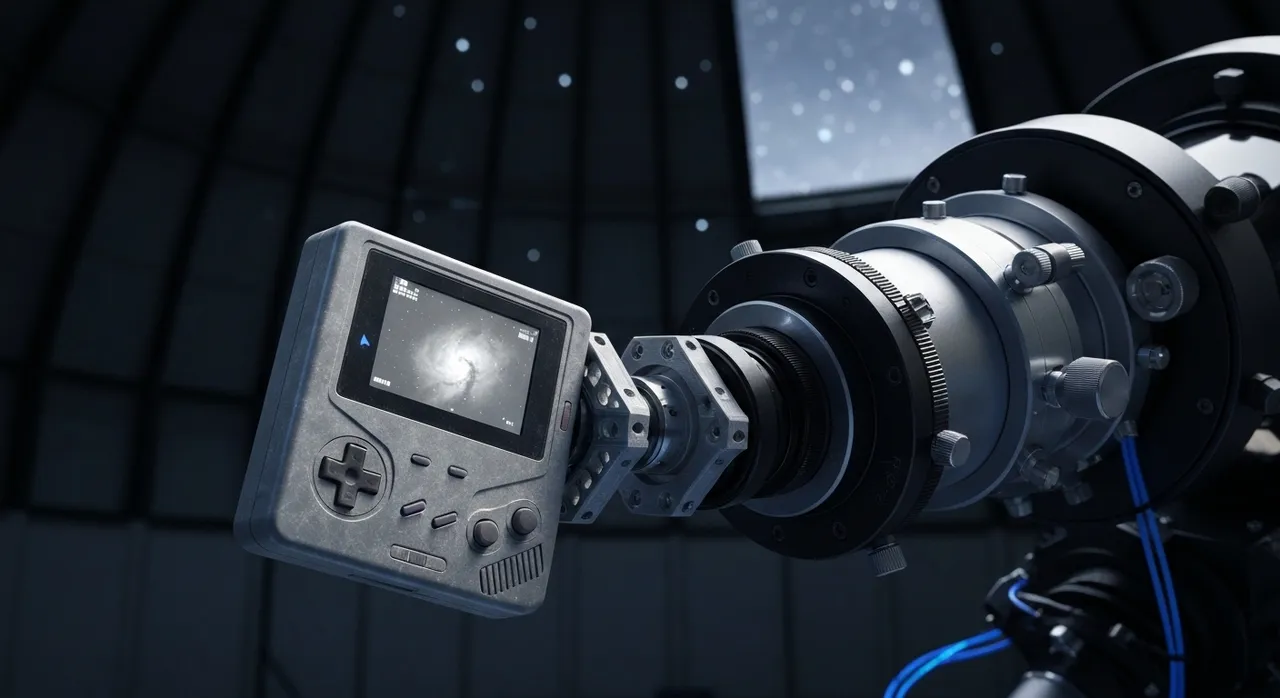
While the C-mount modification allowed the Game Boy Camera to accept external lenses, mounting the cartridge directly to a massive astronomical telescope required bespoke engineering. Chris Graue and Drew van Oort designed a dedicated adapter to ensure mechanical stability, light-tightness, and precise sensor alignment.
The primary engineering goal was to create a rigid physical bridge that could insert into the telescope’s eyepiece and hold the modified cartridge steady against the telescope’s tracking movements. Their finalized design consists of a multi-stage adapter system:
- The 1.25-Inch Pressure-Fit Sleeve: The primary component is a 3D-printed tube engineered to slip tightly into a standard 1.25-inch telescope eyepiece holder.
- The Male C-Mount Interface: A standard male C-mount adapter ring is glued into the 3D-printed tube. The modified Game Boy Camera cartridge, equipped with its C-mount receiver, screws directly onto this threaded ring.
- The Large-Format Reduction: Because the Mount Wilson 60-inch telescope utilizes a massive 4-inch eyepiece assembly (provided by the observatory’s telescope operator, Geovanni “The Telescope Man”), the team used a series of reduction adapters to step down the light path to fit their 1.25-inch printed sleeve.
This design successfully positioned the Game Boy’s tiny Sharp CMOS sensor precisely at the telescope’s focal plane, converting the 1908 optical giant into a singular, ultra-powerful prime lens.
Breaking Records: The Optics of Game Boy Astrophotography
When coupled with the Mount Wilson 60-inch Cassegrain telescope, the Game Boy Camera became part of an optical system of unprecedented proportions. The telescope operates with a massive primary mirror aperture and a native focal length of 24,384 mm (roughly 960 inches) at an f/16 focal ratio.
In optics, pairing a very small sensor with a long focal length lens yields an incredibly narrow field of view. This relationship is quantified by the “crop factor” relative to a standard 35mm full-frame film format. Because the Game Boy Camera’s active sensor area is exceptionally tiny (under 3 mm diagonally), it introduces a crop factor of roughly 30x. When multiplying the telescope’s native focal length of 24,384 mm by this crop factor, the resulting equivalent focal length is approximately 730,000 mm.
According to the dedicated Game Boy Camera astrophotography community, this setup officially secured the world record for the longest focal length lens and the most distant celestial target ever captured using the retro Nintendo hardware. To put this in perspective, a high-end wildlife or sports telephoto lens typically tops out at 800 mm. Graue’s setup bypassed this by several orders of magnitude, turning a 1990s handheld gaming console into an ultra-narrow-field deep-space observer.
Targeting the Cosmos: From Lunar Washout to Jovian Victory
Operating a century-old telescope is an exacting task, and doing so with an 8-bit gaming interface introduced unique, unpredictable hurdles. During a private tour of the facility, Graue and his team initially aimed the 60-inch telescope at the Moon.
Although the Moon is a traditional target for amateur astrophotographers, it proved to be a failure on this setup. Because the 60-inch telescope acts as an enormous light bucket, and the Moon is relatively close (approximately 240,000 miles away), the sheer volume of gathered photons completely saturated the Game Boy’s sensitive, low-dynamic-range sensor. The image rendered on the console’s passive-matrix screen was a blown-out, featureless white glare. Software adjustments inside the Game Boy’s operating system were unable to compensate for the massive influx of light coming from the 1.5-meter primary mirror.
To resolve this, the team re-targeted the telescope toward Jupiter, located approximately 444 million miles from Earth. At this distance, the light-gathering capacity of the Mount Wilson telescope was perfectly balanced by the natural attenuation of deep space. When Jupiter aligned with the optical path, a clear, sharp, spherical outline appeared on the Game Boy’s screen.
By carefully dialling in the telescope’s focus, Graue was able to resolve the planet’s distinct atmospheric features. The final image, though limited to a 128×128 grid and four shades of gray, clearly displayed the parallel cloud bands traversing the gas giant’s surface. To complete the retro-computing aesthetic, Graue linked his console to an original Game Boy thermal receipt printer, outputting physical, pixelated strips of the Jovian atmosphere directly on thermal paper.
Democratizing the Hack: Open-Source Files and the 1.25-Inch Standard
Following intense viral interest from both retro-tech communities and amateur astronomy circles, Chris Graue released the complete 3D-printable schematics for the custom telescope adapter alongside a DIY tutorial video on July 9, 2026.
The open-source package is designed to lower the barrier of entry for other makers, offering several key resources:
- STL and STEP Files: High-precision CAD files are provided for free download, allowing users to 3D-print the adapter shell on standard FDM or resin printers. The inclusion of parametric STEP files allows advanced makers to modify the physical dimensions to compensate for different printer tolerances.
- Universal 1.25-Inch Eyepiece Compatibility: While Graue’s Mount Wilson shoot required specialized reduction steps to fit a 4-inch astronomical eyepiece, the core 3D-printed adapter is designed to fit standard 1.25-inch telescope eyepieces. This is the universal standard for consumer-grade backyard telescopes, enabling hobbyists to mount their own Game Boy Cameras to modest consumer optics.
- Personal Branding: In a humorous nod to his creative roots, the digital files feature the engraved logo of Graue’s punk-pop band, Lo(u)ser.
This open-source release bridges the gap between high-level hardware hacking and accessible backyard astronomy. It demonstrates that while access to a historic 60-inch telescope is rare, the underlying mechanical engineering can be easily replicated by anyone with a 3D printer. By sharing these schematics, Graue and van Oort have democratized a highly specialized hardware bridge, breathing new life into a humble 1998 gaming accessory and preserving the playful, experimental spirit of early digital photography.
Written by
TempMail Ninja
Digital privacy and online security expert. Passionate about creating tools that protect users' identity on the internet.