Hacker Archaeology: The NaClCON BBS Launch and the Retro-Digitalism Trend
Article Content
On April 17, 2026, a quiet but significant tremor echoed through the foundations of the cybersecurity world. It wasn’t a zero-day exploit or a massive data breach, but rather the revival of a protocol many assumed had been relegated to the annals of telecommunications history. The launch of the NaClCON BBS (accessible via telnet: naclconbbs.net) marks a pivotal moment in the 2026 “retro-digitalism” movement, serving as both a precursor to the upcoming NaClCON (Salt Con) conference and a masterclass in hacker archaeology.
Resurrecting the Dial-Up Ghost: Why a BBS in 2026?
In an era dominated by hyper-converged cloud environments and AI-driven security orchestration, the return to a Bulletin Board System (BBS) might seem like an exercise in pure nostalgia. However, the architects behind NaClCON—scheduled to take place in late May at Carolina Beach—view this as a strategic retreat from the commercialized “dead web.” The hacker archaeology project is not just about looking at old code; it is about reclaiming the sovereign digital spaces that existed before the internet was consolidated into a handful of corporate-owned platforms.
The BBS serves as the community’s digital hearth. While modern social media relies on algorithms to dictate engagement, the NaClCON BBS utilizes the Synchronet v3.21 engine to foster synchronous, human-to-human interaction. By stripping away the noise of the modern HTTP/3 landscape, the sysops have created a high-signal environment where “war stories”—first-hand accounts of early phreaking exploits, PBX incursions, and the legendary exploits of the 80s and 90s—can be preserved without fear of censorship or algorithmic suppression.
The Technical Architecture of Hacker Archaeology
To the uninitiated, the NaClCON BBS looks like a relic of 1988, but under the hood, it is a sophisticated hybrid of legacy protocols and modern infrastructure. The sysops have opted for a Synchronet installation hosted on a modern Amazon EC2 instance, proving that the tools of the past can thrive on the backbones of the future. This “bridge” approach allows the system to remain highly available and performant while maintaining the tactile feel of a 14.4k modem connection.
Modern Hosting Meets Legacy Logic
Running a BBS on EC2 presents unique challenges that the project has documented with meticulous detail. The technical implementation includes:
- Synchronet v3.21 JavaScript Modularity: The system utilizes Synchronet’s extensive JS-driven engine to handle custom logic, including the Deuce’s Lightbar Shell, which provides a modern navigational feel within a terminal-bound environment.
- Terminal-Adaptive ANSI Art: In a nod to the varying hardware of its user base, the splash art is designed to be terminal-adaptive. Whether a user connects via a vintage Commodore 64 or a modern terminal emulator on a 4K monitor, the ANSI art renders in either 80-column or wide-format, preserving the visual integrity of the “magenta-and-yellow” palette.
- Security Hardening: Despite its “open” appearance, the BBS is hardened against modern automated threats. The sysops implemented custom
fail2banfilters and anSSH_ANYAUTHworkaround to mitigate brute-force attempts that commonly plague cloud-hosted instances. - TLS-Downgrade Mitigation: One of the most discussed technical README entries on the board tells the story of “The Jamaican,” a script-kiddy who attempted a TLS-downgrade attack on day one. The system’s custom security scripts identified the anomaly and “silent .can’d” (cancelled) the connection, effectively blacklisting the IP without alerting the attacker.
The Aesthetic of Resistance
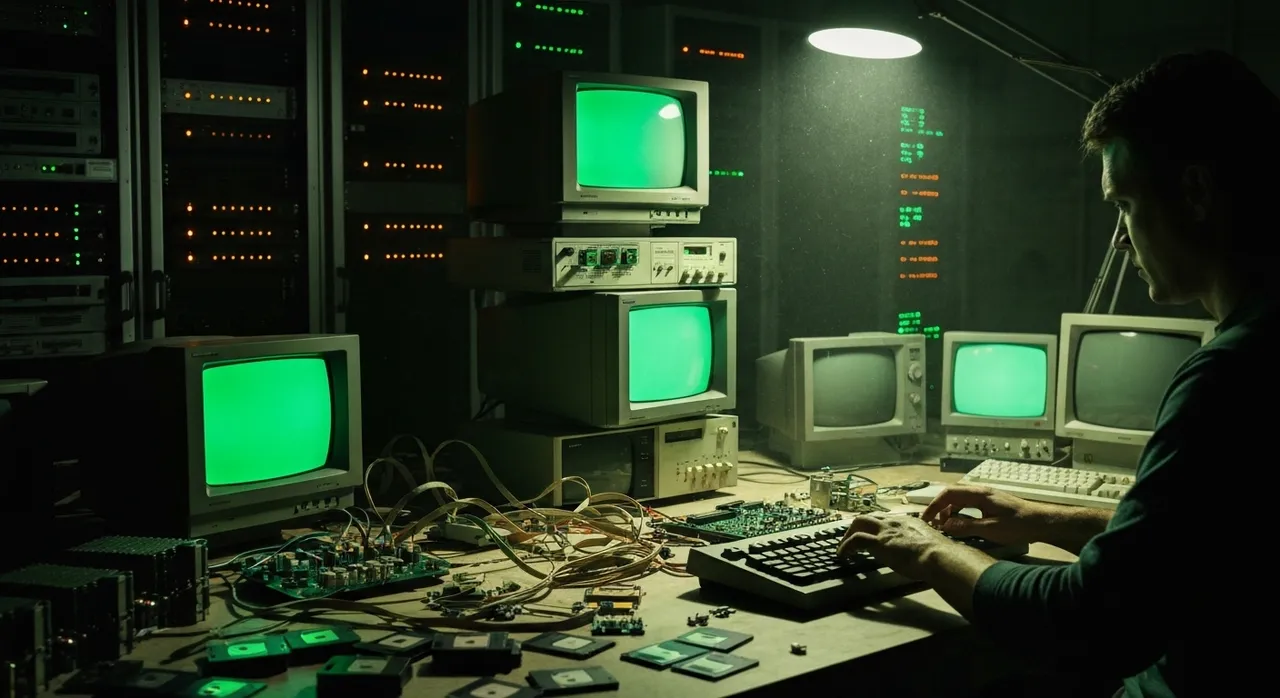
The choice of a magenta and yellow palette is more than an aesthetic preference; it is a rejection of the “matrix green” cliché that has dominated hacker iconography for decades. By opting for high-contrast, hot-pink, and vibrant yellow tones, the NaClCON BBS aligns itself with the “cyberpunk-originalist” aesthetic—a tribute to the neon-drenched covers of early issues of Mondo 2000 and the original paperback of Gibson’s Neuromancer.
“The Pelican”: AI as a Living Archive
Perhaps the most technically ambitious feature of the BBS is The Pelican. Described as a “sassy southern coastal peli-hen,” this chatbot represents a sophisticated implementation of hacker archaeology. Unlike modern LLMs trained on the generic, often sanitized data of the public internet, The Pelican’s knowledge base is narrow, deep, and hyper-specific.
The Pelican has been fine-tuned on a “Canon of Curiosity” consisting of:
- The Phrack Magazine Archive: Every issue from 1985 to the present, capturing the evolution of technical exploits and scene culture.
- The Rainbow Series: The Department of Defense’s “Trusted Computer System Evaluation Criteria” (TCSEC), including the legendary Orange Book, which defined security standards for decades.
- The Hacker’s Manifesto: Loyd Blankenship’s (The Mentor) 1986 seminal text, providing the philosophical backbone for the bot’s interactions.
- William Gibson’s Neuromancer: Ensuring the bot speaks the dialect of the “sprawl,” blending technical precision with the poetic grit of the cyberpunk genre.
Users can interact with The Pelican in one-on-one private messages or in multinode chat rooms. She serves as a digital librarian, capable of citing specific Phrack articles or explaining the nuances of Class C2 security levels under the Orange Book. By restricting the training data to these specific sources, the developers have bypassed the “hallucination” problems of larger models, creating a tool that feels more like an Oracle of the Old Guard than a corporate assistant.
Seeding the Message Bases: The Preservation of “War Stories”
The true value of any BBS lies in its message bases, and the NaClCON BBS is currently seeing a surge in “war stories.” These are not merely historical anecdotes; they are technical blueprints of the logic used to navigate early systems. In the “Hacker History” sub-board, users are documenting the technical details of:
- Blue Boxing and 2600Hz: Deep dives into the signaling protocols of the 1970s PSTN.
- VMS and Unix Exploits: Retrospectives on the vulnerabilities that allowed the first generation of network explorers to traverse the ARPANET and early internet.
- Social Engineering in the Pre-Digital Age: Strategies used by hackers like Kevin Mitnick and the Legion of Doom to gain access through human interaction long before MFA was a concept.
This initiative represents a core tenet of hacker archaeology: the belief that understanding the history of a system is the first step toward securing its future. By archiving these stories in a decentralized, user-moderated format, the NaClCON community is building a repository of knowledge that is immune to the link-rot and platform-decay of the modern web.
NaClCON 2026: The Physical Manifestation of the Ethos
The BBS is merely the preamble to the main event. NaClCON 2026, set to take place from May 31 to June 2 in Carolina Beach, North Carolina, promises to be an intimate gathering of 300 individuals dedicated to the history and community of hacking. The conference tagline, “Play Hard. Hack Harder,” reflects a shift away from the “suit-and-tie” corporate security conferences that have become the industry standard.
The conference will feature:
- The Pirate Pieces of Eight CTF: A Capture the Flag event focused on legacy systems and historical exploit techniques.
- Old-School Tech Demos: Hands-on sessions with VAX/VMS systems, 8-bit computers, and vintage telecommunications hardware.
- Hacker Book Fair: A curated collection of physical zines, rare technical manuals, and cyberpunk literature.
- The Main Stage Speakers: Including legends from L0pht Heavy Industries and early contributors to Phrack, focusing on the cultural shifts that shaped the current infosec landscape.
The conference’s focus is explicitly “no zero-days, no AI hype.” Instead, the focus is on the enduring ethos of the community—the ideas, moments, and people that built the foundations of our digital world. The BBS acts as the triage center for these ideas, allowing attendees to build connections and technical rapport weeks before they ever meet on the sands of Carolina Beach.
Conclusion: The Future is Retro
The launch of the NaClCON BBS is a testament to the resilience of hacker culture. In 2026, as we grapple with the complexities of generative AI and the erosion of digital privacy, the return to a terminal-based, text-driven system feels like a radical act of defiance. It is a reminder that the internet was once a collection of nodes, not a singular monolith, and that the spirit of exploration that defined the early BBS scene is still very much alive.
Through hacker archaeology, the NaClCON project is not just digging up the past; it is planting the seeds for a more decentralized and human-centric digital future. For those willing to open a terminal, type telnet naclconbbs.net, and navigate the magenta-and-yellow menus, a world of forgotten knowledge awaits. The Pelican is waiting, the message bases are filling, and the “old guard” is just getting started.
Written by
TempMail Ninja
Digital privacy and online security expert. Passionate about creating tools that protect users' identity on the internet.