Kazakhstan Pentagram: Uncovering the Truth Behind the Viral Google Maps Mystery
Article Content
In the early days of global satellite mapping, the world shrank in ways that were both exhilarating and deeply unsettling. As armchair explorers navigated the globe from the comfort of their monitors, they occasionally stumbled upon terrestrial anomalies that defied immediate explanation. None of these digital artifacts captured the collective dread and curiosity of the early web quite like the infamous Kazakhstan pentagram. Etched into a desolate, windswept corner of the northern Kazakh steppe, this massive, mathematically precise geometric symbol visible from space triggered years of occult panic, conspiracy theories, and cyber-sleuthing. Decades after it first went viral, the site has resurfaced in modern cultural discourse not as a gateway to the underworld, but as a premier monument of internet archaeology—a masterclass in how human psychology, geopolitical ruins, and digital platforms collide to manufacture modern mythologies.
The Digital Anatomy of the Kazakhstan Pentagram
To understand the hysteria, one must first look at the sheer isolation and precision of the symbol itself. Located at the exact geographic coordinates of 52°28'47"N, 62°11'08"E, the Kazakhstan pentagram sits on the lonely southern shore of the Upper Tobol Reservoir. The nearest sign of modern civilization is the industrial town of Lisakovsk, situated roughly 12 miles (20 kilometers) to the east.
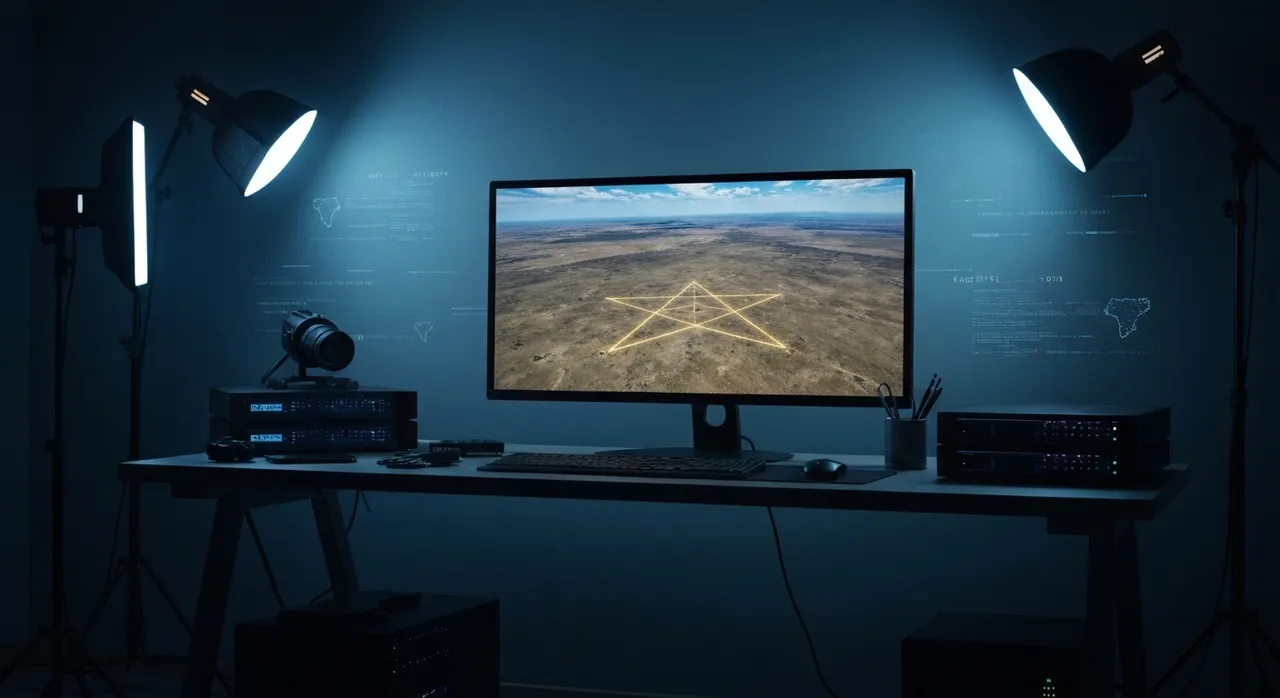
Viewed from a high-altitude satellite perspective on Google Earth, the structure is striking. It is a near-perfect, five-pointed star enclosed within a massive circle, measuring approximately 1,200 feet (360 meters) in diameter. The lines of the star are not merely scratched into the dirt; they are defined by thick, dark lines of vegetation that contrast sharply against the pale, arid tones of the surrounding steppe.
In the late 2000s and early 2010s, as Google Maps grew into a mainstream global phenomenon, this bizarre geometry became the perfect breeding ground for online folklore. The dread was exponentially amplified by several key technical features of early Google Maps:
- The “Adam” and “Lucifer” Map Pins: Early web users who zoomed into the exact center of the star discovered two user-submitted location markers. One was labeled “Adam,” and the other, far more ominously, “Lucifer”.
- The Vanishing Zoom: For a brief period during the height of the viral panic, zooming in too close to the coordinates would cause the screen to glitch or disable deep zoom functionality. This was a standard limitation of low-resolution satellite coverage in remote regions, but to conspiracy theorists, it looked like an active corporate cover-up.
- Inverted Orientation: Because standard maps are oriented with North at the top, the pentagram appeared “inverted”—with one of its points facing due south. In esoteric symbolism, an inverted pentagram—most famously associated with the Sigil of Baphomet used by the Church of Satan—represents the perversion of power and the triumph of the carnal.
The Occult, the Military, and the Myth of the Steppes
Before the true history of the site was revealed, the internet’s imagination ran completely wild. Forums like Reddit, 4chan, and conspiracy blogs like Infowars and The Vigilant Citizen spun intricate webs of speculation. Some argued that the star was an ancient pagan monument built by prehistoric nomads. This theory was actually bolstered by genuine regional history: the area surrounding Lisakovsk is indeed a hotbed of archaeological interest, heavily dotted with untouched Bronze Age settlements, cemeteries, and burial grounds from the Andronovo cultural complex. It was easy for armchair historians to conflate these genuine ancient ruins with the massive geometric symbol nearby.
Other theories took a more modern, militaristic approach. Some hypothesized that the star was a decommissioned Soviet surface-to-air missile (SAM) site or a secret Russian military outpost. During the Cold War, Soviet air defense complexes did occasionally employ hexagonal or star-shaped road configurations to optimize the radar and launch trajectories of their missile systems. However, military analysts quickly pointed out that the geometry of the Lisakovsk star was far too simple, lacking the heavy concrete blast pads, defensive trenches, and access roads characteristic of active military installations.
Then came the dark occult theories. Creepypasta writers claimed the site was a highly active altar for a global cabal of devil worshippers. The “Adam” and “Lucifer” pins were cited as proof that the site was “ground zero” for a dark ritual designed to summon malevolent entities. For years, the Kazakhstan pentagram existed in the public consciousness as an unresolved, deeply creepy anomaly of the digital age.
Demystifying the Star: Emma Usmanova and the Soviet Reality
The truth, when it finally arrived, was far more grounded in the sociopolitical history of the 20th century than the supernatural. The mystery began to unravel when a Russian-language description appeared on the map’s metadata, which translated to “unfinished summer camp, Denisovsky area, Kostanay, Kazakhstan”.
This clue was eventually validated by Emma Usmanova, a highly respected archaeologist with decades of field experience excavating the ancient Bronze Age ruins of the Lisakovsk region. Usmanova explained that the massive geometric star was not an occult altar, but the overgrown footprint of an abandoned Soviet-era public park.
During the decades of the USSR—of which the Kazakh Soviet Socialist Republic was a crucial member state—the five-pointed red star was the ultimate patriotic symbol of the state. It was stamped on everything from military medals to municipal architecture. In the late Soviet period, municipal planners and youth organizations frequently laid out summer camps and parks in the shape of the Soviet star. The plan for the site near the Upper Tobol Reservoir was to build a grand park or a Pioneer summer camp, featuring a central plaza with tree-lined pedestrian paths and roadways radiating outward to form the five points of the star.
However, the project’s timeline collided with history. Following the sudden collapse of the Soviet Union in 1991, funding evaporated overnight. The half-finished park was completely abandoned to the elements. Over the subsequent decades, a natural process took place:
- The dirt pathways and roads that formed the outline of the star remained relatively clear of heavy growth due to their compacted soil.
- The rows of poplars and wind-resistant trees that had been meticulously planted along the edges of the planned pathways grew unchecked.
- As the surrounding steppe suffered from dry, harsh winds, these dense rows of trees flourished near the reservoir’s water table.
This biological growth inadvertently sharpened the geometric lines of the star. What looks from space like a giant, meticulously carved occult drawing is, in reality, simply a collection of trees growing exactly where Soviet urban planners had planted them decades ago.
Digital Pareidolia and the Birth of Internet Archaeology
While the physical mystery has been solved, the cultural phenomenon of the Kazakhstan pentagram remains highly relevant. It stands as a textbook study in what psychologists and digital theorists refer to as digital pareidolia—the psychological tendency for the human brain to perceive meaningful shapes, patterns, or faces in random or mundane visual data.
The human mind is hardwired to seek out patterns as an evolutionary defense mechanism. When presented with low-resolution satellite imagery, compression artifacts, and stark geographic symmetry, our brains instinctively leap to fill in the blanks with culturally significant iconography. We see this happen repeatedly across Google Earth:
- The Badlands Guardian: A natural geological formation in Alberta, Canada, where wind and water erosion have formed the unmistakable shape of an Indigenous head in profile.
- The Chile Demon Face: A deeply unsettling, symmetrical alien-like face spotted in the mountains of Parque Nacional Alberto de Agostini, which is actually the result of satellite image-stitching artifacts and terrain shadowing.
- The Ghost on the Balcony: A blurry, terrifying figure in Nancy, France, that turned out to be a simple tiki statue distorted by camera angles and Google’s blurring algorithms.
In the case of the Kazakhstan pentagram, pareidolia was weaponized by early Web 2.0 interface designs. At the time, platforms like Google Maps allowed users to crowdsource data via tools like Google Map Maker. This democratization of metadata meant that any user with an internet connection could tag a coordinate. The “Adam” and “Lucifer” pins were not evidence of satanic worship; they were simply the digital graffiti of bored internet pranksters playing along with a viral meme. Yet, because the interface displayed these user-generated pins with the same official authority as major geographical landmarks, the public fell victim to a digital illusion.
The Legacy of a Pixelated Relic
Today, looking back at this viral milestone, the Kazakhstan pentagram has transitioned into the annals of “internet archaeology.” It represents a specific era of the web—an age of innocence when the digital world still felt vast, haunted, and full of hidden secrets waiting to be unearthed by curious clickers.
The site remains a fascinating hybrid of two very different ruins. On one hand, it is a physical ruin of the Soviet Union—a monument to an ambitious empire that collapsed, leaving its architectural dreams to rot in the Kazakh wind. On the other hand, it is a digital ruin—a monument to early internet culture, demonstrating how easily a lack of context, a pair of prankster-made map pins, and a satellite view can transform a decaying park into a global urban legend. The pentagram is a reminder that while satellite technology has mapped every square inch of our physical world, the human capacity for myth-making will always find a way to populate the blank spaces with monsters.
Written by
TempMail Ninja
Digital privacy and online security expert. Passionate about creating tools that protect users' identity on the internet.