Ludii AI Archaeology: Decoding the Ancient Roman Game Mystery
Article Content
The silence of two millennia has finally been broken—not by the stroke of an archaeologist’s brush, but by the relentless processing power of a specialized game engine. On April 15, 2026, researchers at Het Romeins Museum (the Roman Museum) in Heerlen, the Netherlands, announced a breakthrough that has bridged the gap between physical artifacts and the intangible culture of play. By leveraging Ludii AI Archaeology, a multidisciplinary team has successfully deciphered the rules of a game that had been “lost” to history for over 1,500 years.
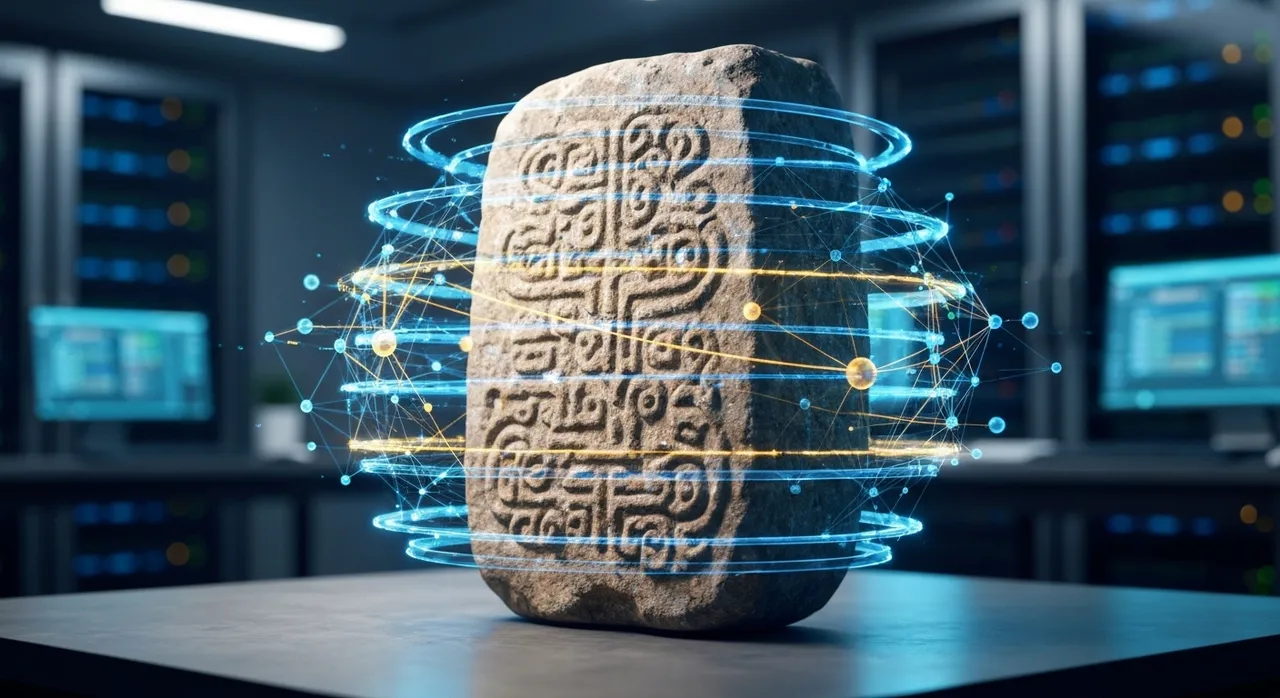
The center of this mystery was a humble limestone slab known as “Object 04433.” Discovered at the site of the ancient Roman settlement of Coriovallum (modern-day Heerlen) at the turn of the 20th century, the artifact had long puzzled scholars. Its surface, etched with a peculiar grid of four diagonals and a single straight line, defied classification as standard Roman art or architectural drafting. For decades, it sat in the museum’s collection as a curiosity—a silent witness to a past whose rules we no longer understood. Today, that silence has ended, revealing a complex strategy game that pushes the known timeline of European “blocking games” back into the Roman era.
The Mechanics of Ludii AI Archaeology: Playing the Past
The success of this project was not a result of a simple database search, but of a sophisticated simulation environment developed at Maastricht University. The Ludii AI Archaeology framework is built upon the “Digital Ludeme Project,” an ERC-funded initiative designed to map the “DNA” of human games. In this system, games are broken down into ludemes—fundamental units of information such as “move to adjacent space,” “capture by leaping,” or “alternate turns.”
To decode Object 04433, the research team, led by Dr. Walter Crist of Leiden University and Dennis Soemers of Maastricht University, followed a rigorous technical protocol:
- 3D Photogrammetric Mapping: Restoration studio Restaura in Heerlen produced high-resolution 3D scans of the stone, revealing micro-topographic details invisible to the naked eye.
- Microscopic Use-Wear Analysis: The team identified specific patterns of abrasion along the incised lines. One diagonal, in particular, showed significantly more wear than the others, suggesting it was a “high-traffic” route for game pieces.
- Algorithmic Stress-Testing: The Ludii system ran thousands of simulations, testing over 130 different rule configurations derived from historical European games like the Scandinavian haretavl and the Italian gioco dell’orso.
- AI Agent Evaluation: Using Alpha-Beta search algorithms, AI agents played the game against themselves. The system looked for rule sets that were not only “playable” and “balanced” but also generated wear patterns that matched the physical damage on the original limestone.
The results were conclusive: the AI identified nine potential configurations that matched the physical evidence, all of which were variations of a specific “blocking game.” This discovery is significant because it suggests that the Romans were playing asymmetric strategy games—where one player has more pieces but different objectives than the other—centuries earlier than previously thought.
Object 04433: From Spolia to Strategy
The physical composition of Object 04433 provides a fascinating glimpse into the life of a Roman frontier town. The stone is white Jurassic limestone, originally quarried from Norroy in northeastern France. This material was typically reserved for grand architectural elements, such as pillars and funerary monuments, due to its soft, carvable nature and aesthetic resemblance to marble. However, Object 04433 is small—measuring roughly 21 by 14.5 centimeters and weighing 3.38 kilograms.
Archaeologists believe the slab was originally a piece of spolia—recycled architectural debris—that was salvaged and recut during the late Roman period (c. 250–476 AD). This was a time when Coriovallum was transforming from a bustling pottery-producing center into a fortified settlement. The fact that someone took the time to carefully shape and smooth all faces of this recycled block suggests that the game was more than a casual scratch in the dirt; it was a dedicated luxury object of leisure.
The grid itself—a rectangle bisected by diagonals—is the key to what the researchers have dubbed “Ludus Coriovalli” (The Game of Coriovallum). Unlike Ludus Latrunculorum (the “Game of Soldiers”), which focused on capturing an opponent’s pieces, Ludus Coriovalli is a game of containment. The AI simulations revealed that the most “human-logical” way to play involved an asymmetric setup: four “Hounds” against two “Hares.”
The Rules of Ludus Coriovalli
Based on the Ludii AI Archaeology reconstruction, the game follows a strict logic that prioritizes positioning over destruction:
- The Setup: The four “Hounds” (traditionally dark pieces) start on the four outer points of the right side of the board. The two “Hares” (light pieces) start on the two outer points on the left.
- The Movement: Players alternate turns moving one piece to any adjacent empty node along the marked lines. There is no jumping or capturing.
- The Hound Objective: The Hounds win by maneuvering the Hares into a position where they have no legal moves remaining—a “deadlock.”
- The Hare Objective: The Hares win by successfully evading the Hounds for a set number of turns or by breaking through the Hound line to reach the other side.
The AI found that the heavy wear on the central diagonal was the result of the Hares’ desperate attempts to switch flanks, a move that the AI “Hounds” consistently tried to prevent. This mathematical alignment between machine-learned optimal play and ancient physical abrasion provides a level of forensic certainty that was previously unattainable in digital archaeology.
Coriovallum: A Hub of Roman Leisure
The discovery of Ludus Coriovalli changes our understanding of the social fabric of the Germania Inferior province. Heerlen, known as Coriovallum, was a vital node in the Roman road system, connecting the Rhine to the coast. It was a town defined by its massive public bathhouse—the largest in the Netherlands—and its thriving pottery industry.
Games were an essential part of the Roman bathhouse experience, but they were often fleeting, played with pebbles in the dust. The existence of Object 04433 suggests a more permanent, perhaps even professionalized, culture of gaming. As Dr. Walter Crist noted, “Most everyday Roman games were drawn in materials unlikely to survive. This limestone piece is a rare survivor that tells us about the complexity of the mental landscape of the people living on the empire’s northern edge.”
The asymmetric nature of the game is also culturally telling. Unlike the symmetric balance of modern Chess or Checkers, blocking games like “Hounds and Hares” often reflect social hierarchies or the predatory nature of frontier life. That the AI identified this specific genre of play is a testament to its ability to recognize cultural patterns within raw geometric data.
The Future of Digital Archæoludology
The work on Object 04433 is a “historic first,” representing the most advanced application of Ludii AI Archaeology to date. It marks the transition from archaeology being a purely descriptive science to one that is predictive and functional. We are no longer just asking “What is this object?” but rather “How did this object facilitate human behavior?”
Dr. Matthew Stephenson, a computer scientist from Flinders University who collaborated on the project, emphasizes the broader implications: “This is a promising new tool for understanding ancient games that don’t resemble those known from surviving texts or artworks. We can now test behavioral hypotheses on artifacts without any written record.”
The Digital Ludeme Project has now cataloged over 1,000 traditional strategy games from around the world. By using AI to calculate “ludemic distance”—the number of rule changes needed to turn one game into another—researchers can trace the migration of people and ideas across the globe. If a game found in the Netherlands shares the same ludemes as a game found in modern-day Italy or Scandinavia, it serves as a computational proxy for trade routes and cultural exchange.
As we move deeper into 2026, the success of the “Object 04433” mission will likely inspire museums worldwide to re-examine their “unclassified” storage units. Millions of fragments currently sit in boxes labeled “unknown.” With the Ninja Editor precision of modern AI, we are finally realizing that these are not just stones—they are the discarded software of ancient minds, waiting for the right processor to boot them back to life.
The Ludus Coriovalli is now available for the public to play online through the Maastricht University portal, allowing 21st-century users to match wits with a game last played when the Roman Empire still claimed the banks of the Meuse. In the end, the Ludii AI has done more than just solve a mystery; it has restored a piece of human connection that had been forgotten by time, proving that while empires fall, the impulse to play—and the strategies we use to win—remain eternal.
Written by
TempMail Ninja
Digital privacy and online security expert. Passionate about creating tools that protect users' identity on the internet.