Plasticizer Migration: Why Your Retro Gear Cables Melt into Plastic
Article Content
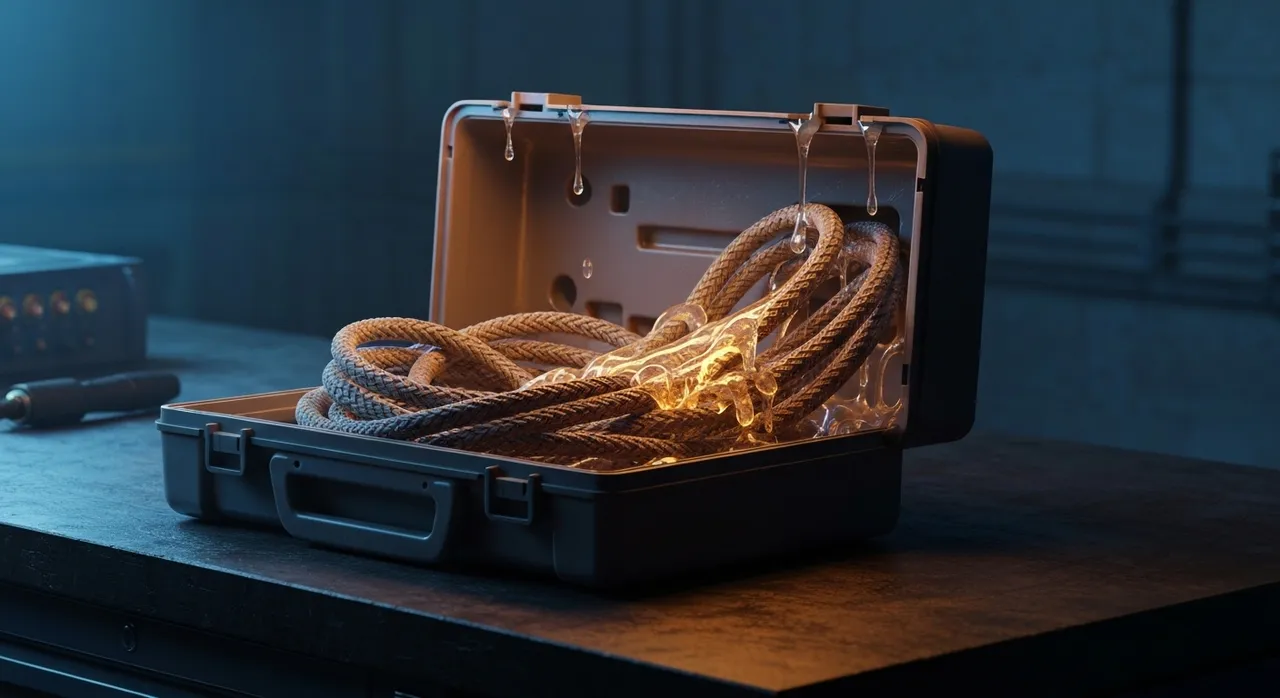
For decades, retrocomputing and vintage gaming collectors have been haunted by a bizarre hardware mystery. Upon pulling pristine, decades-old gear—such as Commodore datasettes, classic consoles, and heavy external power bricks—out of long-term storage, they would discover deep, cable-shaped indents permanently etched into the hard plastic casings. It frequently looked as though the power cords had literally melted directly into the hardware, leaving collectors highly confused since the gear had been completely powered down, unplugged, and kept in cool, dark storage environments. There was no electricity, no heat, and no logical source of thermal energy. Yet, the physical evidence of “melting” was undeniable.
The science behind this long-standing mystery was recently brought to light, unpacking a deep-dive analysis inspired by a technical video demonstration from the YouTube channel Run Stop Restored. Far from being a thermal event, the culprit behind this physical distortion is actually a slow-motion chemical phenomenon known as plasticizer migration. This chemical reaction occurs at the interface where two distinct classes of polymers—flexible cable jackets and rigid console shells—are forced into direct, pressurized contact over long periods of storage.
The Molecular Combatants: PVC vs. ABS Plastics
To understand why vintage hardware appears to melt in cold storage, we must examine the polymer chemistry of early consumer electronics. Hardware of the 1970s and 1980s relied heavily on two main thermoplastic formulations, each chosen for its specific physical properties:
- Polyvinyl Chloride (PVC): Widely used for flexible vintage cable insulation, native PVC is actually an incredibly rigid, brittle polymer. Due to the high polarity of its carbon-chlorine bonds, PVC chains bind tightly to one another via strong intermolecular forces. To make these cables flexible, bendable, and easy to package, manufacturers blended PVC with organic chemical additives known as plasticizers—most commonly phthalate esters like di-2-ethylhexyl phthalate (DEHP) or diisononyl phthalate (DINP).
- Acrylonitrile Butadiene Styrene (ABS): This incredibly tough, rigid terpolymer was the go-to material for console shells, keycaps, and computer housings. ABS gains its strength from its structural components: acrylonitrile provides chemical resistance, butadiene rubber particles absorb impact, and styrene gives the housing its glossy, hard surface finish.
The core structural vulnerability of flexible PVC lies in how these plasticizers are integrated. Phthalates do not form covalent chemical bonds with the PVC polymer backbone; they are merely physically interspersed between the polymer chains, acting as molecular lubricants or “spacers”. This physical dispersion lowers the glass transition temperature ($T_g$) of the PVC, allowing the chains to slide past one another. However, because these plasticizer molecules are unbound, they remain highly mobile within the polymer matrix.
The Chemistry of Plasticizer Migration
When collectors prepare their hardware for storage, a very common practice is to wrap the power or connection cables tightly around the console’s plastic casing to keep the package neat. This creates the exact physical environment required for plasticizer migration to occur. Under the constant, localized mechanical pressure of the wrapped cable, the highly mobile phthalate molecules in the PVC begin a slow thermodynamic journey toward the surface of the cord—a process known as exudation.
Once these phthalate molecules reach the surface of the PVC insulation, they do not simply evaporate. Instead, because ABS is highly susceptible to these specific organic solvents, the phthalates partition across the contact boundary and dissolve directly into the adjacent ABS casing. The hard ABS housing effectively acts as a physical sponge or chemical reservoir, absorbing the migrating plasticizers.
As the localized area of the ABS casing absorbs the phthalates, its own molecular structure is disrupted. The absorbed plasticizers dramatically lower the glass transition temperature of the ABS at the point of contact, transitioning the hard, rigid plastic into a soft, gooey, semi-liquid state at room temperature. Under the constant mechanical pressure of the tightly wrapped cord, this softened ABS deforms and flows around the cable. When the system is finally unpacked decades later, pulling the cable away reveals a permanent, deep indentation that perfectly mimics a thermal burn. Once the cable is removed and the immediate source of migrating plasticizers is severed, the remaining affected ABS slowly resolidifies, leaving behind a permanent, scarred “melt” mark.
The Environmental Catalysts: Kinetic Drivers of Material Decay
While the thermodynamic drive to reach concentration equilibrium is the root cause of this degradation, several environmental factors dictate how quickly the migration will ruin a piece of history:
- Mechanical Contact Pressure: Tightly wrapping cords around consoles eliminates any air gaps and increases contact surface area. This physical pressure acts as a mechanical pump, driving the molecular exchange at the interface.
- Ambient Temperature: Higher storage temperatures provide thermal kinetic energy to the polymer molecules. This causes the PVC chains to expand, increasing the free volume within the plastic and allowing the phthalate molecules to diffuse through the polymer matrix at an accelerated rate. In general polymer science, the rate of plasticizer diffusion approximately doubles for every 10°C (18°F) rise in temperature.
- Polymer Quality and Age: Vintage plastic formulations from the 1970s and 1980s were manufactured prior to modern regulatory standards. These early materials featured high concentrations of highly volatile, low-molecular-weight phthalates that are far more prone to migration than modern high-molecular-weight polymeric plasticizers.
The Dual Tragedy: Degradation of Both the Cable and the Case
The damage caused by this chemical migration is not a one-sided issue; it is a mutual destruction of both components. While the hard ABS casing of the retro computer or console suffers catastrophic cosmetic and structural deformation, the flexible PVC cable simultaneously undergoes a devastating loss of its internal physical properties.
As the PVC cord bleeds out its internal plasticizers, it loses the very agents that gave it flexibility. Over time, the cord undergoes a material transition, reverting to its native, brittle state. This leads to a phenomenon known to vintage collectors as “dry rot,” where the cord becomes fragile, stiff, and prone to cracking, splitting, or snapping upon the slightest bend. This exposes live inner copper conductors, turning a cosmetic storage issue into a serious electrical and fire hazard.
Furthermore, in many vintage PVC cables, the exiting phthalates react directly with the underlying copper wiring. This chemical reaction produces a sticky, green, oily substance containing copper salts of phthalic acid. Known colloquially as “green goo” or “green slime,” this highly corrosive byproduct can migrate along the copper strands, eventually seeping out of connectors or power plugs, destroying PCB traces and permanently staining any materials it touches.
Preservation Strategies: Defending Vintage Collections from Chemical Self-Destruction
Because the physical indentation left by plasticizer migration is a permanent structural deformation of the ABS casing, it cannot be reversed. Therefore, preventing this chemical exchange is the only viable path forward for retro-tech archivists, museum curators, and hobbyist collectors. The retrocomputing community has established several key preservation tactics to mitigate this risk:
- Never Wrap Cables: Under no circumstances should power cords, controller lines, or connection cables be wrapped around, or left in direct contact with, the plastic housings of vintage gear during storage.
- Physical Isolation: Store cables completely unwrapped and separated from the consoles. The gold standard of vintage preservation involves storing detached cords in separate bags made of polyethylene or polypropylene, which are highly resistant to plasticizer absorption. Never use PVC-based storage bags.
- Protective Barriers: For hardware with hardwired cables (such as classic joysticks or older power supplies), use physical barriers to isolate the cable from the housing. Wrapping the cable in acid-free tissue paper, Teflon sheets, or high-density polyethylene film will block the path of migrating phthalates and safeguard the ABS.
- Strict Climate Control: Store all vintage electronics in a cool, dry, temperature-controlled environment. Minimizing heat and humidity dramatically slows the molecular kinetic energy required for plasticizers to diffuse out of the cables.
How to Deal with Active Migration and Residue
If you discover a vintage system that is currently undergoing active migration, immediate action is required to halt further damage. First, carefully peel the cable away from the plastic housing. If the cable has started to produce the dreaded “green goo” or is leaving a sticky, plasticizer-rich residue on the console shell, you must clean it immediately using high-purity isopropyl alcohol (90% or higher). Isopropyl alcohol acts as an effective solvent to dissolve the sticky phthalate residues without further dissolving the underlying ABS casing. Always wear personal protective equipment (PPE), such as nitrile gloves, when handling these degraded compounds, as legacy phthalates and copper oxides carry toxicity risks.
For systems with heavily degraded, stiff, or oozing cords, the absolute best practice is complete cable replacement. Modern replacement cables utilize advanced thermoplastic elastomers (TPE) or stable, modern polyurethane jackets. These modern plastics maintain their flexibility without the use of highly volatile phthalate plasticizers, ensuring that they will never bleed, ooze, or “melt” into your prized vintage electronics again.
Safeguarding Our Digital Heritage
The mystery of the “melting” vintage cables is a stark reminder of the material vulnerabilities inherent to early digital history. The consumer electronics of the 20th century were designed for immediate convenience and cost-effectiveness, not for multi-decade archival survival. By understanding the polymer chemistry of plasticizer migration, collectors can transition from passive storage to active, scientifically informed preservation. Isolating polymers, managing climate conditions, and choosing modern replacement materials are simple yet vital steps to ensure that these iconic machines remain physically intact for generations to come.
Written by
TempMail Ninja
Digital privacy and online security expert. Passionate about creating tools that protect users' identity on the internet.