Pompeii AI Reconstruction: First Hyper-Realistic Victim Revealed
Article Content
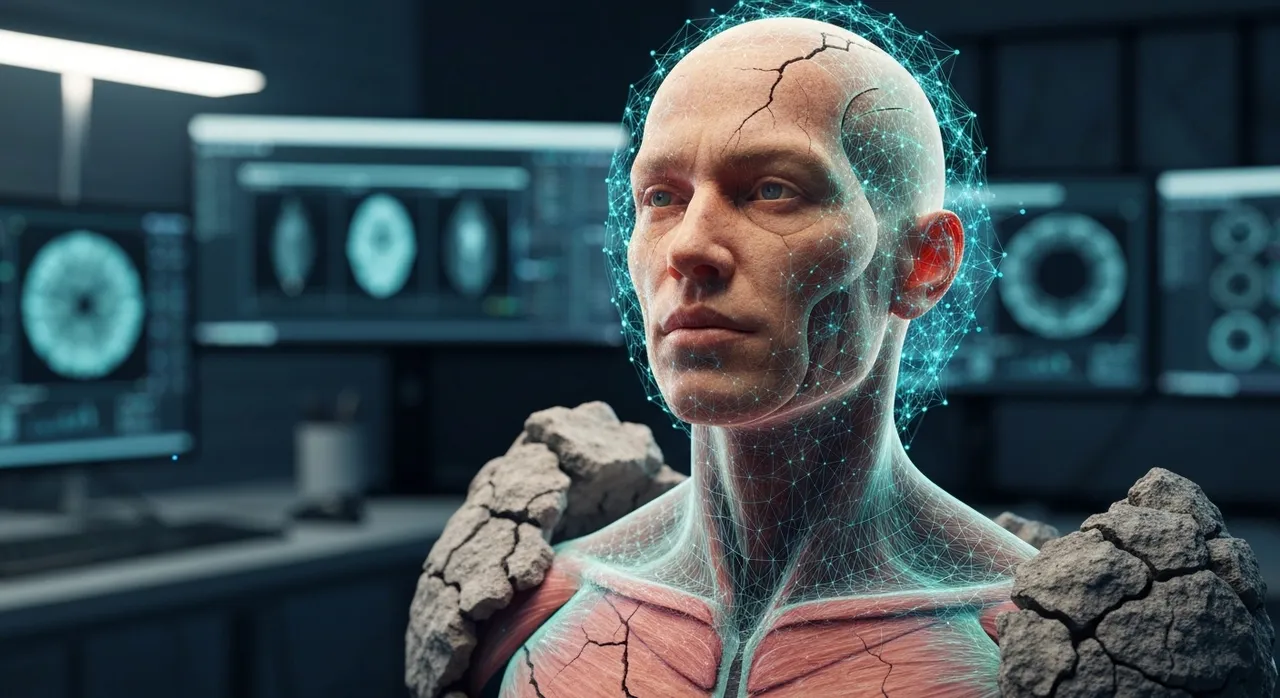
On April 27, 2026, the silence of the ancient city of Pompeii was broken not by the roar of Vesuvius, but by the hum of high-performance servers. In a landmark announcement that has electrified both the global archaeological community and the tech world, the Pompeii Archaeological Park unveiled the first-ever hyper-realistic Pompeii AI reconstruction of a victim from the 79 CE eruption. This digital resurrection marks a paradigm shift in how we interface with the past, moving beyond the haunting, hollow plaster casts of the 19th century into a realm of vivid, breathing historical presence.
The subject of this groundbreaking project is an adult male, discovered during recent excavations near the Porta Stabia, one of the city’s southern gates. His remains were found in a posture that tells a harrowing story of improvisation and desperation: he lay huddled on the ground, clutching a heavy terracotta mortar—a common kitchen implement—over his head as a makeshift shield against the rain of volcanic lapilli. Through the fusion of artificial intelligence, genetic sequencing, and advanced 3D modeling, this man is no longer a mere statistic of a natural disaster; he is a recognizable human being, restored to the collective memory of the 21st century.
Beyond the Plaster Casts: The Dawn of the Pompeii AI Reconstruction
For over a century, the primary way the public has “seen” the victims of Pompeii was through the plaster casts pioneered by Giuseppe Fiorelli in 1863. While these casts captured the physical “void” left by the deceased, they remained monochromatic, anonymous, and frozen. The current Pompeii AI reconstruction initiative, led by Park Director Gabriel Zuchtriegel in collaboration with the University of Padua’s Digital Cultural Heritage Laboratory, aims to replace that “marble-white” myth with a diverse, multi-tonal reality.
Zuchtriegel noted that the sheer volume of data currently being extracted from the site has surpassed the capacity of traditional human analysis. “The vastness of archaeological data is now such that only with the help of artificial intelligence will we be able to adequately protect and enhance it,” Zuchtriegel stated. By leveraging AI, researchers can synthesize disparate data points—from bone density and dental records to DNA markers—to create a digital artifact that is scientifically grounded yet emotionally resonant.
The objective is not merely to create a “pretty picture” for social media, but to provide a technical bridge to the classical world. This process involves several layers of high-tech intervention:
- High-Resolution Photogrammetry: Creating 3D models of the skeletal remains with sub-millimeter accuracy.
- Skeletal AI Mapping: Using neural networks to predict soft tissue depth based on bone morphology.
- DNA Phenotyping: Analyzing ancient DNA (aDNA) to determine physiological traits such as pigmentation and ancestry.
- Environmental Integration: Using AI to simulate the atmospheric conditions of 79 CE to ensure lighting and texture accuracy.
The Shield of Porta Stabia: A Final Stand in the Ash
The narrative of the reconstructed victim is one of the most poignant ever recovered from the site. Found near the Porta Stabia necropolis, specifically near the schola tomb of Numerius Agrestinus Equitius Pulcher, the man was discovered alongside a younger companion. While the younger victim likely perished later from a pyroclastic surge, the older man—the subject of the reconstruction—died during the initial phase of the eruption, caught under a heavy shower of volcanic rocks.
The presence of the terracotta mortar held over his head confirms the vivid accounts of Pliny the Younger, who described residents of the doomed city tying cushions to their heads to guard against falling material. This man’s choice of a heavy clay bowl suggests a frantic search for any available protection. The AI reconstruction captures this exact moment, depicting him in a crouched, protective stance, his face reflecting a mixture of exhaustion and terror as the sky darkens with ash.
In his final moments, the man was not fleeing empty-handed. Archaeologists recovered several personal items that provide a window into his social standing and priorities:
- 10 Bronze Coins: A modest sum, suggesting he was a man of the working or middle class, perhaps a tradesman or a freedman.
- A Ceramic Oil Lamp: Essential for navigating the pitch-black streets choked with volcanic smoke.
- An Iron Ring: Found on the little finger of his left hand, a common personal ornament for Roman citizens.
The Technical Architecture of Digital Resurrection
The success of the Pompeii AI reconstruction rests on a sophisticated “tech stack” that blends forensic science with generative modeling. Unlike standard AI-generated images that rely on creative prompts, this reconstruction is an “evidence-led” synthesis. The University of Padua utilized a proprietary framework that integrates Craniofacial Reconstruction (CFR) principles with Deep Multimodal Integration.
The process began with the skull. AI algorithms, trained on thousands of modern CT scans and archaeological data, calculated the most probable thickness of muscle, fat, and skin at various “landmarks” on the face. For instance, the shape of the nasal spine provided the AI with data on the tilt and length of the nose, while the jaw’s wear patterns informed the facial muscle structure. This stage alone removes much of the artistic subjectivity that previously plagued forensic reconstructions.
The most revolutionary aspect, however, is the use of DNA Phenotyping. By extracting viable genetic material from the petrous bone (a part of the inner ear that often preserves DNA), the team was able to identify Single Nucleotide Polymorphisms (SNPs) associated with specific physical traits. This allowed the AI to bypass generic “Mediterranean” templates and instead apply the victim’s actual eye color, skin tone, and hair texture to the digital model. The result is a man who looks like an individual—complete with sun-weathered skin and the characteristic features of the Campania region’s ancient population.
Challenging the “Marble-White” Myth
One of the project’s most significant cultural contributions is its direct challenge to the “white marble” perception of the ancient world. For centuries, Western art history has presented the Greeks and Romans as sterile, monochromatic figures. The Pompeii AI reconstruction proves otherwise. The skin tones are vivid; the eyes are expressive; the clothing—though tattered by the disaster—shows the rich textures of Roman wool and linen.
Professor Jacopo Bonetto from the University of Padua emphasized that AI is a tool for accuracy rather than embellishment. “A technology that can contribute to the production of interpretive models and the improvement of communication tools requires a controlled and methodologically grounded use,” he noted. By presenting the victim in hyper-realistic color, the project forces modern viewers to acknowledge the common humanity shared with those who lived 2,000 years ago.
The Ethics of AI in Archaeology: Floridi’s Perspective
As with any application of AI to human remains, ethical considerations are paramount. Luciano Floridi, the founding director of the Digital Ethics Center at Yale, has praised the Pompeii project but offered a word of caution. He argues that while AI can “expand and deepen” the potential of archaeology, it must never replace the critical oversight of human scholars.
“The man of Pompeii fled with a mortar on his head, an oil lamp in his hand, and ten coins,” Floridi observed. “He carried what seemed useful to him. Two thousand years later, AI helps us reconstruct his final moments, but we must ensure we are not losing the habit of critical thinking while relying on it.” The danger, according to Floridi, is that we might begin to view AI reconstructions as absolute “truth” rather than highly probable scientific models. The humanities remain essential to separate factual reconstruction from digital imagination.
To address these concerns, the Pompeii Archaeological Park has made the process transparent. The digital display includes “uncertainty bounds,” highlighting which features are directly supported by skeletal evidence and which are inferred based on statistical probability. This transparency is vital for maintaining the scientific integrity of “digital archaeology.”
Future Horizons: Immersive History and Global Accessibility
The 2026 reconstruction is just the beginning. The Park plans to expand this project into a full suite of immersive VR and AR experiences. Visitors will soon be able to use augmented reality glasses at the Porta Stabia site to see the reconstructed victims in the exact locations they were found, effectively turning the entire park into a “living museum.”
Furthermore, the data generated by this Pompeii AI reconstruction is being uploaded to an open-access digital archive. This allows researchers worldwide to study the remains without the need for physical handling, which can lead to degradation. Digital archaeology is democratizing access to history, allowing a student in Tokyo or a researcher in New York to interact with the high-fidelity remains of a Roman citizen with the same level of detail as the director in Italy.
Conclusion: The Bridge Between 79 CE and 2026
The reconstruction of the man from the southern gates is more than a technical achievement; it is an act of historical empathy. In an era where AI is often viewed through the lens of automation and job displacement, its application in Pompeii serves as a reminder of its potential to preserve and honor human legacy. By filling the gaps in the physical record, we are no longer looking at the debris of a dead civilization—we are looking at the faces of people who, like us, lived, worked, and fought for survival.
As Gabriel Zuchtriegel aptly summarized, this project represents a “renewal of classical studies.” It bridges the gap between the ancient world and the digital age, proving that the more we advance into the future, the more clearly we can see the past. The man with the mortar shield has finally made it home—not to a house of stone and mortar, but to the digital consciousness of a world that refused to let his story be buried forever.
Written by
TempMail Ninja
Digital privacy and online security expert. Passionate about creating tools that protect users' identity on the internet.