Roman helmets myth in North Carolina: The Truth Behind the Viral Claim
Article Content
In an era where the boundary between objective reality and manufactured fiction is becoming increasingly porous, the recent “discovery” of Roman helmets in North Carolina serves as a stark, cautionary tale. As of April 2026, social media platforms—particularly TikTok and X (formerly Twitter)—were inundated with viral clips claiming that ancient Roman military hardware had been unearthed on a golf course in the American South. The narrative was seductive, promising a monumental shift in our understanding of transoceanic contact, claiming it would “rewrite American history.”
However, the truth is far more mundane and emblematic of the modern digital landscape. The entire saga was a complete fabrication, fueled by sophisticated AI-generated narration and the cynical repurposing of unrelated, historical imagery. This investigation dissects how this Roman helmets myth took root, how it was rapidly debunked, and why it represents a growing threat to public understanding of legitimate archaeology.
The Anatomy of a Digital Hoax
The viral narrative relied on a classic disinformation tactic: the mixture of a grain of truth with a mountain of fabrication. Earlier in 2026, legitimate archaeological work did indeed occur in North Carolina, resulting in the identification of significant Native American artifacts. This genuine discovery provided a veneer of legitimacy to the hoax. Bad actors, recognizing the potential for high engagement, synthesized this real-world news with entirely fabricated claims about the presence of Roman weaponry.
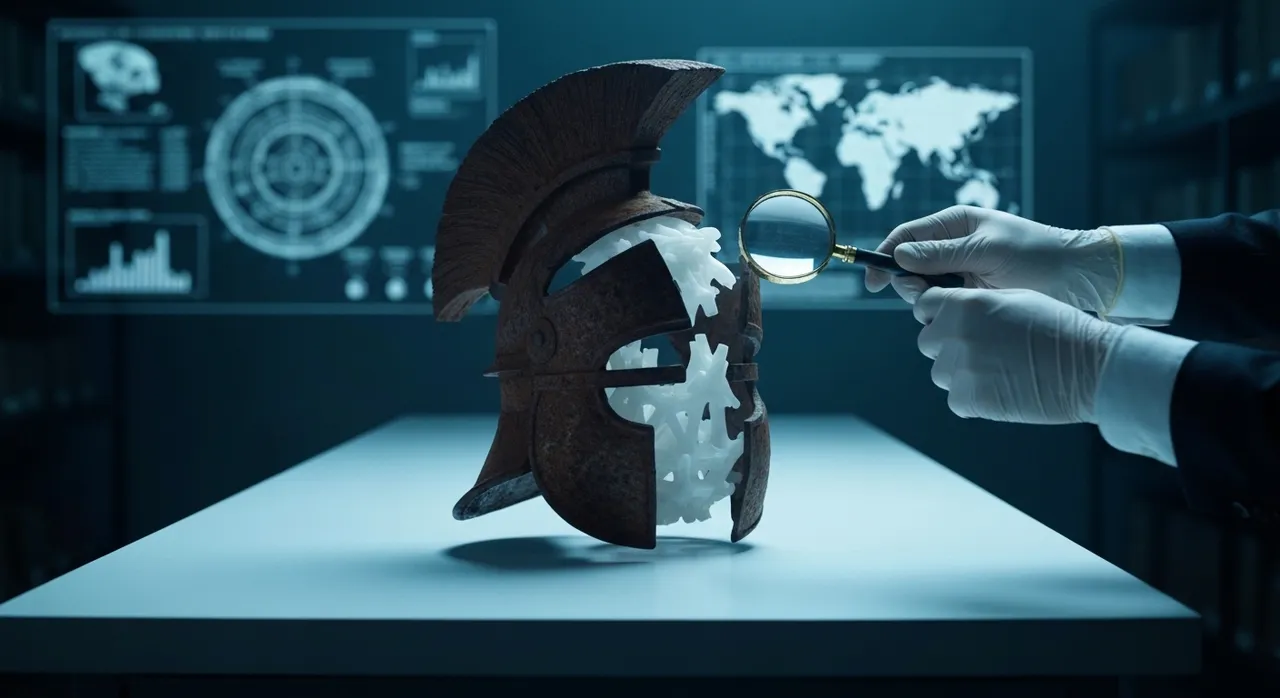
The centerpiece of the deception was a video—or a series of them—that used AI-generated narration to sound authoritative and urgent. These tools, which have democratized the production of persuasive media, allowed the creators to frame a compelling, albeit entirely fictional, story without the need for human journalists or researchers. The visual “evidence” presented in these clips was equally deceptive. Instead of showing the North Carolina site, the videos featured footage of a Corinthian helmet originally discovered in Greece in 2016. By lifting this footage and stripping it of its original context, the creators successfully misled thousands of users who were either unable or unwilling to verify the visual evidence.
How AI Amplifies Archaeological Misinformation
The vulnerability of public knowledge to such hoaxes is not merely a product of gullibility; it is a structural issue within the modern information ecosystem. As research published in Advances in Archaeological Practice has demonstrated, generative AI models frequently rely on outdated scientific literature and popular stereotypes. When AI is used to create historical “reconstructions” or narrate historical events, it often fails to synthesize contemporary evidence, instead defaulting to archaic, colonial-era, or completely fictional tropes that have been discarded by legitimate academia.
The risks are multifaceted:
- Normalization of Inaccuracy: When AI-generated misinformation is indistinguishable from factual reporting, the public begins to struggle with distinguishing between peer-reviewed history and “hallucinated” narratives.
- Exploitation of Visual Mediums: TikTok and X rely heavily on visual storytelling. A single, high-quality image of an ancient artifact, even if the context is entirely false, carries more emotional weight than a detailed, textual debunking.
- Lack of Epistemic Awareness: AI systems lack the capacity to recognize falsehoods or verify claims against established archaeological data. They predict the “next most likely” word or image, not the “most truthful” one.
The Critical Need for Source Criticism
The Roman helmets myth succeeded because it tapped into the human fascination with “forbidden” history—the idea that the mainstream academy is hiding the truth about ancient civilizations. This is a common theme in pseudo-archaeology. The fact that the story gained traction on platforms designed for engagement-driven algorithms is no accident. These algorithms reward content that triggers strong emotional responses, such as excitement, disbelief, or indignation.
For the average consumer of digital media, distinguishing between a legitimate discovery and a synthetic fabrication requires a disciplined approach to information consumption. Archaeologists and historians emphasize the importance of provenance—the history of an object’s discovery and its subsequent ownership. A legitimate archaeological find is accompanied by:
- Formal documentation in peer-reviewed scientific journals.
- Involvement from reputable universities, museums, or state historical agencies.
- Comprehensive reporting that includes site maps, stratigraphic data, and expert analysis.
The “North Carolina Roman find” possessed none of these pillars. It originated from an “anonymous” or non-institutional source, lacked any record of peer review, and failed to undergo professional analysis. These are the hallmarks of modern digital deception.
The Erosion of Historical Truth
Archaeology is, at its core, a science of evidence. It involves the meticulous, slow, and often grueling process of excavating, analyzing, and contextualizing material remains. By contrast, the misinformation cycle is instantaneous, designed to maximize virality at the expense of veracity. This clash is not new, but the velocity and scale at which AI-driven falsehoods now travel threaten to distort public memory and delegitimize genuine historical inquiry.
The danger is not just that people believe there were Romans in North Carolina; it is that these hoaxes contribute to a wider culture of cynicism. When people realize they have been duped, they do not always develop a stronger commitment to media literacy. Often, they become less likely to trust legitimate sources of information altogether, creating a vacuum that is then filled by more radical conspiracy theories. This is a form of cultural pollution that harms our collective understanding of human history.
Moving Forward: A Call for Digital Literacy
As we navigate this digital era, the burden of proof must shift back to the user. The “Ninja Editor” approach is simple: if a discovery sounds like it would “rewrite history,” it probably hasn’t happened. Groundbreaking archaeological discoveries are almost always preceded by years of academic work, field surveys, and peer discussions. They are not announced via viral social media posts using stock footage of artifacts from other continents.
The debunking of the Roman helmets myth by organizations like Snopes serves as a critical checkpoint. It highlights that while the tools of deception are evolving, the methods of verification remain largely the same: check the source, examine the context, and demand evidence beyond a compelling video clip. We must learn to treat digital content with the same scrutiny we would apply to any other historical claim. In the fight for the integrity of our past, critical thinking is the only weapon that matters.
The future of public history depends on our ability to distinguish between the artifacts of real, human discovery and the synthetic, AI-generated fabrications that seek to sell us a fantasy. By demanding rigor, supporting institutions that uphold it, and rejecting the allure of “clickbait” history, we can ensure that the truth remains the bedrock of our understanding of the world.
Written by
TempMail Ninja
Digital privacy and online security expert. Passionate about creating tools that protect users' identity on the internet.