Undersea Communications Cables: UK Deploys Military Assets for Protection
Article Content
The era of treating the internet as a purely ethereal, digital construct has definitively ended. On April 24, 2026, the United Kingdom government signaled a monumental shift in its defense posture, moving from passive monitoring to a proactive, kinetic military deployment to safeguard the undersea communications cables that form the physical backbone of the global digital economy. This “National Security Operation” represents the largest mobilization of maritime surveillance assets since the Cold War, involving RAF P-8 Poseidon aircraft, Merlin helicopters, and a fleet of surface warships patrolling the volatile waters of the North Sea and the Atlantic.
The Kinetic Shield: Protecting Undersea Communications Cables
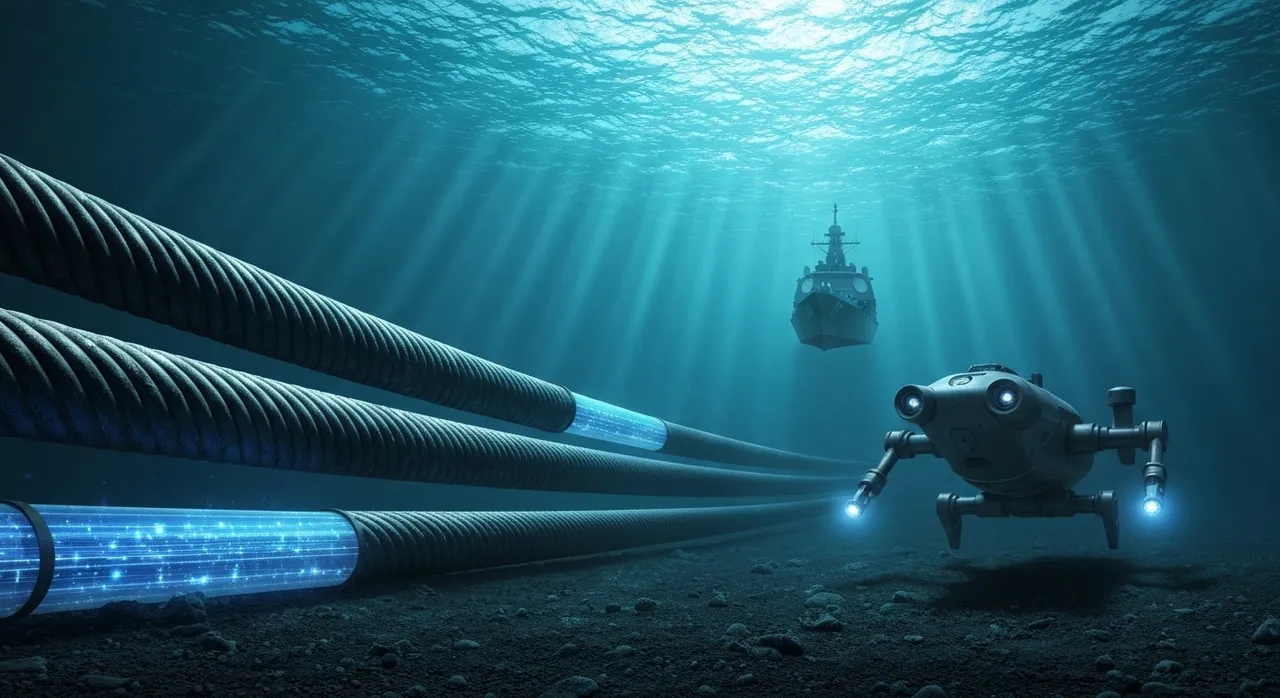
For decades, the security of undersea communications cables was largely the concern of telecommunications consortiums and repair vessel operators. However, as the geopolitical climate sours, these thin strands of fiber-optic glass—no thicker than a garden hose in many sections—have become the front line of “gray-zone” warfare. The UK’s decision to deploy military force follows a month-long period of heightened tension in which Russian submarines, including the formidable Akula-class attack submarine and specialized units from the GUGI (Main Directorate for Deep Sea Research), were tracked loitering over critical infrastructure.
The stakes are difficult to overstate. Recent data from the International Telecommunication Union (ITU) and market analysts confirm the staggering reliance of modern civilization on these subsea arteries:
- 99% of Intercontinental Traffic: Despite the rise of satellite constellations, nearly all global data—from emails to cloud storage—travels through roughly 500 active subsea cable systems.
- $10 Trillion Daily Transactions: Global financial markets, including the SWIFT banking system and high-frequency trading, are entirely dependent on the low-latency connectivity these cables provide.
- Energy Security: In the North Sea, the integration of data cables with offshore wind power and gas pipelines means a single sabotage event could trigger both a blackout and a communication blackout.
Technical Breakdown: The UK’s Surveillance Arsenal
The UK’s “Atlantic Bastion” program is not merely a show of force; it is a sophisticated, multi-domain sensor network designed to detect threats long before they reach the seabed. Central to this operation is the RAF P-8A Poseidon MRA1. This militarized version of the Boeing 737 is specifically engineered for long-range maritime patrol and anti-submarine warfare (ASW). Its technical suite includes:
- APY-10 Multi-Mission Radar: Capable of high-resolution mapping and detecting even small surface threats, such as periscopes or specialized diver-delivery vehicles, in all-weather conditions.
- Acoustic Sensor Systems: The P-8 can deploy up to 129 sonobuoys—active and passive acoustic sensors that create a “sound web” in the water column to track the distinct signatures of deep-diving Russian “spy” submarines.
- MX-20 HD EO/IR Turret: An electro-optical/infrared system that allows crews to visually identify vessels and activities at extreme distances, day or night.
Complementing the P-8s are the Leonardo AW101 Merlin HM2 helicopters. Operating from the decks of Royal Navy frigates like HMS St Albans and HMS Somerset, the Merlin is the world’s most advanced anti-submarine helicopter. It utilizes the AQS-950 dipping sonar, which can be lowered into the water while the helicopter hovers, providing a high-fidelity “look” under the thermal layers of the ocean where submarines often hide.
The GUGI Threat: Deep-Sea Sabotage and Hybrid Warfare
The primary driver for this military escalation is the activity of Russia’s Main Directorate for Deep Sea Research (GUGI). Unlike standard naval units, GUGI operates specialized “mother” submarines—such as the Belgorod or BS-64 Podmoskovye—which carry deep-diving mini-submarines and autonomous underwater vehicles (AUVs). These assets are capable of operating at depths of several thousand meters, well beyond the reach of standard commercial divers or conventional naval forces.
Defense Secretary John Healey, in his address on the 2026 deployment, warned that the “mapping” of undersea communications cables is a precursor to potential sabotage. Following the 2022 Nord Stream pipeline explosions, the strategic logic has shifted. Russian leadership has openly suggested that the subsea infrastructure of “unfriendly nations” is a legitimate military target. By “hovering” over these cables, GUGI units can perform several hostile acts:
Physical Severance: Using mechanical cutters or small explosive charges to disrupt connectivity for weeks or months.
Signal Tapping: Attempting to install inductive taps that can intercept data without physically piercing the fiber-optic shielding—though this is technically difficult in deep water, the threat remains a high-priority concern for intelligence agencies.
Infrastructure Mapping: Creating a “digital twin” of the seabed to identify the exact locations of repeaters and landing points, which are the most vulnerable parts of the network.
Engineering Resilience: The Tech Industry’s Response
The UK government’s warning has echoed through the boardrooms of Silicon Valley and the City of London. Tech giants like Google, Meta, and Microsoft, who are now the primary investors in new subsea projects, are moving toward a strategy of “route diversity” and “kinetic resilience.”
Historically, subsea cables were laid along the most efficient geographical paths, creating “chokepoints” like the Luzon Strait or the Egyptian Red Sea corridor. In 2026, the mandate is different. Enterprises are now engineering global networks with three specific redundancies:
- Geographic Diversity: Bypassing traditional bottlenecks by laying cables through the Arctic Circle or southern oceanic routes that are harder for adversary fleets to monitor constantly.
- Mesh-Grid Topology: Moving away from point-to-point connections toward a “mesh” where data can be instantly rerouted through dozens of different paths if a single cable is severed.
- Hybrid Redundancy: Integrating Low Earth Orbit (LEO) satellite constellations as a Tier-1 backup. While satellites cannot match the terabit-per-second capacity of fiber, they provide a “heartbeat” connection that ensures critical command-and-control functions remain active during a total subsea blackout.
The Economic Stakes of the “Cyberspace Pulse”
The market for subsea infrastructure is projected to reach $32.8 billion by the end of 2026, driven by the explosive demand for AI-led data processing. AI models require massive, low-latency data transfers between global data centers, making undersea communications cables even more vital than they were a decade ago. A disruption to the “cyberspace pulse” would not just slow down Netflix streams; it would halt the algorithmic training of the world’s most advanced AI systems and freeze the logistics chains of global commerce.
The UK’s deployment of P-8 Poseidons and Merlin helicopters is, therefore, an economic policy as much as a military one. By establishing a “Continuous At-Sea Deterrence” for data, the UK aims to maintain its status as a global financial hub. If the “City” cannot guarantee its connectivity to New York or Tokyo, its economic model collapses.
Strategic Implications: The New Maritime Doctrine
This 2026 operation marks a definitive move toward Maritime Domain Awareness (MDA) as the primary pillar of national security. The UK’s “Atlantic Bastion” program also leverages autonomous technology, such as Uncrewed Surface Vessels (USVs) and “gliders” that can stay at sea for months, using passive sonar to listen for the cavitation of submarine propellers near cable landing stations.
The integration of these autonomous systems with high-end assets like the P-8 creates a “layered defense.” While the USVs provide the persistent “eyes and ears,” the P-8 and Merlin provide the “heavy lift” capability to intercept and, if necessary, neutralize threats. This shift from digital cybersecurity to physical maritime security is a recognition that in the 21st century, the most dangerous “hacker” might not be a teenager in a basement, but a specialized diver with a pair of cable cutters 2,000 meters under the Atlantic.
Conclusion: Sovereignty in the Deep
As the UK military secures the undersea communications cables of the North Atlantic, the world is watching a new form of territorial sovereignty emerge. The “Exclusive Economic Zone” (EEZ) is no longer just about fishing rights or oil and gas; it is about the sanctity of the data flow. The deployment on April 24, 2026, serves as a stark reminder that the digital world is anchored in the physical one, and that the protection of the internet now requires the same steel and sensors as the protection of the high seas.
For enterprises and governments alike, the message is clear: internet resilience is no longer a matter of software updates and firewalls. It is a matter of maritime patrol, acoustic signatures, and the constant, vigilant presence of military force over the silent arteries of the deep.
Written by
TempMail Ninja
Digital privacy and online security expert. Passionate about creating tools that protect users' identity on the internet.