VapourDeck: The Ultimate Handheld 486 DOS Gaming PC
Article Content
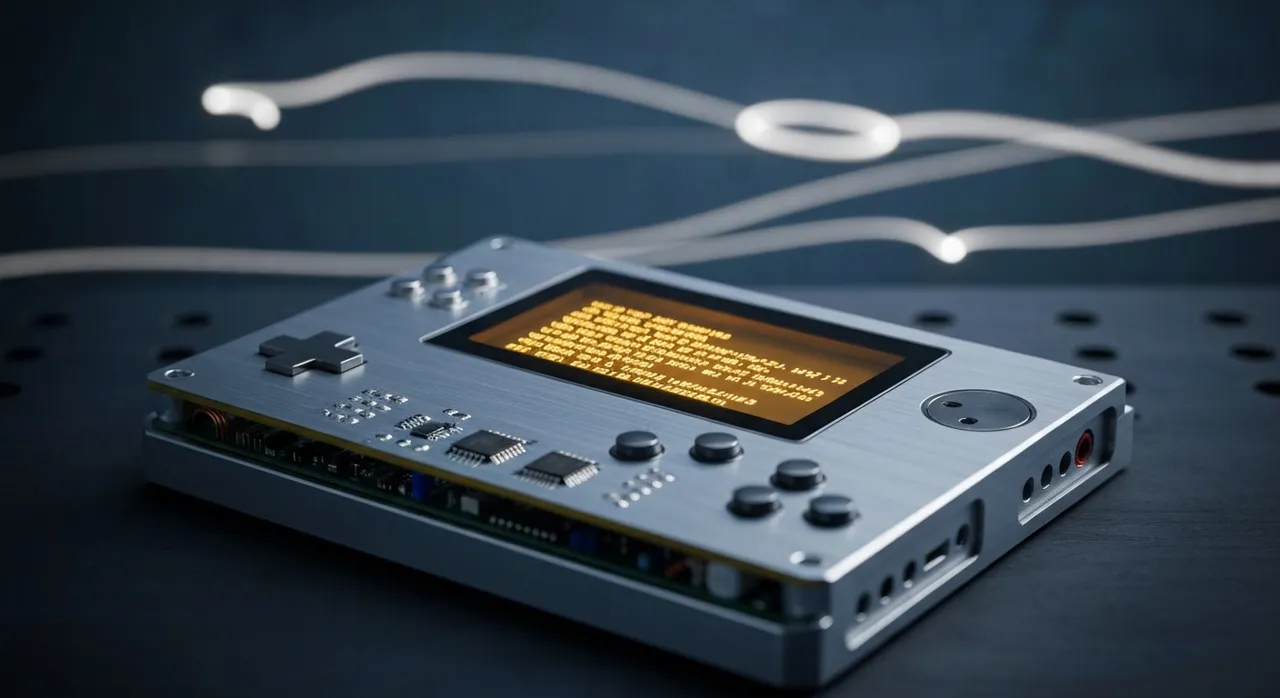
For retro-computing enthusiasts, the year 1995 represents a watershed moment: a golden, wild-west era of PC gaming where MS-DOS reigned supreme before 3D-accelerated GPUs and standardized Windows APIs permanently reshaped the digital landscape. While software-based emulation like DOSBox has made playing these ancient classics accessible, true purists often yearn for the tactile precision of authentic vintage silicon. Legendary hardware hacker Jeroen Domburg, widely known as sprite_tm, has bridged this decades-long divide in spectacular fashion. On July 5, 2026, Domburg published his most ambitious project to date: the VapourDeck, a custom-engineered, Steam Deck-style handheld PC designed to run native MS-DOS games using a real, physical 486 processor.
Unlike modern handhelds that rely on x86-64 emulation or translation layers, the VapourDeck features custom circuitry engineered from the ground up to support hardware-native DOS execution. Initially previewed at Hackaday Europe, Domburg’s full project documentation on his site, Spritesmods, details the archaeological and electrical challenges of building a portable retro PC. The result is a masterclass in electrical engineering that combines obsolete CPU architectures with modern FPGA and microcontroller technology.
The Philosophy of Bare Silicon: Emulation vs. Hardware Reality
In the modern maker space, there is no shortage of single-board computers and pocket devices capable of running retro emulators. However, software emulation inherently abstracts the hardware layer, occasionally introducing frame pacing issues, audio latency, and compatibility bugs. For Domburg, the ultimate goal was to experience the peak era of MS-DOS gaming using authentic, period-accurate microarchitectures running actual physical signals rather than virtualized instruction sets.
To achieve this, the VapourDeck avoids software-only emulation completely. Instead, it utilizes physical vintage microprocessors executing standard x86 real-mode and protected-mode instructions on a custom circuit board. The difficulty of this approach cannot be overstated. Sourcing obsolete chips, matching high-frequency bus constraints, mapping legacy memory layouts, and designing a handheld power delivery system required a total reconstruction of 1990s motherboard architectures inside a modern, portable footprint.
The First Blueprint: The Rise and Fall of the Elan SC520
Domburg’s journey to construct the VapourDeck began with a search for a compact, highly integrated x86 processor. His first prototype targeted the AMD Elan SC520. Sourced as an anachronistic choice from the year 2000, the SC520 was essentially a “586” microcontroller—a souped-up 486 core clocked at 133 MHz. Crucially, it was a System-on-Chip (SoC) that integrated critical motherboard components directly onto the silicon, including the real-time clock (RTC) and the programmable interval timer (PIT).
While the SC520 initially seemed like the perfect shortcut to keep the handheld’s PCB footprint minimal, it introduced severe assembly bottlenecks. The chip was packaged as a massive Ball Grid Array (BGA). Hand-soldering a high-density BGA of this complexity proved incredibly stressful and highly unreliable. During the testing phase, Domburg encountered persistent timing bugs and intermittent bus failures. It was nearly impossible to determine whether these issues stemmed from custom Verilog code or micro-fractures in the BGA solder balls. Recognizing that the SC520 BGA package was a debugging dead-end, Domburg returned to the drafting board to design a cleaner, more reliable architecture.
The Architecture of the VapourDeck: Real x86 Power
For his second, successful attempt, Domburg abandoned the SoC route in favor of a traditional, separate CPU and chipset topology. He selected a classic, hand-solderable CPU package: the AMD AM486DX5-133. This physical vintage processor is a 133 MHz chip that represents the absolute peak of 486-era performance, enabling smooth framerates in resource-heavy DOS titles. Alternatively, the board was designed to support an Intel i486DX4-100.
To manage video, the VapourDeck bypasses complex analog-to-digital signal converters by incorporating a dedicated, vintage graphics chip: the Chips and Technologies (C&T) F65545 VGA controller. Originally designed for mid-90s high-end laptops, this chip integrates the graphics accelerator, flat-panel timing generators, and memory interfaces into a single QFP package. This allowed Domburg to interface the vintage graphics controller directly with a modern digital flat-panel LCD without converting an analog VGA CRT signal, maintaining pixel-perfect native output.
The completed VapourDeck hardware profile features a robust array of technical specifications:
- Central Processing Unit (CPU): Vintage AMD AM486DX5-133 operating natively at 133 MHz.
- Graphics Controller (GPU): Period-accurate Chips and Technologies F65545 flat-panel VGA chip.
- System Chipset & Bus Controller: Lattice ECP5 LFE5UM-45 FPGA managing address decoding, DMA, PIC, and interrupt handling.
- System Memory: 64MiB of modern SDRAM bridged dynamically by the FPGA to match 486 bus cycles.
- Storage Interface: Espressif ESP32-S3 microcontroller serving as a custom SD-to-IDE bridge.
- Audio Engine: On-chip MIDI synthesis executed via the ESP32-S3 coprocessor.
- I/O & Connectivity: USB-C charging, USB host port, physical MicroSD slot, and an integrated headphone jack.
The Silicon Bridge: FPGA Chipset and ESP32 Co-Processing
One of the most complex challenges of using a true 486 CPU is replacing the massive, obsolete motherboard chipsets of the 1990s. Rather than hunting down rare, power-hungry Northbridge and Southbridge chips, Domburg engineered a custom chipset inside a modern Lattice ECP5 LFE5UM-45 FPGA.
The FPGA acts as the central logic bridge, managing the high-speed CPU local bus and translating it to the memory and peripheral interfaces. Since the 486 processor expects traditional asynchronous DRAM (such as Fast Page Mode or EDO RAM), the FPGA contains custom Verilog to translate these legacy memory access cycles into the burst-mode cycles required by the VapourDeck‘s 64MiB SDRAM chip. To implement these complex timing models, Domburg adapted and optimized elements from open-source MiSTer FPGA cores.
Working in tandem with the FPGA is an Espressif ESP32-S3 coprocessor. This chip handles several modern peripheral conveniences that did not exist in 1995:
- MicroSD-to-IDE Storage Bridge: Real MS-DOS requires a hard drive interface, traditionally handled by bulky IDE ribbons. The ESP32-S3 intercepts standard ATA/IDE commands sent by the 486 and translates them on-the-fly into block reads and writes on a modern MicroSD card.
- On-Board MIDI Synthesizer: Standard PC audio of the mid-90s relied on Sound Blaster FM synthesis or expensive MPU-401 MIDI hardware. The ESP32-S3 acts as a high-fidelity MIDI synthesizer, parsing MPU-401 MIDI commands generated by games and rendering rich wavetable audio.
Controller Innovations: Trackpad Mouse-Logic and UX Design
Playing DOS games on a handheld presents a glaring ergonomic issue: many of the best titles from 1995 were designed around a physical keyboard and mouse. The VapourDeck addresses this with an elegant, custom controller firmware layout. It integrates a built-in trackpad that maps directly to serial mouse movements via standard DOS mouse drivers (such as CTMOUSE.EXE).
To keep the controls streamlined and intuitive, Domburg implemented a smart button-remapping feature. The controller firmware actively monitors the trackpad for capacitive touch. As soon as the system detects the user’s thumb resting on the trackpad, the physical **”A” and “B”** buttons are dynamically remapped from their joystick roles to function as **left and right mouse clicks**. When the thumb is lifted, the buttons instantly revert to their standard gamepad mapping. This makes moving between pointer navigation and standard arcade controls seamless.
For software execution, the device boots beyond a custom-coded BIOS directly into a clean installation of MS-DOS 6.22. Instead of forcing users to type command lines on the go, the system immediately loads a custom-made, graphical retro game launcher. Classic games like *Doom*, *SimCity*, and *Prince of Persia 2* can be selected and launched instantly. Furthermore, because many DOS games require keyboard prompts—such as typing “Y” to exit a play session—the firmware includes an overlay that displays a virtual, custom-mapped on-screen keyboard.
A Masterclass in Modern Retro-Engineering
By successfully marrying a real AMD AM486DX5-133 CPU with a custom FPGA chipset and an ESP32-S3 co-processor, Jeroen Domburg has created more than just a novelty handheld; he has built a highly optimized platform for physical retro-computing preservation. The VapourDeck stands as a stunning testament to what is possible when modern manufacturing and design sensibilities are applied to vintage computing architecture.
Rather than keeping his design proprietary, Domburg has open-sourced the project, uploading the PCB schematics, custom BIOS code, ESP32 firmware, and Verilog chipset files to Codeberg. His work provides an invaluable blueprint for electrical engineers and retro-computing historians alike. It proves that with enough technical ingenuity, the legendary games of the MS-DOS golden era do not have to live inside virtualized software emulators—they can still run proudly on the native, ticking logic of real, physical silicon.
Written by
TempMail Ninja
Digital privacy and online security expert. Passionate about creating tools that protect users' identity on the internet.