AI Infrastructure Spending: Big Tech Hits Record Highs in 2026
Article Content
The week of April 29, 2026, will be remembered in financial history as the moment the “Great AI Build-out” moved from a speculative frenzy to a permanent, nation-scale industrial reality. As the Q1 2026 earnings season unfolded, the quartet of global hyperscalers—Meta Platforms, Microsoft, Alphabet, and Amazon—shattered previous records, revealing a collective commitment to AI infrastructure spending that now rivals the GDP of major European economies. With a projected combined annual expenditure nearing $725 billion, the shift is no longer merely about software or services; it is about the ownership of the physical bedrock of intelligence itself.
The $725 Billion Arms Race: Decoding the AI Infrastructure Spending Supercycle
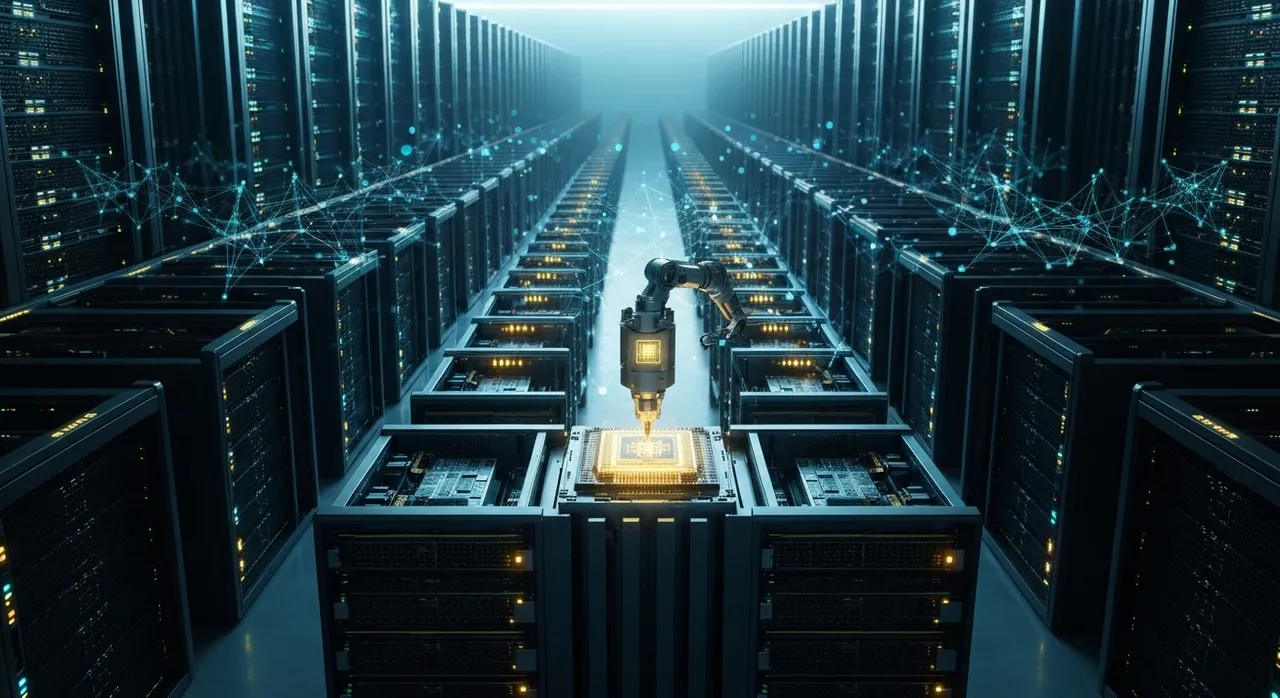
The sheer magnitude of the capital being deployed is unprecedented. To put the 2026 figures into perspective, the total investment in artificial intelligence infrastructure by Big Tech has nearly tripled since 2022. This “capital supercycle” is driven by a fundamental realization: dominance in the AI era is inextricably linked to the possession of private, sovereign-scale compute capacity. The leading firms are no longer content with purchasing off-the-shelf hardware; they are building massive, vertically integrated ecosystems encompassing everything from custom silicon and liquid-cooled data centers to proprietary energy grids.
While the broader market remains sensitive to the immediate return on investment (ROI), the hyperscalers are sending a clear message: the risk of under-investing in AI infrastructure spending far outweighs the risk of over-building. This conviction is underscored by the current “supply-constrained” environment, where even these gargantuan budgets are struggling to keep pace with the soaring costs of advanced components and the energy required to power next-generation foundation models.
Meta’s $145 Billion Pivot: From Social Media to Silicon Hegemony
Perhaps the most jarring disclosure of the week came from Meta Platforms. CEO Mark Zuckerberg, who previously faced skepticism for his multi-billion dollar “Metaverse” pivot, has successfully refocused the company’s capital toward a massive AI offensive. Meta jolted the markets by raising its full-year 2026 capex guidance to a range of $125 billion to $145 billion, nearly double its 2025 levels.
The “Sustained Underestimation” of Compute
Zuckerberg cited a “sustained underestimation” of the compute power required to train and run the next iteration of Llama-series foundation models. This realization has led Meta to move beyond its traditional reliance on merchant silicon. The company is now aggressively deploying its Meta Training and Inference Accelerator (MTIA) series, developed in partnership with Broadcom. Key technical milestones for Meta’s 2026 strategy include:
- MTIA 400 Deployment: The first generation of Meta’s custom silicon capable of competing with commercial high-end GPUs on raw performance, utilizing 72-chip racks to form massive “scale-up” domains.
- GenAI Inference Optimization: The upcoming MTIA 450 and 500 chips, scheduled for mass deployment, will focus on doubling High-Bandwidth Memory (HBM) capacity to handle the massive context windows of 2026-era LLMs.
- Energy Diversification: Meta has secured deals for up to 1 GW of space-based solar capacity and 100 GWh of long-duration storage to ensure its data centers remain operational despite grid limitations.
Despite a 6% drop in share price following the announcement—driven by investor fears over near-term margin compression—Meta’s core advertising business remains robust, with Q1 revenue hitting $56.31 billion. Zuckerberg is betting that the efficiency gains from custom silicon will eventually lower the cost-per-inference, providing Meta with a structural margin advantage over competitors who remain tethered to the “Nvidia tax.”
Microsoft’s $190 Billion Fortress: Scaling the Azure AI Cloud
Microsoft remains the undisputed heavyweight in the AI infrastructure spending race, disclosing that its 2026 investments will reach approximately $190 billion. CFO Amy Hood clarified that roughly $25 billion of this increase is directly attributable to the soaring prices of specialized components, including HBM4 memory and advanced networking interconnects.
The “Braga” Architecture and Maia 200
To mitigate these costs, Microsoft is rapidly transitioning workloads to its custom Maia 200 silicon (internally codenamed “Braga”). This chip is specifically optimized for Microscaling (MX) data formats, allowing Microsoft to run Copilot and ChatGPT workloads with significantly higher power efficiency than standard GPU clusters. The technical specifications of Microsoft’s 2026 build-out are staggering:
- $37 Billion AI ARR: Microsoft’s AI services have already reached an annual recurring revenue of $37 billion, a 123% increase year-over-year.
- The 40% Acceleration: Azure sales grew 39% last quarter, with guidance suggesting a “modest acceleration” as more capacity comes online.
- Capacity Constraints: Despite spending over $30 billion per quarter, Microsoft expects to remain supply-constrained through the end of 2026, highlighting the insatiable demand for AI compute.
By building out its own infrastructure at this scale, Microsoft is effectively creating a “moat of megawatts.” The company’s ability to self-fund this expansion through its $82.9 billion quarterly revenue allows it to weather the high interest rate environment that has slowed smaller cloud providers.
Alphabet’s 107% Surge: The TPU v7 and Vertical Integration
Alphabet’s Q1 2026 earnings report revealed a 107% year-over-year increase in quarterly capex, reaching $35.7 billion. While the market initially expressed concern over the impact on free cash flow—which declined 47%—the breakthrough performance of Google Cloud has silenced many critics. Google Cloud revenue surged 63% to $20.0 billion, with operating margins expanding dramatically to 32.9%.
Alphabet’s strategy centers on its TPU v7 custom silicon. Unlike its peers, Alphabet has a decade-long head start in custom AI hardware, allowing it to achieve a level of vertical integration that is difficult to replicate. The TPU v7 provides a cost-leadership position for training the Gemini model suite, which now powers over 350 million paid subscriptions across YouTube and Google One. The company’s “Other Income” line also saw a massive $37.7 billion gain, primarily from unrealized gains on equity securities, providing even more dry powder for the 2027 investment cycle.
The Hardware Crisis: Why AI Infrastructure Spending is Skyrocketing
One of the primary drivers behind the 2026 capex hike is the explosive increase in component pricing. As models grow in complexity, the demand for High-Bandwidth Memory (HBM) and advanced packaging has created a global bottleneck. Data from the first quarter suggests that memory and storage prices have, in some instances, tripled since late 2025.
Nvidia’s Blackwell architecture remains the gold standard for frontier model training, but its power requirements have introduced new physical limitations. A single GB200 NVL72 rack now requires up to 120kW of power, necessitating a complete redesign of data center cooling systems. Hyperscalers are now forced to invest in advanced liquid-to-chip cooling and custom power delivery systems, adding billions to the construction costs of new facilities. This has led to a strategic shift where the availability of power and land has become as valuable as the chips themselves.
Power and Procurement: The Physical Limits of Scaling
The race for AI infrastructure spending has expanded into the energy sector. In 2026, the discussion has shifted from “FLOPs” (floating-point operations) to “Watts.” The hyperscalers are now the primary drivers of the energy transition, funding massive projects in nuclear, geothermal, and solar energy to ensure their “AI factories” have a stable supply of carbon-neutral power.
- Amazon’s $200B Commitment: Amazon has maintained a steady $200 billion capex guide for 2026, focusing heavily on its Trainium 3 chips (3nm process) and regional data center hubs located near major renewable energy sources.
- Sovereign Compute: The move toward private infrastructure is also a defensive measure against geopolitical instability. By owning the entire stack—from the silicon design to the power grid—these companies are shielding themselves from supply chain disruptions and “GPU diplomacy.”
The ROI Void: Investor Anxiety vs. Strategic Conviction
Despite the robust revenue growth across the hyperscalers, a “valuation compression” remains visible in the market. Investors are increasingly vocal about the timeline for realized profitability. The gap between the hundreds of billions spent on AI infrastructure spending and the tens of billions currently generated in AI-specific revenue is the defining tension of the 2026 fiscal year.
However, the hyperscalers argue that we are at the beginning of a multi-decade technology cycle. As Daniel Newman, CEO of The Futurum Group, noted, “The ‘AI capex is speculative’ narrative is dead.” The reacceleration of cloud revenues at Google, Microsoft, and Amazon suggests that the infrastructure being built today is already being monetized by an enterprise sector that is finally moving from AI experimentation to full-scale deployment.
In conclusion, the surge in AI infrastructure spending seen on April 29, 2026, marks the end of the “asset-light” era for Big Tech. To lead in the next decade, these companies have accepted that they must become the world’s most capital-intensive businesses. The $725 billion bet is a wager on the future of human productivity—and for Meta, Microsoft, and Alphabet, it is a bet they cannot afford to lose.
Written by
TempMail Ninja
Digital privacy and online security expert. Passionate about creating tools that protect users' identity on the internet.