BBC Bridge Companion Reverse-Engineered to Play Tetris
Article Content
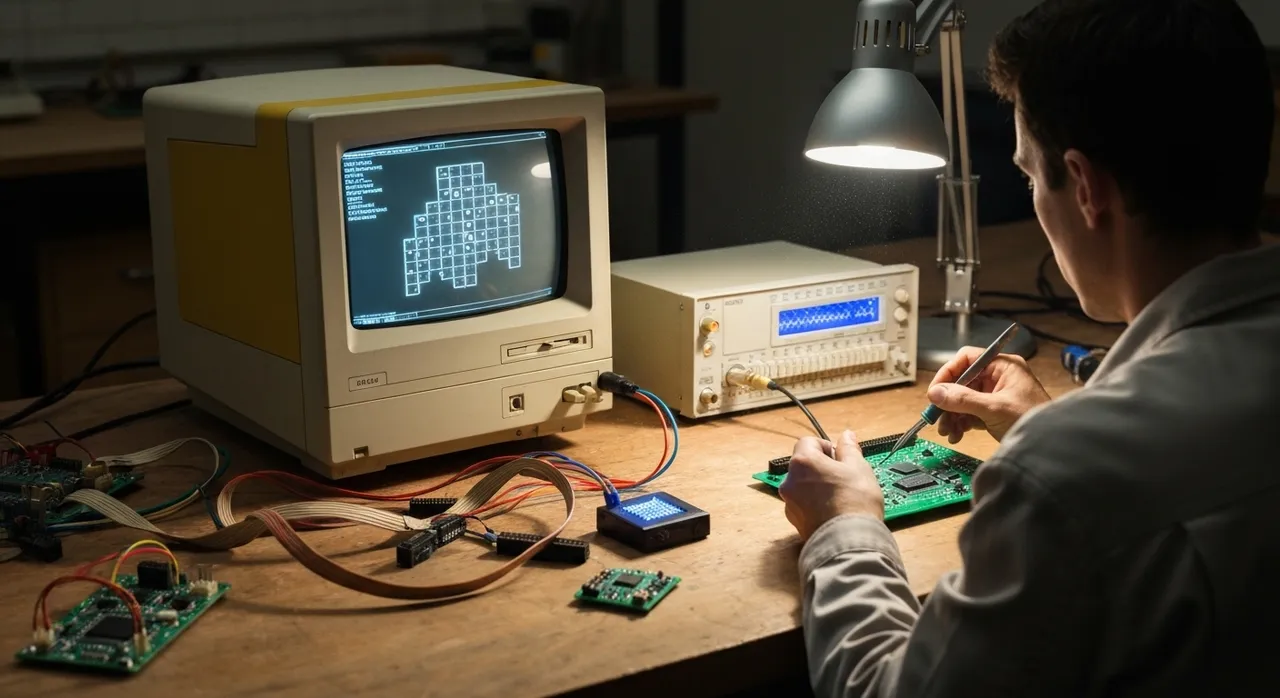
In the annals of retro-computing, few micro-consoles are as esoteric or narrowly targeted as the BBC Bridge Companion. Released in the United Kingdom in 1985 by BBC Enterprises Ltd at a staggering price point of £199.99, the console was built with a singular, unapologetic purpose: teaching players the intricacies of contract bridge. Fading rapidly into obscurity after selling a negligible number of units due to its steep price and niche target demographic, the system remained a forgotten footnote in digital history for over four decades. However, digital archaeologist and hardware developer [Leaded Solder] recently turned the retrogaming community on its head by successfully reverse-engineering this rare piece of silicon to force it to play bare-metal Tetris—a project affectionately dubbed “Bridgetris”.
The transformation of a failed 1980s educational device into a working arcade platform represents a masterclass in modern retro-computing forensics, custom hardware design, and low-level software engineering. To achieve custom code execution on a machine built purely for card tutorials, Leaded Solder had to overcome undocumented BIOS security checks, repair mangled forty-year-old hardware, hand-craft custom printed circuit boards (PCBs), and write a complete falling-block puzzle game entirely in Z80 assembly language from scratch.
The Hardware Anatomy of the BBC Bridge Companion
On the surface, the BBC Bridge Companion looked more like a piece of high-end lab equipment or a chunky electronic calculator than a conventional home video game console. Its distinct plastic chassis housed a dedicated keypad tailored for card bidding and trick play rather than standard gaming directional pads or action buttons. However, underneath its conservative exterior, the console harbored architecture remarkably potent for 1985—specifications that rivaled many contemporary home computers and early third-generation gaming platforms.
At the heart of the system lies a Zilog Z80 microprocessor paired with a Texas Instruments TMS9918-family Video Display Controller (specifically the PAL-native TMS9129 VDP). While many budget consoles of the era severely throttled memory access, the Bridge Companion was outfitted with a surprisingly generous 16KB of dedicated Video RAM (VRAM), driven by a pair of Texas Instruments TMS4416 DRAM chips, alongside a 2KB 6116 Static RAM chip for general system variables and stack space.
The complete hardware architecture of the console consists of the following key technical components:
- Central Processing Unit: Zilog Z80 running as the primary 8-bit system controller.
- Graphics Processor: Texas Instruments TMS9129 VDP (PAL video variant) supporting tile-based character modes, custom pattern tables, and hardware sprites.
- Memory Configuration: 16KB VRAM (via twin Texas Instruments TMS4416 DRAMs) alongside 2KB 6116 SRAM for main CPU work RAM.
- System Decoding: Custom Programmable Array Logic (PAL) chip at IC1 handling memory
Written by
TempMail Ninja
Digital privacy and online security expert. Passionate about creating tools that protect users' identity on the internet.