BornHack Radio 102.8 FM Brings Ephemeral Analog Broadcasts to Hacker Camp
Article Content
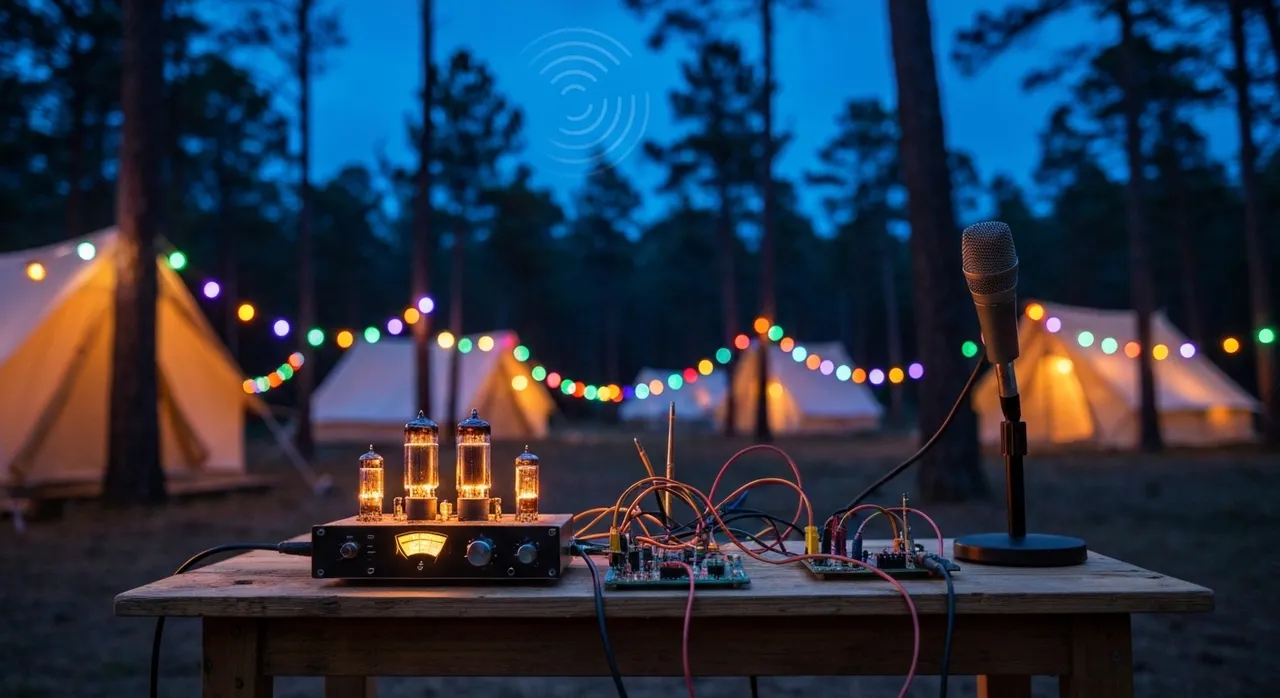
In an era dominated by hyper-connected edge computing, cloud-native logging, and pervasive digital surveillance, a quietly radical experiment in localized, off-grid media took flight at the annual Danish hacker camp. Nestled within the rolling terrain of the Hylkedam scout camp near Gelsted on the island of Funen, organizers and community volunteers deployed BornHack Radio—a temporary, purely analog broadcast operating on 102.8 MHz FM. While contemporary hacker events are renowned for establishing high-speed gigabit fiber backbones, temporary cellular base stations, and complex mesh communication layers, BornHack Radio deliberately took a giant leap backward in media architecture. By operating with zero internet streams, no podcast archives, and no digital repositories, the station converted airwaves into a transient physical experience: once a voice left the mast, it drifted across the Danish countryside and vanished into the ether, reviving the unscripted magic of vintage pirate broadcasting and low-power event radio.
RF Architecture and Studio Deployment of BornHack Radio
Operating a temporary FM broadcast station within strict national regulatory frameworks requires both technical precision and administrative rigor. The technical foundation of BornHack Radio was engineered to deliver maximum local coverage across the camp site and immediate surrounding rural environment while adhering to Danish spectrum authorization guidelines.
- Frequency Allocation: 102.8 MHz on the standard FM broadcast band (87.5 to 108.0 MHz).
- Transmitter Power: Operating with an Effective Radiated Power (ERP) between 3.8 and 5 watts.
- Antenna Elevation: A vertical dipole antenna mounted on a ten-meter structural mast at the highest topographic point of the Hylkedam scout camp site.
- Coverage Radius: Strong line-of-sight coverage spanning the entire camp grounds, extending across the rural topography of Funen, and reaching into the two nearest surrounding towns.
- Signal Chain Architecture: Purely analog audio signal routing from studio microphones through hardware mixing consoles directly into the FM transmitter without digital encoding, packetization, or stream processing.
The nerve center for BornHack Radio was housed inside a heavy-duty Coleman shelter positioned directly along the main pedestrian walkway traversing the camp. This open-air studio design placed broadcast operations at the physical heart of the event. Rather than hiding behind soundproof booth glass, presenters operated in full view of passing hackers, incorporating ambient outdoor acoustics, thermal fluctuations, and spontaneous street-level interactions directly into the live audio feed. The studio setup was intentionally minimalist: multi-channel analog mixing desks, dynamic broadcast microphones, hardware audio processing gear, and zero computers dedicated to online webcasting or digital logging.
Speech-Only Airwaves: Turning Licensing Constraints into Creative Focus
One of the defining characteristics of BornHack Radio was its complete lack of a commercial music license. In conventional broadcast radio, securing public performance rights from music collection societies is standard procedure. However, the station organizers made the conscious decision to forgo music licensing altogether. What might initially have appeared to be an operational limitation quickly revealed itself to be a powerful curatorial catalyst, stripping away background music and forcing 100% of the broadcast schedule to focus on spoken-word, hacker-centric programming.
Without the safety net of automated music playlists or commercial filler, the station relied entirely on live human voices, technical discussions, and experimental audio art. The schedule offered a diverse array of community-driven content:
- Hacker Jeopardy Live Broadcast: For the first time in the event’s history, the legendary game show was piped directly from the main speakers’ tent into the analog FM spectrum, allowing campers across the venue to follow every round of technical trivia from their tents.
- This Week in Hackaday Panel: Technology journalist Jenny List hosted a live radio panel show alongside community members, dissecting hardware hacks, open-source projects, and engineering news in a classic roundtable radio format.
- Chad’s Electronics Corner: A deep-dive technical show dedicated to component sourcing, circuit design, signal integrity, and embedded systems engineering.
- Aflyttet Analog med Kjaerulv: An investigative show exploring the philosophy of analog systems, signal interception, electromagnetic spectrum monitoring, and the mechanics of vintage communications infrastructure.
- Robotic Numbers Station: Operated in tandem with the BornHack Game Team, the station transmitted automated, synthetic number sequences at scheduled intervals, serving as an interactive puzzle piece for the annual BornHack Token Game.
- Roving Street Interviews: Mobile reporters equipped with wireless microphones traversed the camp’s main drag, capturing spontaneous conversations with project creators, security researchers, and hardware makers.
The Ephemeral Paradigm: Countering the Permanent Web
In modern digital culture, media consumption is overwhelmingly characterized by extreme permanence and pervasive indexing. Modern web broadcasts are systematically cached, scraped, transcribed by machine-learning models, and indexed by search engines. Video streams live indefinitely on centralized cloud servers, tracked by telemetry algorithms and user profiling data. While this cloud architecture offers convenience, it strips media of its immediacy and localized intimacy.
BornHack Radio offered an intentional counterweight to this culture of hyper-archiving. Because there were no server logs, no online streams, and no official MP3 downloads, listening to the station required active, present-moment participation. To experience a broadcast, a camper had to physically tune an FM receiver to 102.8 MHz while the host was speaking. If a listener stepped away, lost battery power, or tuned away, the moment was gone forever, swallowed by background noise.
This strict impermanence recreated a unique shared social reality across the Hylkedam camp. Campers gathered outside their tents around vintage portable boomboxes, modified Software Defined Radios (SDRs), hand-crank survival receivers, and car stereos. Because everyone was consuming the exact same analog broadcast in real time without buffering delays or stream latency, BornHack Radio generated a synchronous communal experience that digital platforms fail to reproduce.
Field Operations and the Hardware Realities of Camp Broadcasting
Executing an over-the-air radio station in an outdoor, semi-rugged scout camp environment presents significant operational challenges. The engineering crew behind BornHack Radio had to account for unpredictable outdoor conditions, thermal management, power stabilization, and strict RF interference mitigation.
The studio’s placement inside an open shelter exposed sensitive analog audio equipment to ambient summer temperatures, dust, and wind noise. To maintain audio quality without digital noise gates or cloud-managed DSP plugins, operators relied on traditional hardware gain staging, acoustic microphone positioning, and physical pop filters. Ground loop isolation and clean power distribution were critical, as hundreds of high-power computing rigs, soldering stations, and temporary lighting rigs operated simultaneously across the camp’s power grid.
Furthermore, tuning into the station became a mini-project for the camp’s attendees. Hackers dusted off legacy AM/FM transistor radios, built custom wire dipole antennas, programmed handheld SDR dongles, and repurposed automotive receivers. The simple act of sweeping an analog dial through the FM band and locking onto 102.8 MHz reconnected participants with the fundamental physics of radio frequency propagation.
The Cultural Legacy of Temporary Analog Media
The success of BornHack Radio underscores a growing yearning within the global hacker community for off-grid, privacy-centric, and ephemeral media formats. As digital networks become increasingly consolidated, monitored, and monetized, temporary analog broadcasts demonstrate that powerful community connections do not require cloud infrastructure or massive bandwidth.
By transforming 102.8 MHz into a localized canvas for technical dialogue, unscripted commentary, and cryptographic puzzles, the organizers at BornHack demonstrated the enduring relevance of broadcast radio. The experiment served as a potent reminder that technology is at its best when it brings people together in a shared time and place—where words carry weight precisely because they fade away into the airwaves once spoken.
Written by
TempMail Ninja
Digital privacy and online security expert. Passionate about creating tools that protect users' identity on the internet.