Digital Tourism and The Backrooms: The Rise of Virtual Exploration
Article Content
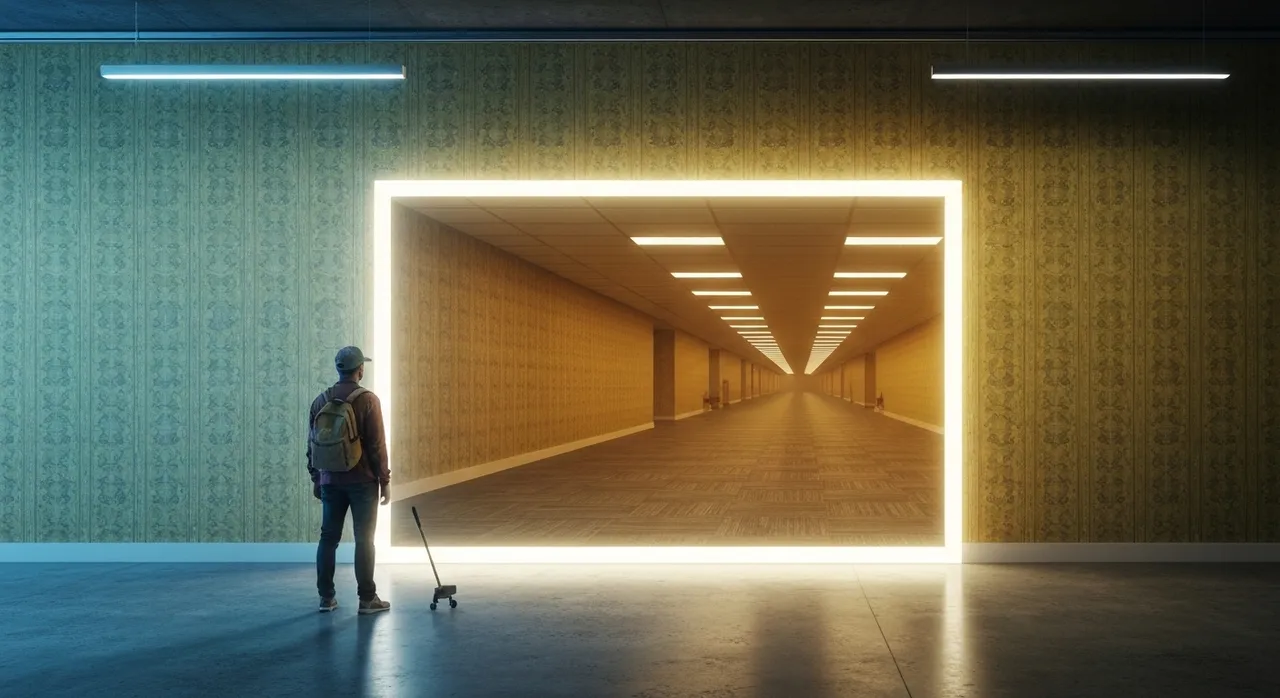
On May 12, 2019, an anonymous user on a 4chan paranormal imageboard posted a single, strangely unsettling photograph: a desaturated, featureless room defined by monotonous yellow wallpaper, waterlogged carpet, and the harsh, buzzing glare of fluorescent light fixtures. Accompanied by a brief snippet of flash fiction warning readers about the danger of accidentally “noclipping out of reality in the wrong areas,” the post birthed the internet legend known as “The Backrooms”. What began as a fleeting piece of online horror trivia has evolved into one of the most expansive, crowdsourced world-building phenomena in contemporary digital culture. Groundbreaking academic research released in July 2026 by media and marketing scholars at Lancaster University reveals that this viral mythos represents a paradigm shift in digital tourism—a psychological and spatial trend wherein internet users actively explore, map, and inhabit eerie, synthetic virtual environments rather than merely consuming static horror narratives.
From Video Game Glitches to Infinite Mazes: The Genesis of an Urban Legend
The core concept of the Backrooms relies heavily on mechanics borrowed from interactive entertainment, specifically the video game phenomenon of “noclipping”. In 3D game engines—such as Valve’s Source or id Software’s early renderers—noclipping refers to a developer command or software glitch that disables spatial collision detection, allowing a player character to pass through solid walls and drop into the unrendered, void-like geometry beneath the game map. The Backrooms adapted this technical artifact into a cosmic horror trope: reality itself is a glitchy rendering engine, and a misstep can clip a human being out of physical existence and drop them into a boundless, subterranean labyrinth.
Unlike traditional gothic horror, which relies on supernatural monsters, haunted castles, or ancient curses, the early Backrooms mythos derived its dread entirely from spatial disorientation and extreme monotony. The original description established Level 0—often dubbed “The Tutorial”—as an endless expanse of roughly six hundred million square miles of randomly segmented office rooms. The terror was non-entity-driven; it stemmed from sensory deprivation, endless repetition, and the claustrophobic realization that modern civilization’s mundane architecture could become an inescapable physical prison.
The Architecture of Digital Tourism: Virtual Legend-Tripping in Uncanny Spaces
In their July 2026 study published through Lancaster University Management School, researchers Dr. Sophie James and Professor James Cronin analyzed how online communities transformed the Backrooms from a passive meme into a destination for virtual exploration. Physical “legend-tripping”—a folk tradition where adolescents visit local haunted bridges, abandoned asylum ruins, or eerie rural crossroads—has migrated into the virtual realm. Through digital tourism, netizens engage with synthetic spaces that evoke intense emotional states without requiring physical travel.
According to spatial theorists, the Backrooms function as hyper-real virtual tourism destinations because they capitalize on several key architectural and cultural mechanisms:
- Virtual Legend-Tripping: Users do not merely read stories; they actively simulate the act of stepping across reality’s threshold by navigating custom 3D renders, participating in ARG (Alternate Reality Game) lore streams, and recording simulated “found footage” logs.
- Architectural Uncanny Valley: The Backrooms evoke an “uncanny valley of place”. Rooms look functional and familiar—resembling corporate call centers, hotel hallways, or suburban basements—yet lack furniture, doors, windows, or human life, creating a unsettling juxtaposition of utility and abandonment.
- Participatory Open-Source Worldbuilding: The mythology is entirely decentralized. Collaborative wikis allow thousands of contributors to establish rules, create survival handbooks, write entry logs, and debate environmental physics.
- Interactive Spatial Agency: Through playable gaming adaptations, audiences exercise direct spatial agency, navigating disorienting corridors while managing survival mechanics like stamina, sanity, and light resources.
The Collaborative Wiki Ecosystem: Cartography of an Infinite Multiverse
As the Backrooms spread across Reddit (r/Backrooms), 4chan, and dedicated wiki platforms like Wikidot and Fandom, the original single-room concept underwent a massive collaborative expansion. Netizens collectively authored a complex taxonomy of “Levels,” transforming a solitary creepypasta into a structured multiverse complete with environmental hazards, supply routes, and hostile entities.
This crowd-sourced cartography organized the chaotic void into distinct, cataloged zones, each possessing unique atmospheric and physical properties:
- Level 0 (“The Tutorial”): The foundational level, characterized by mono-yellow wallpaper, damp carpet, fluorescent lighting hum, and absolute spatial loop anomalies.
- Level 1 (“Habitable Zone”): A sprawling industrial warehouse of dim concrete corridors, flickering lights, mist, and lootable crates containing water and basic supplies.
- Level 4 (“Abandoned Office”): A calm, entity-free administrative building filled with functional water coolers and furniture, serving as a primary hub for fictional human factions like the M.E.G. (Major Explorer Group).
- Level 37 (“The Poolrooms”): A widely celebrated aesthetic offshoot consisting of an endless, submerged complex of clean white tiles, warm waist-deep water, and soft ambient light, straddling the line between peaceful sanctuary and eerie aquatic labyrinth.
In addition to levels, the community developed an extensive biological catalog for fictional entities—ranging from “Smilers” (bioluminescent predatory faces haunting pitch-black zones) to “Hounds” (agitated humanoid quadrupeds). While some purists argue that adding entities undermines the pure cosmic dread of empty space, this cataloging impulse highlights how digital tourists seek to master and colonize the unknown environments they inhabit online.
Cinematic Realism: Kane Pixels, Blender, and the Analog Horror Boom
The Backrooms mythos experienced a seismic explosion in early 2022 when 16-year-old artist Kane Parsons (known online as Kane Pixels) published his viral YouTube short film, The Backrooms (Found Footage). Built using the open-source 3D software Blender and polished with VHS-style post-production tracking glitches in Adobe After Effects, Parsons introduced an astonishing level of photorealism to the concept.
Parsons recontextualized the lore through a retro-futuristic, sci-fi narrative framework involving “ASYNC Foundation,” a fictional 1980s research organization whose experimental low-frequency magnetic resonance tests accidentally breached the fabric of space-time, opening a permanent doorway into the Backrooms. This cinematic treatment catalyzed a surge of analog horror videos, indie video games on Steam (such as Escape the Backrooms), and thousands of user-created Roblox experiences that allowed players to explore the ASYNC research complexes firsthand. By mid-2026, Parsons’ vision culminated in an official feature film adaptation produced by Hollywood powerhouse A24, proving that open-source internet folklore could seamlessly transition into mainstream studio cinema.
Psychological Underpinnings: Anemoia, Non-Places, and Institutional Gothic
Why do millions of modern internet users willingly spend hours exploring oppressive, synthetic hallways? Cultural theorists point to the concept of liminality—a term originally coined by anthropologist Arnold van Gennep to describe transitional, threshold states during cultural rituals. In modern spatial design, French anthropologist Marc Augé famously defined modern transit hubs, hotel lobbies, and shopping malls as “non-places”—transitional zones devoid of history, identity, or organic human connection.
The Backrooms monetize this exact spatial discomfort. By stripping non-places of their functional context—removing passengers from airports or workers from office cubicles—the architecture becomes a mirror for contemporary existential anxieties. Furthermore, the aesthetic evokes anemoia: a deep, melancholy nostalgia for a time or place one has never actually lived through. The desaturated late-1990s carpets, drop-ceiling acoustic tiles, and wood-paneled walls evoke subconscious memories of childhood dentist waiting rooms, corporate lobbies, or vacant school hallways after hours.
In an era dominated by hyper-connected digital screens, urban density, and post-pandemic isolation, these empty digital landscapes offer a peculiar form of psychological catharsis. They provide a safe, controllable container for experiencing alienation, solitude, and spatial dread within an online community of like-minded digital wanderers.
Conclusion: The Horizon of Synthetic Tourism and Modern Digital Folklore
The evolution of the Backrooms mythos demonstrates how the internet has redefined narrative creation and spatial experience. It is no longer enough for digital audiences to read a ghost story or watch a traditional film; the modern netizen craves spatial presence and active immersion. Through collaborative wiki writing, hyper-realistic 3D rendering, and interactive game design, the web community has pioneered a brand-new medium of crowd-authored mythology.
As virtual reality headsets become lighter, graphics engines achieve photorealistic real-time path tracing, and AI tools allow instantaneous procedural generation of endless environments, digital tourism will only expand its reach. The Backrooms have proven that humanity’s oldest storytelling instinct—the desire to venture beyond the map into unknown, dangerous territory—has found a permanent, infinite new home inside the digital realm.
Written by
TempMail Ninja
Digital privacy and online security expert. Passionate about creating tools that protect users' identity on the internet.