Hamster Wheel Strava Tracking Setup Goes Viral Worldwide
Article Content
In the high-stakes world of digital fitness tracking, where marathoners meticulously analyze split times and cyclists obsess over wattage, an unexpected athlete has captured the global spotlight: a ten-month-old, jet-black Syrian hamster named Mollie. Living in Utrecht, Netherlands, Mollie spends his nights logging serious mileage on a plastic exercise wheel. However, unlike standard pet rodents whose nocturnal habits remain an unquantified mystery, Mollie’s every stride is captured, converted, and published to the internet. Thanks to a sophisticated hardware hack engineered by his owner, Dutch MRI physicist Thijs de Buck, the tiny runner’s workouts are routed through a custom hamster wheel Strava pipeline, making Mollie one of the most celebrated—and disciplined—endurance athletes on the platform.
De Buck, an imaging scientist at the Spinoza Centre for Neuroimaging who routinely works with ultra-high-field 3T and 7T MRI scanners, brought a high level of technical rigor to what began as a tongue-in-cheek side project. As an avid endurance runner himself, de Buck was accustomed to logging every cadence shift, heart rate zone, and GPS split during his marathon prep. Yet, while recovering from a minor injury, he realized he knew virtually nothing about the actual distance covered by his pet. Combining embedded electronics, telemetry file generation, and cloud API integration, de Buck created a system that transformed a basic rodent cage into a fully quantified athletic laboratory.
Engineering the Hamster Wheel Strava Integration
Quantifying the movements of a rodent moving at high rotational speeds required a hardware setup that was lightweight, durable, and electrically quiet. Standard optical sensors or mechanical switches can prove unreliable in dust-prone environments or under continuous high-frequency vibration. De Buck opted for a magnetic sensing architecture built around low-power embedded microcontrollers.
Building the Hardware Sensing Stack
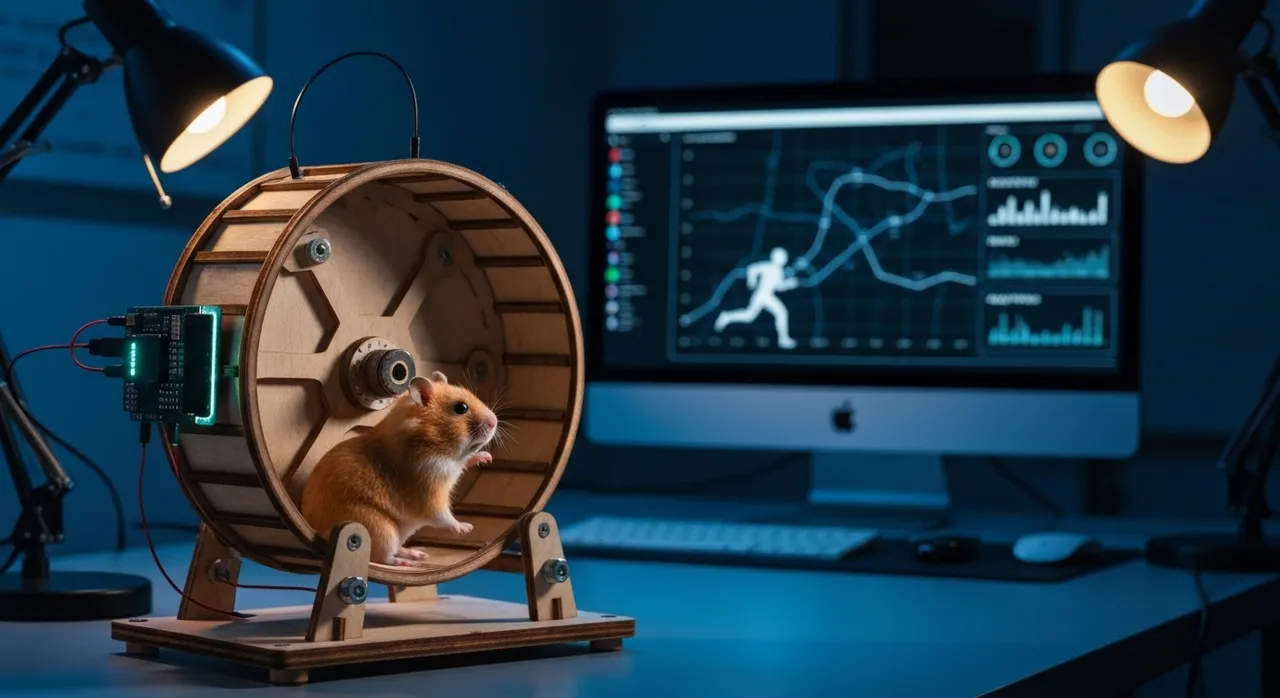
The foundation of the measurement setup is a standard hamster wheel with a known circumference of exactly 65 centimeters (0.65 meters). To detect complete rotations without introducing friction, de Buck mounted a tiny neodymium magnet to the outer rim of the wheel and placed a Hall effect sensor on the static mounting framework. A Hall effect sensor detects variations in magnetic field strength, closing a circuit every time the magnet passes.
The sensor is wired directly to an ESP32 microcontroller, a popular Wi-Fi and Bluetooth-enabled system-on-a-chip (SoC) favoured by hardware makers. The ESP32 runs lightweight firmware that listens for hardware interrupts triggered by the Hall sensor. Each time the magnet passes, the microcontroller logs a microsecond-accurate timestamp, calculates the instantaneous velocity based on the rotation period, and increments the cumulative distance.
To provide local, real-time feedback inside the room, de Buck integrated a small OLED display onto the enclosure. The display shows live metrics, including:
- Current Speed: Calculated dynamically from rotation intervals (often hitting 3 to 4 km/h in full sprint).
- Nightly Distance: Running total of distance accumulated since dusk.
- Automated Personal Bests: On-device memory tracking peak velocity and longest continuous run blocks.
The Software Pipeline: From Pulses to .FIT Telemetry
Capturing raw rotational pulses on a microchip is only half the battle; integrating those pulses into the modern fitness ecosystem required sophisticated telemetry processing. Most athletic platforms do not natively support fixed-location indoor rodent wheels, meaning the raw hardware logs needed to be transformed into standardized athletic file formats.
Every morning, as Mollie finishes his nightly running session and retreats to sleep, a custom Python script running on a local network node executes automatically. The script pulls the raw event logs and timestamps stored on the ESP32 and performs spatial-temporal processing to map the wheel revolutions into continuous movement data.
Generating Standardized .FIT Files
To make the data palatable to modern workout trackers, the script encodes the continuous timestamp and distance array into a binary Flexible and Interoperable Data Transfer (.FIT) file—the standard file specification developed by Garmin and utilized universally across digital sports technology. The script simulates a treadmill or indoor track workout, assigning realistic pacing and stride rates derived from the hamster’s wheel revolution frequencies.
API Automation and the Strava Premium Paywall
Once the .FIT file is compiled, the script invokes the Strava REST API to automatically authenticate and push the payload directly to Mollie’s dedicated account. However, de Buck hit an unexpected roadblock during implementation: Strava’s developer guidelines and automated third-party uploading features restricted full API access for basic tier profiles, requiring subscriber verification.
Faced with an engineering impasse, de Buck chose the only logical path forward. “There was really only one reasonable solution: my hamster now has Strava Premium,” de Buck noted. With a paid subscription active, Mollie’s daily workouts sync without friction every morning.
To add personality to the automated uploads, the Python pipeline includes an automated title generator. The script randomly pulls from a library of over 100 rodent- and running-themed puns. Some of Mollie’s recent activity titles include:
- “The Fast and the Furriest”
- “No Rest for the Whiskered”
- “Spinning into the Abyss”
- “Midnight Mileage Madness”
Quantifying an Elite Athlete: Mollie’s Athletic Metrics
When the initial telemetry began uploading to Strava, the sheer volume of Mollie’s workouts astounded both de Buck and the broader running community. Far from casual, sporadic movement, the data revealed that Mollie possesses the physiological habits of an elite ultra-marathoner.
Mollie’s athletic profile yields remarkable statistics:
- Nightly Average Distance: ~10 kilometers (~6.2 miles) per night.
- Weekly Total Volume: ~70 kilometers (~43.5 miles) per week.
- Single-Night Personal Record (PR): 11.15 kilometers (~6.9 miles) in a single uninterrupted nocturnal block.
- Strava Monthly Challenge Performance: Completed Strava’s official 400-minute August monthly running challenge on the second day of the month.
- Circadian Precision: Across a recorded seven-day window, Mollie initiated his primary evening run within the exact same 10-minute time frame on five separate nights.
In human terms, maintaining a consistent 70-kilometer weekly training load is typical of high-level marathoners preparing for competitive races. For a Syrian hamster weighing roughly 150 grams, logging 10 kilometers a night represents extraordinary endurance and mental focus.
Viral Phenomenon: Outperforming Human Marathoners
What started as an internal hobby project quickly exploded across digital subcultures after being highlighted by Runner’s World and subsequently surging to the top of Hacker News. Maker communities applauded the elegant hardware execution, while fitness enthusiasts were humbled by the rodent’s sheer volume.
Mollie’s Strava profile rapidly accumulated thousands of global followers, resulting in a humorous imbalance within the de Buck household. De Buck, who spent over six months rigorously training for a marathon, admitted that his own hard-won long runs typically yielded around 40 “kudos” (Strava’s equivalent of a like) from friends and training partners. Mollie, by contrast, routinely pulls in over 1,000 kudos per run.
“I trained for a marathon for like half a year and gave a good effort, I thought,” de Buck told CBC Radio’s As It Happens. “I got, like, maybe 40 ‘kudos’… But Mollie’s getting about a thousand for each run each night. It’s not fair. He’s beating me”.
Future Horizons: Race Predictions and Human Benchmarks
As Mollie approaches his twentieth logged activity on the platform, his account will trigger Strava’s internal machine-learning algorithms that generate estimated race finish times. “I can’t wait to see his estimated 5K and marathon times,” de Buck commented, “and whether he’ll manage to improve those predictions over time! Although I’m a bit worried he’ll have a better marathon time than me”.
For de Buck, as he completes his physical recovery, Mollie’s data offers a playful challenge. Matching his hamster’s weekly volume of 70 kilometers will require disciplined human effort. Ultimately, the project stands as a brilliant intersection of biomedical background, embedded engineering, and lighthearted internet culture—proving that with an ESP32, a Hall sensor, and a Strava Premium account, even the smallest household pets can leave a massive digital footprint.
Written by
TempMail Ninja
Digital privacy and online security expert. Passionate about creating tools that protect users' identity on the internet.