IBM 604 Vacuum Tube Flip-Flop Module Restored by Hardware Historian
Article Content
In the field of computer archaeology, few milestones capture the transition from electromechanical tabulators to high-speed electronic computing as vividly as the 1948 IBM 604 Electronic Calculating Punch. Prominent hardware historian and reverse-engineering expert Ken Shirriff recently achieved a remarkable technical feat: restoring and powering up an original, antique TR-3 “trigger” pluggable module salvaged from an IBM 604 system. Built during an era when the transistor had just been invented at Bell Labs but was still years away from commercial viability, the system relied on over 1,300 vacuum tubes arranged in modular, hot-swappable assemblies. Shirriff’s successful bench test of the TR-3 flip-flop module offers a rare, granular glimpse into the analog roots of digital state storage and highlights how mid-century engineers solved early reliability, maintenance, and thermal management challenges.
Inside the Modular Computing Breakthrough of the IBM 604
Introduced by International Business Machines in 1948, the IBM 604 was a watershed product for commercial data processing. Prior to its release, corporate accounting and scientific computation depended heavily on electromechanical tabulating equipment, relay-based adders, and mechanical gear wheels. While room-sized, first-generation custom electronic computers like the ENIAC (1946) demonstrated the raw speed of vacuum tubes, they were notoriously unsuited for everyday commercial deployment due to their massive physical footprint, exorbitant cost, and constant hardware failures that required dedicated teams of on-site technicians.
The IBM 604 bridged this operational gap by condensing electronic computing power into a unit roughly the size of a double refrigerator, renting for $550 per month. Operating alongside a Type 521 Card Reader/Punch, the machine could read 100 punch cards per minute, executing up to 60 programmed arithmetic operations—including addition, subtraction, multiplication, and division—on each card in under a second. IBM marketed the unit as the computational equivalent of 150 human engineers, selling and leasing over 5,600 units across its production lifespan.
To make a machine containing 1,300 fragile, heat-generating vacuum tubes commercially viable, IBM engineers introduced a fundamental architectural innovation: the pluggable tube module. Rather than soldering vacuum tube sockets, resistors, and capacitors directly onto a monolithic chassis, IBM grouped functionally discrete circuits into compact, standardized sub-assemblies. Each pluggable unit featured:
- Standardized 9-Pin Base: High-density connector pins that inserted into backplane sockets, enabling rapid field removal and replacement.
- Socketed Vacuum Tubes: Glass tubes mounted inside or alongside metal frames, allowing individually blown tubes to be swapped without replacing entire passive networks.
- Three-Dimensional Component Stacking: Carbon resistors and mica capacitors mounted vertically on insulated ceramic or bakelite wafers to maximize spatial packing density.
- Insulated Maintenance Handles: Ergonomic pull handles protruding from the frame, allowing Customer Engineers to hot-swap malfunctioning logic circuits in minutes.
This modular philosophy reduced system downtime dramatically and laid the structural foundation for card-based computer architectures that would dominate mainframe design for decades.
Technical Breakdown of the TR-3 Trigger Module
At the center of Shirriff’s investigation was the TR-3 “trigger” module, an essential logic block responsible for single-bit storage and clock pulse generation. In 1940s computer parlance, a “trigger” was the functional equivalent of what modern computer architects call a bistable multivibrator or flip-flop. These modules formed the core registers, program counters, and accumulator bits within the calculator.
The 2033 Dual-Triode Vacuum Tube
To maximize spatial density, the TR-3 module was built around a specialized 2033 dual-triode vacuum tube. Rather than using two separate single-triode envelopes, the 2033 housed two complete, independent triode amplifier structures inside a single miniature glass envelope. Each triode section contained:
- Heater Filament: An internal filament requiring low-voltage AC power to heat the cathode.
- Cathode: An electron-emitting element that releases thermionic electrons when heated.
- Control Grid: A fine wire mesh surrounding the cathode that modulates electron flow based on applied negative voltage bias.
- Plate (Anode): A high-voltage metallic collector plate that attracts electrons emitted by the cathode.
By housing two triodes within one 2033 envelope, IBM engineers effectively doubled the logical density of the module, creating a compact cross-coupled inverter pair.
Eccles-Jordan Flip-Flop Circuit Topology
The TR-3 module operates on the classical Eccles-Jordan trigger circuit concept, invented in 1918 by William Eccles and Frank Jordan. In this topology, the plate of the first triode section is cross-coupled via resistive and capacitive networks to the control grid of the second triode section, and vice versa.
When the first triode conducts heavily (state “1”), current flows through its plate resistor, dropping its plate voltage low. This low voltage is fed into the control grid of the second triode, pushing its bias far below cutoff. With no current flowing through the second triode, its plate voltage remains high. That high plate voltage is fed back to the control grid of the first triode, reinforcing its conduction state. The circuit remains locked in this stable state indefinitely until an external negative trigger pulse is applied to the conducting grid, forcing the circuit to rapidly flip into the opposite state.
Bench Restorations and Modern Power Experiments
Restoring a 78-year-old vacuum tube logic module presents significant electrical and safety challenges. Vacuum tube circuits operate at high DC voltages that can easily destroy delicate modern breadboard setups or present severe shock hazards if not strictly controlled. To safely power up the antique TR-3 module, Ken Shirriff constructed a custom bench setup designed to replicate the power distribution buses of the original 1948 IBM 604 rack frame.
The bench testing setup required multi-rail electrical provisioning:
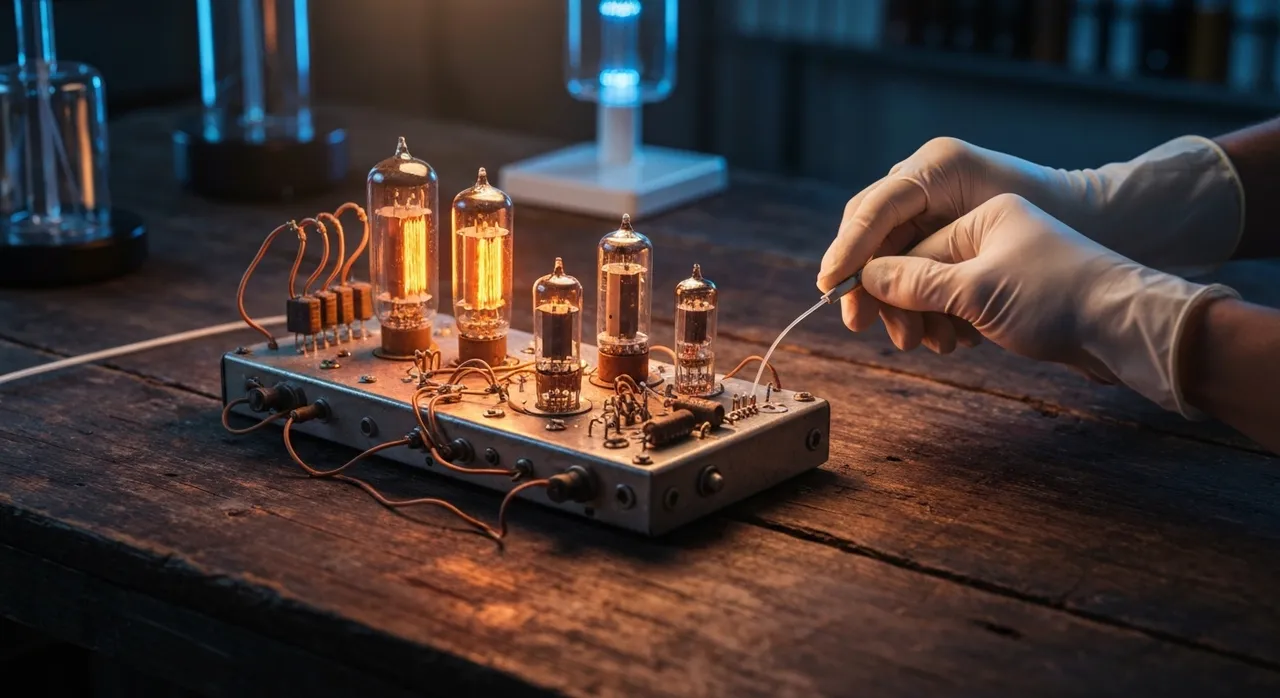
- Filament AC Supply: Low-voltage AC current delivered directly to the 2033 tube’s heater pins, bringing the cathode to thermal emission temperature (visually evident as a warm orange glow at the top and bottom of the tube envelope).
- Plate Voltage (B+ DC): High-voltage direct current supplied to the plate load resistors to establish the necessary anode potential for electron acceleration.
- Grid Bias Supplies: Negative DC bias lines used to keep non-conducting triode sections firmly below the cutoff threshold, preventing false triggering caused by noise.
- Input Pulse Conditioning: Push-button toggle switches routed through RC de-glitching networks to supply clean, well-defined input trigger pulses without mechanical switch contact bounce.
- Visual State Indication: Vintage neon indicator bulbs wired across the plate outputs. Neon bulbs illuminate when plate voltage rises high (triode cut off) and extinguish when plate voltage drops low (triode conducting), providing direct visual feedback of single-bit state storage.
During testing, Shirriff demonstrated that despite sitting idle for decades, the passive components and 2033 dual-triode tube inside the TR-3 module maintained sufficient electrical integrity to toggle between stable binary states on command. However, achieving reliable triggering required fine-tuning the input voltage levels, underscoring the analog sensitivity inherent in early digital computing hardware.
An Architectural Dead End: Vacuum Tube Logic vs. Diode Logic
While the TR-3 trigger module was a triumphant engineering solution in 1948, Shirriff’s analysis highlights how vacuum-tube flip-flops represented an architectural dead end in the evolution of computer logic.
In pure vacuum tube flip-flop architectures, every binary state change depends on complex, continuous analog interactions between electron streams, grid bias voltages, thermal filament emission, and passive component tolerances. As computers scaled from hundreds to thousands of logic gates, several critical
Written by
TempMail Ninja
Digital privacy and online security expert. Passionate about creating tools that protect users' identity on the internet.