Jamie Zawinski Restores San Francisco’s Legendary Eye of the Pizza
Article Content
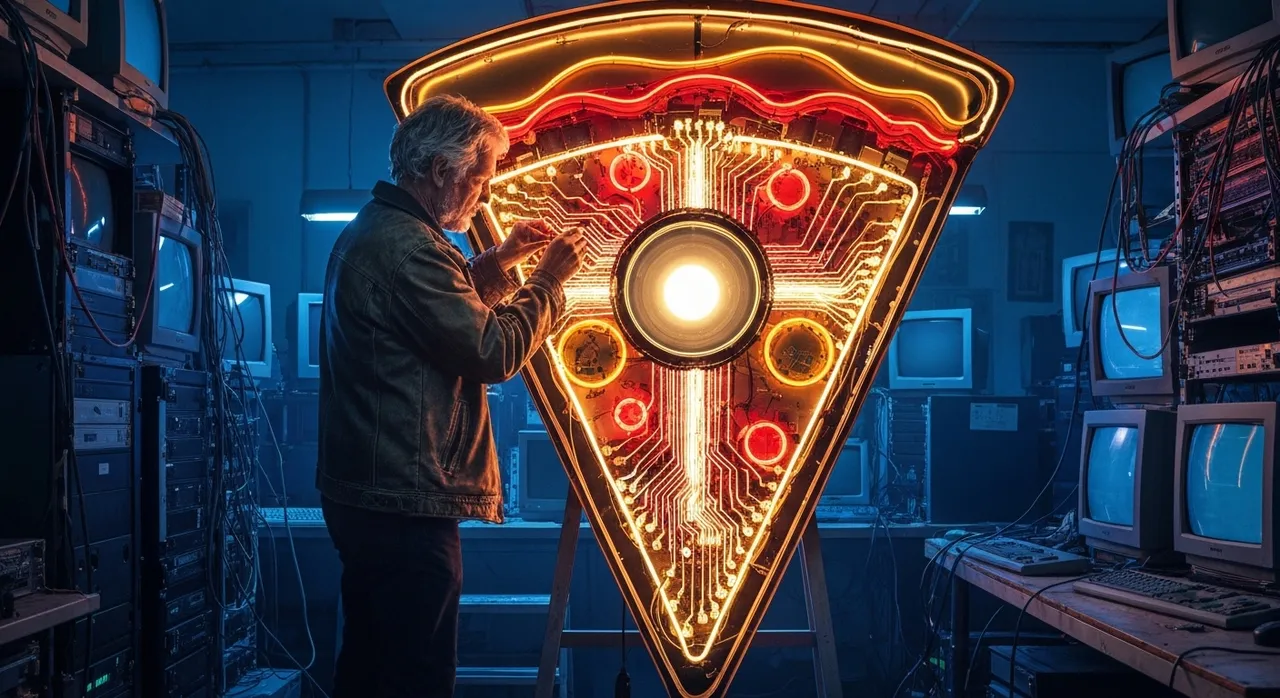
In the heart of San Francisco’s SoMa district, suspended high above the counter at DNA Pizza, a giant glowing eye has stared down at night owls, programmers, and music lovers for nearly a decade. Known colloquially as the “Eye of the Pizza,” this bizarre piece of ambient digital art is the brain child of early open-source icon and Netscape pioneer Jamie Zawinski. Owners of nightspots rarely troubleshoot complex optical hardware between dough tosses, but Zawinski—famously known across the tech ecosystem simply as “jwz”—has never been a conventional proprietor. When a recent utility power surge fried the irreplaceable hardware driving the installation, the survival of this beloved neighborhood artifact hung in the balance. Rather than letting the piece vanish into lost internet history, Zawinski staged a daring DIY hardware intervention that perfectly captures the enduring spirit of hacker culture.
The story of the Eye of the Pizza is a testament to how creative repurposing can breathe immortal life into obscure consumer electronics. First conceived and deployed in 2017, the fixture relied on hardware that was never intended for late-night pizza parlors or permanent ambient graphics installations. By taking an out-of-production Japanese educational device and hacking it into a living, blinking sculpture, Jamie Zawinski proved once again that code, optics, and unconventional hardware remain the ultimate playground for digital preservationists.
The Origins of a Cyberpunk Artifact: Jamie Zawinski and the Gekkin WorldEye
To understand the technical marvel of the resurrected Pizza Eye, one must go back to 2017, when Jamie Zawinski first acquired a Gekkin WorldEye. Originally manufactured by the Japanese educational hardware company Gakken, the WorldEye was designed for classroom environments to project animated globes, weather maps, and planetary surfaces onto a translucent hemispherical dome. Unlike flat-panel screens or standard video projectors, the Gekkin WorldEye used specialized internal mirrors and curved optics to cast an image cleanly across its curved 180-degree dome without severe edge distortion.
Recognizing the creative potential of a physical spherical display, Zawinski envisioned something far more surreal than a rotating Earth. He envisioned a giant, vigilant eye peering down at patrons waiting for a late-night slice. To translate this concept into reality, Zawinski collaborated with renowned hardware hacker Phillip Burgess (known online as PaintYourDragon from Adafruit). Burgess helped write and optimize custom graphics code to generate an animated, blinking, and tracking eye graphic formatted specifically for spherical projection.
For nearly nine years, the installation ran silently overhead at DNA Pizza—an eatery adjacent to Zawinski’s legendary music venue, DNA Lounge. It became a piece of living San Francisco lore: a glowing, biological-looking anomaly floating in a sea of neon light, cheese, and late-night revelry.
The Anomaly: How a Power Surge Struck Down the Pizza Eye
The uninterrupted nine-year watch of the Eye of the Pizza came to a sudden halt in mid-2026. A sudden grid-level power spike caused by the local utility company surged through the venue’s electrical system, catastrophic to sensitive legacy circuitry. The original Gekkin WorldEye projection board was fried instantly, turning the irreplaceable dome assembly into an expensive, dormant plastic paperweight.
The failure posed a daunting restoration challenge. The Gekkin WorldEye had long been discontinued by its Japanese manufacturer. On the secondary market, surviving units had transformed into high-priced collector’s items, frequently costing thousands of dollars—if one could even be located. Moreover, ordering another vintage unit carried no guarantee that its aged components would survive the grueling, 24/7 operational demands of a commercial pizzeria.
In modern corporate technology culture, such an obstacle typically marks the end of an asset’s lifecycle, resulting in disposal and replacement with a modern off-the-shelf flat display. However, the open-source philosophy embodied by Jamie Zawinski—who co-founded Mozilla, developed XScreenSaver, and helped build the foundation of the modern web—offered a different path forward: aggressive, practical hardware modification.
Sub-Surface Optics: Dissecting the DIY “Eye Surgery”
Faced with an astronomical replacement bill and a dead optical engine, Zawinski chose to perform radical “eye surgery” inside the existing WorldEye chassis. The goal was straightforward yet optically demanding: completely gut the proprietary internal projection machinery of the Gekkin housing while retaining the original external hemispherical dome, then retrofit modern, low-cost components into the tight enclosure to recreate the wide-angle beam required to illuminate the dome from within.
Zawinski acquired an extremely inexpensive, off-the-shelf mini projector—a standard budget LED model designed for casual home video streaming. However, standard mini projectors emit light in a narrow, rectangular 16:9 cone suited for flat walls, which cannot illuminate a short-throw hemispherical dome from a distance of mere inches inside its base. To solve this geometric incompatibility, Zawinski fitted a bargain-bin macro fisheye lens onto the mini projector’s primary lens assembly.
The surgical retrofit required gutting internal mounting brackets, hand-fitting the projector inside the housing, and aligning the optical axis with the center of the dome without relying on precise factory alignment jigs. Despite ignoring theoretical optical fripperies like exact focal length calculations or custom-molded spherical glass, the improvised lens stack successfully scattered the projected light across the interior surface of the translucent dome.
The resulting display is remarkably effective. Because the retrofitted projector natively outputs a 16:9 aspect ratio rather than a native circular or 1:1 image, the projection does not cover 100% of the hemispherical boundary, and the image exhibits slight focal softening near the outer perimeter. Nevertheless, the glaring iris and pupil remain strikingly vivid, rendering the installation fully functional once again as ambient venue decor.
Technical Breakdown: Original Architecture vs. The 2026 Hack
The technical evolution of the Eye of the Pizza highlights the sharp contrast between factory-engineered proprietary devices and scrappy, open-source hardware repair. Below is a structural comparison of the original 2017 setup versus the revived 2026 retrofit:
- Original 2017 Configuration:
- Hardware Core: Stock Gekkin WorldEye educational hemispherical projector.
- Projection Engine: Proprietary internal short-throw micro-projector with integrated convex mirror assembly.
- Aspect Ratio & Optics: Custom circular mapping designed for 180-degree hemispherical diffusion.
- Software & Code: Custom tracking eye rendering developed with Adafruit’s PaintYourDragon.
- Failure Point: Internal power regulation board destroyed by high-voltage grid spike in 2026.
- Retrofitted 2026 Hack:
- Hardware Core: Preserved original Gekkin dome and outer casing; fully gutted internal electronics.
- Projection Engine: Budget off-the-shelf mini LED projector (16:9 native aspect ratio).
- Optics Retrofit: Inexpensive macro fisheye lens adapted onto the mini projector output lens.
- Display Characteristics: Slight edge fuzzing and aspect ratio padding, mitigated by ambient lighting.
- Future Improvements: Planned software-side image pre-warping and keystone distortion correction to optimize dome edge coverage.
The Resilient Ethos of the Pioneer Hacker
The revival of the Eye of the Pizza is more than a quirky story about pizza parlor decor; it stands as a poignant symbol of the original hacker philosophy that built the personal computing movement. In an era dominated by locked-down hardware, glued shut cases, non-repairable assemblies, and cloud-dependent smart devices designed for planned obsolescence, Jamie Zawinski’s successful repair demonstrates the power of right-to-repair ingenuity.
Zawinski’s career has long been defined by defiance against artificial technical limits. From his foundational work on the Early Netscape Navigator browser and Lucid Emacs to his decades-long stewardship of XScreenSaver, jwz has championed software longevity, user autonomy, and hardware independence. His refusal to let a power surge kill an eccentric piece of digital art reflects that same lifelong ethos.
As San Francisco continues to navigate rapid transformations in tech culture, real-world monuments to the city’s quirky, creative hacker past are increasingly rare. The revived Eye of the Pizza hanging overhead at DNA Pizza serves as a glowing reminder that with a budget mini projector, a cheap fisheye lens, and a refusal to accept hardware death, old-school hacker magic is alive and well.
Written by
TempMail Ninja
Digital privacy and online security expert. Passionate about creating tools that protect users' identity on the internet.