Venice Flood Defense Breach: Cyber Attack Targets Critical Infrastructure
Article Content
On the morning of April 22, 2026, the city of Venice—already a masterpiece of human engineering and historical preservation—found itself at the center of a different kind of survival drama. While the world watched the rising tides of the Adriatic, a more insidious threat had already infiltrated the “Jewel of the Adriatic” from behind a keyboard. Security researchers confirmed that a Venice flood defense breach had occurred, targeting the sophisticated hydraulic pump systems that protect the lowest-lying areas of the city, specifically the iconic Piazza San Marco.
The breach, claimed by a threat group known as the “Infrastructure Destruction Squad” (or “Dark Engine”), represents a watershed moment in the history of cyber-physical attacks. By gaining administrative access to the city’s flood defense mechanisms, the attackers have effectively held the historical heart of Venice for a digital ransom. This incident is not merely a data leak; it is a direct assault on the Operational Technology (OT) that bridges the gap between digital instructions and physical movement.
The Mechanics of the Venice Flood Defense Breach
According to technical reports and screenshots circulated on underground forums, the attackers gained entry into the hydraulic control systems at Piazza San Marco by exploiting a vulnerability in the Human-Machine Interface (HMI). These HMIs are the graphical dashboards that allow city engineers to monitor water levels, activate pumps, and manage the pneumatic valves that keep the rising tides at bay. In the case of the Venice flood defense breach, the attackers didn’t need a multi-million-dollar zero-day exploit. Instead, they reportedly utilized “living off the land” techniques, exploiting internet-exposed management ports and administrative credentials that had likely been harvested through earlier phishing campaigns or simple credential stuffing.
The technical fallout is alarming. The “Dark Engine” group posted evidence including:
- System Layouts: Detailed schematic diagrams of the hydraulic network.
- Valve State Controls: The ability to manually override automatic sensor-driven triggers.
- HMI Web Server Access: Screenshots showing a persistent presence within the administrative dashboard.
- Root Access Offer: The group offered full control of the system to the highest bidder for a mere $600.
This low price tag for such critical infrastructure suggests that the group’s primary motive is symbolic disruption rather than pure financial gain. By selling access cheaply, they invite a “chaotic actors” scenario where any script kiddie or lower-level hacker could potentially trigger an environmental disaster.
Operational Technology: The Achilles’ Heel of the Smart City
The incident in Venice highlights a growing crisis in municipal “smart city” architecture. For decades, infrastructure like water pumps, power grids, and transit systems operated on isolated, “air-gapped” networks. However, the push for efficiency and remote monitoring has led to the convergence of IT (Information Technology) and OT (Operational Technology). When legacy hydraulic systems, some of which were designed in an era before pervasive cybersecurity, are connected to the public internet without sufficient segmentation, they become “low-hanging fruit” for sophisticated threat actors.
Cybersecurity experts have long warned about the lack of network segmentation in public works. In the Venice flood defense breach, it appears that the administrative network—used for daily office tasks—was not sufficiently separated from the industrial control layer. This allowed the attackers to pivot from an initial entry point into the core PLC (Programmable Logic Controller) environment. In OT security, this represents a failure of the “Purdue Model,” the industry standard for ICS (Industrial Control System) security architecture which requires strict boundaries between different levels of the network.
Piazza San Marco: The Zero-Point of Digital Vulnerability
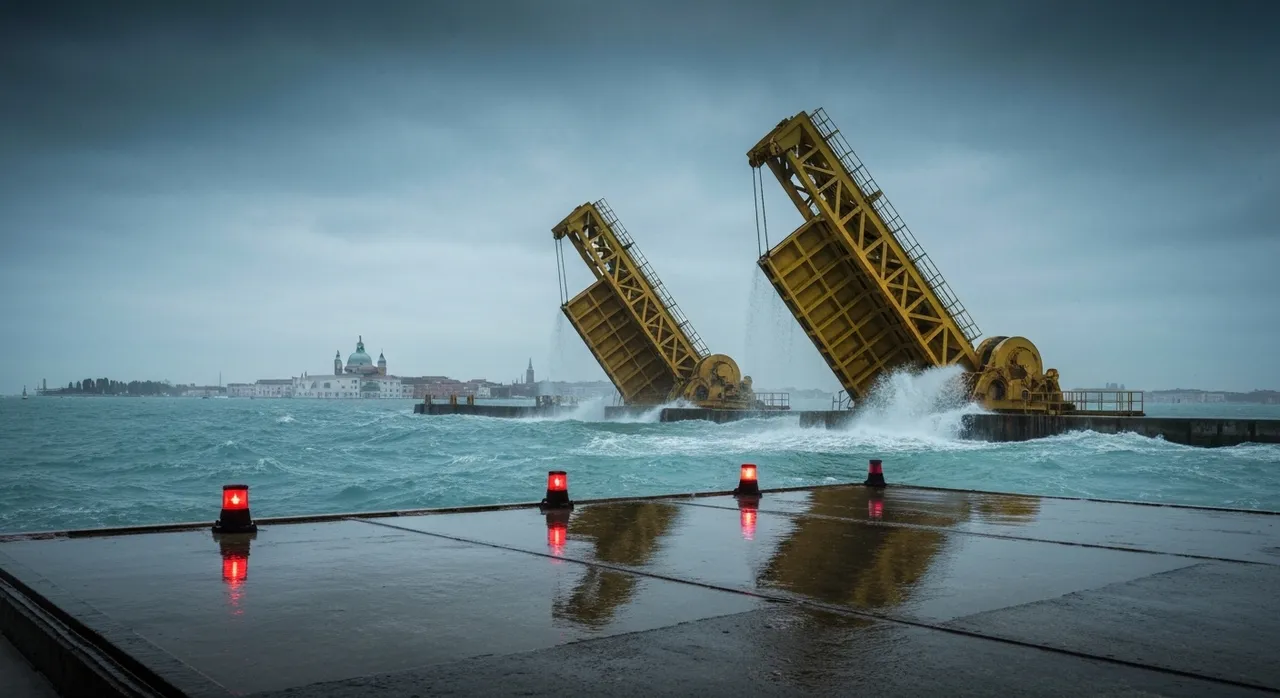
While the much larger MOSE (Modulo Sperimentale Elettromeccanico) system protects the Venetian Lagoon at its three inlets, the Piazza San Marco remains unique. As the lowest point in the city, the square begins to flood at just 80 centimeters of “Acqua Alta” (high tide). To counter this, a specialized Sistema di Riduzione Rischio Allagamento (Flood Risk Reduction System) was installed. This system consists of an intricate web of sensors, motorized sluice gates, and a massive hydraulic pumping station designed to purge water from the square’s drainage system back into the lagoon.
By breaching this specific system, the “Infrastructure Destruction Squad” targeted the city’s most immediate defense. If the pumps are disabled during a high tide, the Basilica di San Marco—containing centuries-old mosaics and priceless marble—could be inundated, even if the larger MOSE gates are functioning perfectly. The Venice flood defense breach demonstrates that an attacker does not need to destroy the main gate to drown the city; they only need to compromise the localized pumps that handle the “backflow” from the sewer and drainage networks.
A Profile of the Threat Actor: “Dark Engine”
The Infrastructure Destruction Squad, often synonymous with the moniker “Dark Engine,” has emerged in 2026 as a highly vocal hacktivist group with apparent ties to broader geopolitical tensions. Their communications, often delivered via Telegram in Mandarin and English, suggest a professional level of organization. While the use of Mandarin has led some analysts to point toward East Asian origins, forensic evidence in previous attacks against Baltic infrastructure suggests a more complex, multi-national “mercenary” structure.
In their manifesto regarding Venice, the group stated: “We are not here to destroy you. We are simply here to deliver a message: No tests conducted by your security teams can drive us away. We have been here for months and will remain here for months to come.” This claim of long-term persistence is particularly troubling for the Venice Water Authority. It suggests that even if the city resets its passwords, the attackers may have embedded “backdoor” accounts or malicious firmware into the control units themselves, requiring a total teardown and rebuild of the digital infrastructure.
The Global Implications of the Venice Breach
The Venice flood defense breach is a wake-up call for municipalities worldwide. From the storm surge barriers of London and Rotterdam to the drought-management reservoirs of the American Southwest, critical infrastructure is increasingly managed by automated systems that are vulnerable to the same exploits as a corporate email server. The incident serves as a blueprint for “Cyber-Physical Terrorism,” where the goal is not to steal credit card numbers, but to manipulate the physical environment to cause public panic and economic damage.
The risks identified by the Venice incident include:
- Vulnerability of Legacy Protocols: Industrial protocols like Modbus and DNP3, used in many flood systems, were designed without encryption or authentication.
- The “Access Brokering” Market: The sale of infrastructure access for small sums ($600) lowers the barrier to entry for terrorists and rogue states.
- Psychological Impact: The threat of a “flood on demand” creates a persistent state of anxiety among the citizenry, eroding trust in the government’s ability to protect basic services.
Emergency Protocols and the Path to Remediation
In response to the Venice flood defense breach, local authorities have activated “Plan B.” For the first time since the automation of the San Marco pumps, engineers have been stationed at the pump houses for 24/7 manual override duty. This low-tech solution bypasses the digital control loop entirely, ensuring that the physical switches can be flipped regardless of what the HMI screens show. However, manual operation is a stop-gap measure that cannot be sustained indefinitely, especially during periods of frequent high-tide cycles.
A full security audit is currently underway. This involves more than just scanning for malware; it requires a “Zero Trust” overhaul of the network. Venice must implement:
- Complete Network Segmentation: Physically or logically separating the hydraulic controls from any internet-facing administrative networks.
- Multi-Factor Authentication (MFA): Ensuring that no single set of credentials can authorize a pump shutdown or valve opening.
- Hardware-Based Security: Moving away from software-only controls to dedicated security appliances that can inspect industrial traffic for anomalous commands.
- Behavioral Monitoring: Implementing AI-driven tools that recognize when a “Close Valve” command is being sent at an illogical time or from an unrecognized source.
Conclusion: The Tides are Changing for Cyber-Physical Security
The Venice flood defense breach of April 22, 2026, will likely be remembered as the moment the “smart city” dream met the reality of the “persistent threat.” Venice, a city that has spent a millennium fighting the sea, must now learn to fight the signal. The battle to protect our history and our infrastructure is no longer just about stone, mortar, and steel; it is about the integrity of the code that moves those materials.
As the “Dark Engine” continues to flaunt its access on underground forums, the message for city planners from San Francisco to Singapore is clear: Connectivity without security is not progress; it is vulnerability at scale. The Venice flood defense breach is not just Italy’s problem—it is a herald of the new era of infrastructure warfare. Only by prioritizing OT-specific security and returning to the principles of air-gapping and rigorous access control can we ensure that the cities of the future don’t succumb to the digital tides of the present.
Written by
TempMail Ninja
Digital privacy and online security expert. Passionate about creating tools that protect users' identity on the internet.