Vintage Computing Revival Preserves Early Hacker History Amid AI Boom
Article Content
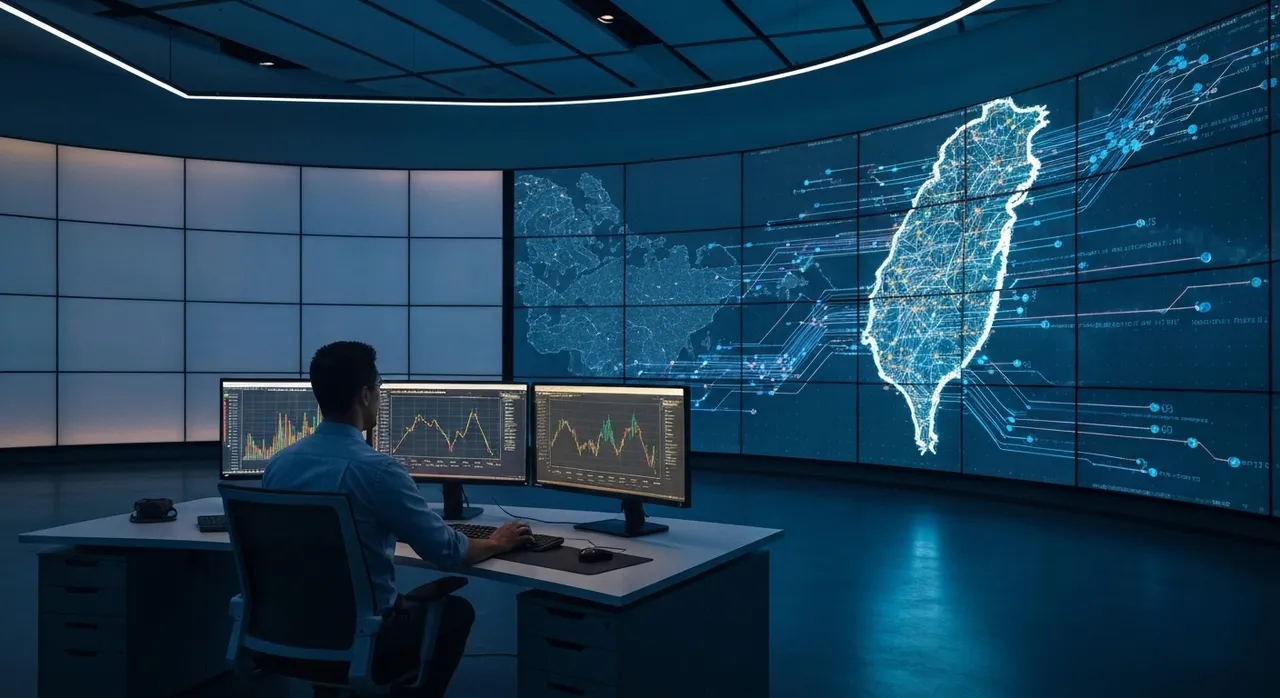
In an era where trillion-parameter neural networks and black-box artificial intelligence architectures increasingly mediate modern life, an impassioned counter-current is asserting itself across the digital landscape. Rather than chasing the next iteration of opaque cloud compute, a surging global community of digital archaeologists, hardware preservationists, and reverse-engineers is reclaiming the physical roots of the microcomputer revolution. This growing movement around vintage computing is not merely an exercise in nostalgic retro-gaming, but a vital preservation campaign dedicated to safeguarding human-comprehensible systems before their silicon, magnetic traces, and undocumented firmware decay into complete obsolescence.
The cultural and technical resonance of this movement was on full display in Mountain View, California, where more than 3,500 engineers, historians, and hobbyists convened at the Computer History Museum for the annual Vintage Computer Festival. Organized by the Vintage Computer Federation, this landmark gathering marked the 50th anniversary of Apple’s 1976 founding in nearby Cupertino. While current Silicon Valley focuses heavily on autonomous agents and generative models, the festival offered an evocative return to deterministic computing—a realm where every gate, trace, and opcode was open to inspection, understanding, and direct control.
The 50-Year Milestone: Apple, Homebrew, and the Hacker Ethic
The centerpiece of the festival was an extraordinary retrospective featuring Apple co-founders Steve Wozniak and Ronald Wayne, who took the stage to reflect on the garage-built beginnings of the personal computer industry. Fifty years after Wozniak hand-wired the prototype of the Apple I using the MOS Technology 6502 microprocessor, the co-founders revisited the fertile culture of the Homebrew Computer Club—the legendary meeting ground where engineers freely swapped schematics, typed paper-tape hex dumps, and championed open hardware exploration.
Wozniak’s early designs epitomized a philosophy of radical elegance and resource efficiency: squeezing maximum utility out of minimal dynamic RAM, timing color-burst subcarriers directly from system clocks, and writing handcrafted assembly routines stored in tiny PROM chips. At the panel, the discussions highlighted how personal computing was originally built on radical transparency. Unlike contemporary consumer devices encased in tamper-resistant resin and locked behind cryptographic bootloaders, early microcomputers were shipped with comprehensive circuit schematics, memory maps, and source-code listings right in the manual.
Digital Archaeology in Practice: Restoring Living Silicon
Behind the public celebrations lies an intricate, demanding discipline: the restoration of decaying digital hardware. A prominent example is Seattle-based software engineer Josh Dersch, who curates a living historical archive of more than 200 operational vintage computer systems and historical workstations. At the festival, Dersch showcased the legendary Xerox Alto, the pioneering 1973 graphical workstation developed at Xerox PARC that laid the architectural blueprint for the graphical user interface (GUI), bitmapped displays, Ethernet networking, and mouse-driven computing.
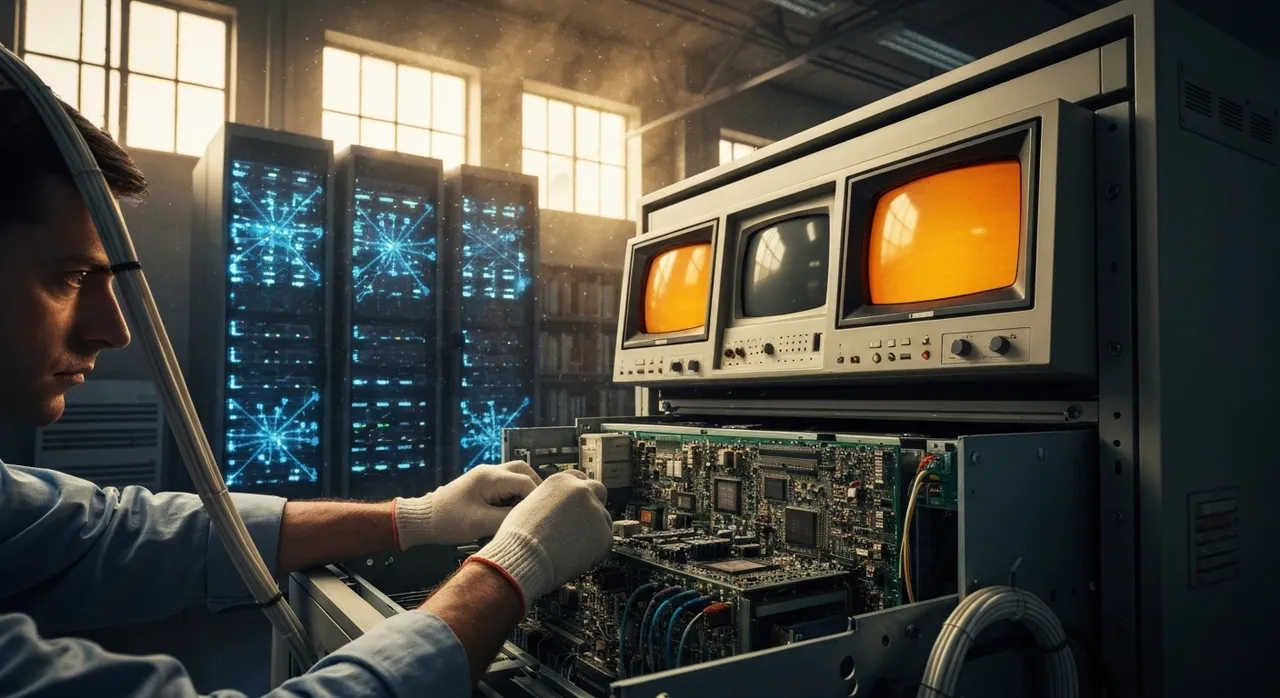
Restoring a machine of the Alto’s complexity requires deep technical mastery spanning obsolete electronics, microcode reverse engineering, and custom FPGA synthesis. Hardware conservators like Dersch do not treat these machines as static museum sculptures behind glass; they believe computers can only be truly preserved when maintained in full working order.
The restoration cycle often requires tackling a rigorous set of technical challenges:
- Capacitor Remediation and Power Rail Stabilization: Decades-old electrolytic and tantalum capacitors are notorious for drying out, shorting, or violently bursting, risking catastrophic overvoltage to rare custom ICs. Technicians systematically desolder and “re-cap” vintage switch-mode power supplies and motherboards before initial power-up.
- Custom Silicon and Microcode Emulation: Proprietary ASICs, PLA chips, and fusible-link ROMs frequently suffer internal silicon degradation. Restorers dump raw bitstreams with specialized programmers or construct daughterboards containing modern microcontrollers and FPGAs to replicate undocumented logic.
- Magnetic and Optical Media Recovery: 8-inch floppies, Shugart-interface drives, and vintage magnetic platters suffer from binder hydrolysis (“sticky-shed syndrome”). Preservationists utilize specialized flux-level disk transition samplers (such as Greaseweazle and KryoFlux boards) to extract bit-perfect images from degrading magnetic substrates before physical decay destroys the sectors.
- CRT Monitor and Deflection Chassis Calibration: Restoring original raster and vector displays requires handling high-voltage flyback transformers, adjusting yoke geometry, and sourcing cathode-ray tubes that have been out of commercial production for decades.
Why Vintage Computing Is Vital in the Age of Opaque AI
The revival of vintage computing provides an essential counterweight to modern engineering paradigms. As artificial intelligence platforms transition computation toward non-deterministic matrix multiplications and massive distributed server farms, foundational systems understanding is increasingly abstracted away. Modern programmers often interact with systems through deep layers of virtualization, container runtimes, high-level frameworks, and proprietary cloud APIs.
By contrast, vintage systems demand that the engineer grapple directly with the bare metal. On a Commodore 64, an Apple II, an IBM 5150, or an Atari 800, there are no background operating system services intercepting interrupts or preempting CPU cycles. The programmer writes instructions that directly address registers, strobe control lines, and synchronize execution with the precise electron-beam raster beam of the monitor.
This deterministic clarity offers profound pedagogical and historical value:
- Complete Architectural Comprehension: A single person can completely understand every register, logic gate, bus protocol, and instruction timing of an 8-bit or 16-bit computer—a feat rendered structurally impossible by multi-billion-transistor modern microprocessors.
- Preservation of Early Software Ergonomics: Emulation alone fails to capture the true tactile cadence, audio frequency characteristics, keyboard travel, and phosphor latency that dictated human-computer interaction in the foundational years of personal technology.
- Resilience Against the Ephemeral Web: Cloud services, DRM authentication servers, and software-as-a-service (SaaS) ecosystems can vanish overnight when hosting companies shut down. Self-contained vintage machines operate independently of remote server infrastructure, serving as permanent monuments to standalone computation.
The Technical Architecture of Early Computing Icons
The diversity of early computing architectures is one of the most compelling aspects driving the historical revival. Between 1975 and 1985, hardware designers had not yet converged on standard x86 or ARM architectures, sparking intense creativity across system designs:
1. The MOS 6502 Ecosystem (Apple I/II, Commodore PET, Atari 8-bit): Designed by Chuck Peddle and his team, the 6502 made computing economically feasible with its aggressive price reduction. Its short pipeline, minimal register set (Accumulator, X, Y), zero-page addressing modes, and tightly coupled memory cycles forced programmers to write tight, efficient assembly algorithms.
2. The Zilog Z80 Bastion (CP/M Systems, Sinclair ZX Spectrum, MSX): Extending the Intel 8080 instruction set, the Z80 introduced dual register banks, built-in DRAM refresh logic, and sophisticated indexed addressing, quickly establishing itself as the operational backbone for early business computing under the CP/M operating system.
3. The Xerox Alto and Motorola 68000 Workstations: Before the IBM PC solidified standardized corporate architectures, systems like the Xerox Alto utilized bit-sliced ALUs (such as the 74181) running specialized microcode tasks for disk formatting, Ethernet transmission, and display scanning, setting the conceptual foundation for the 16/32-bit graphical systems of the mid-1980s.
Conclusion: Safeguarding the Foundations of the Digital Age
The growing interest in vintage computing demonstrates that computing history cannot be relegated solely to software emulators or archived Wikipedia articles. Hardware is the tangible bedrock upon which modern information society was constructed. Without working physical hardware, the craftsmanship, economic realities, and design choices of the engineers who pioneered personal computing remain theoretical abstractions.
As Erik Klein and the Vintage Computer Federation expand their events across North America, Europe, and South America, the movement stands as a testament to the enduring human desire to understand the tools we create. In a technological era characterized by rapid AI deployment and sealed black boxes, the hum of an 8-inch disk drive, the green glow of a P1 phosphor screen, and the unmistakable click of a mechanical reed-switch keyboard remind us of a foundational truth: computing was once fully transparent, humanly graspable, and entirely open to anyone with a soldering iron, an assembly manual, and the curiosity to explore.
Written by
TempMail Ninja
Digital privacy and online security expert. Passionate about creating tools that protect users' identity on the internet.